Amazon Cargo Jet Crash Kills Five at Miami Airport
By SyndicatedNews | SNN.BZ
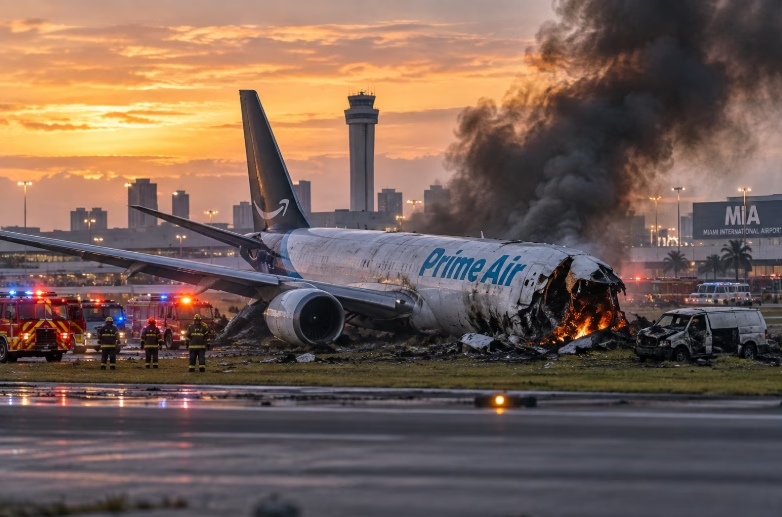
MIAMI — Federal investigators are examining a catastrophic runway overrun at Miami International Airport that killed five people and injured five others Sunday, September 6. The aircraft was Amazon Prime Air Flight 7598, operated for Amazon by cargo carrier 21 Air. The FAA identifies the aircraft as a Boeing 767-300 cargo jet arriving from Luis Muñoz Marín International Airport in San Juan, Puerto Rico. The jet overran Runway 30 at about 2 p.m. and continued far beyond the paved surface.
The aircraft had two crew members aboard and was completing its third flight of the day, having flown Cincinnati-to-Miami, Miami-to-San Juan and then San Juan-to-Miami. NTSB Chair Jennifer Homendy said investigators traced a debris path extending approximately 1,300 feet beyond the paved runway. The Boeing first struck airport navigational equipment and then slammed into a white 2012 Ford E-150 Econoline van carrying seven employees of Professional Ocean Service Corp., an airline-cleaning contractor.
The aircraft continued through the airport perimeter fence and struck a Toyota Corolla Cross LE traveling on Northwest 67th Avenue outside airport property before finally coming to rest. Homendy described the destruction as “utter devastation,” saying the Econoline van had essentially been torn apart and that wreckage from vehicles, the aircraft, airport equipment and fencing was scattered across the scene. Five people were killed and five others were hospitalized; three of the injured remained in critical condition Monday.
Authorities have not yet publicly identified the five people killed, the injured survivors, or the two pilots by name, according to the latest reporting available Monday evening. I am therefore not going to attach names to victims until authorities officially release them. Officials who can be identified include Jennifer Homendy, chair of the National Transportation Safety Board; Rosie Cordero-Stutz, Miami-Dade County sheriff; Ray Jadallah, chief of Miami-Dade Fire Rescue; and Greg Chin, spokesman for the Miami-Dade Aviation Department. More than 60 Miami-Dade Fire Rescue units reportedly responded as rescuers worked to reach people trapped in the aircraft and vehicles.
Investigators recovered both crucial “black boxes” Monday: the flight data recorder and cockpit voice recorder. They are being sent to NTSB headquarters for analysis. Homendy said the agency already possesses some information concerning the aircraft’s speed but wants to verify those figures against the flight recorder before releasing them. Investigators will examine the touchdown point, speed, braking performance, wind and weather, mechanical condition of the aircraft, crew actions, company procedures and airport infrastructure before reaching conclusions about why the aircraft could not be stopped.
One important question is where Flight 7598 actually touched down. Video examined by aviation experts appears to show the 767 remaining airborne unusually far down the runway. Investigators will determine whether it landed beyond the normal touchdown zone and, if so, why the crew continued the landing rather than executing a go-around. Those questions should not yet be interpreted as proof of pilot error; the NTSB has specifically cautioned that it is gathering evidence and is not determining probable cause while investigators are still documenting the scene.
The aircraft itself was manufactured in 1994, making it approximately 32 years old, and had previously served as a passenger aircraft before conversion to cargo service. Published aviation reporting identifies the aircraft as N1997A. Its age alone does not establish anything about the cause of the accident, but Homendy said investigators will examine its maintenance and ownership history. The crash also raises questions about runway-overrun protection: Miami International does not have an Engineered Materials Arresting System at this runway, although former FAA airport-safety official Mike O’Donnell told the Associated Press that MIA appears to comply with federal requirements because it has the required 1,000-foot runway safety area.
The investigation is only beginning. The NTSB has 32 personnel at the scene and expects investigators to remain there for at least a week. Amazon said it was heartbroken by the deaths and pledged cooperation with investigators. Meanwhile, the accident produced widespread disruption at one of America’s busiest international airports, with two of MIA’s four runways still closed Monday and scores of additional cancellations following Sunday’s shutdown. The most important unanswered questions — exact touchdown point, speed, braking, weather, aircraft condition, cockpit decisions and the identities of the victims — should become clearer as recorder data, interviews, surveillance video and physical evidence are analyzed.
Photographs
I searched specifically for photographs that could safely be treated as free for SNN.BZ to republish without paying a licensing fee. The strongest photographs currently circulating are credited to AFP/Getty Images, Getty Images, Miami Herald/Tribune News Service, or individual photographers such as Milton Delgado. Those should not be assumed to be free merely because they appear online.
Because I did not find a set of actual crash photographs with sufficiently clear public-domain/free-commercial-reuse rights that I would be comfortable telling you to publish without permission, I generated the reconstruction above instead. For publication, label it “AI-generated illustration of the Miami International Airport crash scene” rather than presenting it as an actual photograph. Also, despite your reference to “planes,” this accident involved one cargo aircraft, not a collision between two airplanes.