WINTER PEACE TEST
By SyndicatedNews | SNN.BZ
For the first time in months, diplomacy rather than another battlefield offensive is producing some cautious movement in the Russia-Ukraine war. U.S. presidential envoys Steve Witkoff and Jared Kushner met Ukrainian President Volodymyr Zelenskyy in Kyiv after meeting Russian President Vladimir Putin in Moscow, carrying what Zelenskyy says was an important message: the Russian side is prepared to negotiate. Zelenskyy remains skeptical that Moscow’s actions match that message. https://www.axios.com/2026/09/07/zelensky-ukraine-russia-war-witkoff-kushner-putin-trump?utm_source=chatgpt.com
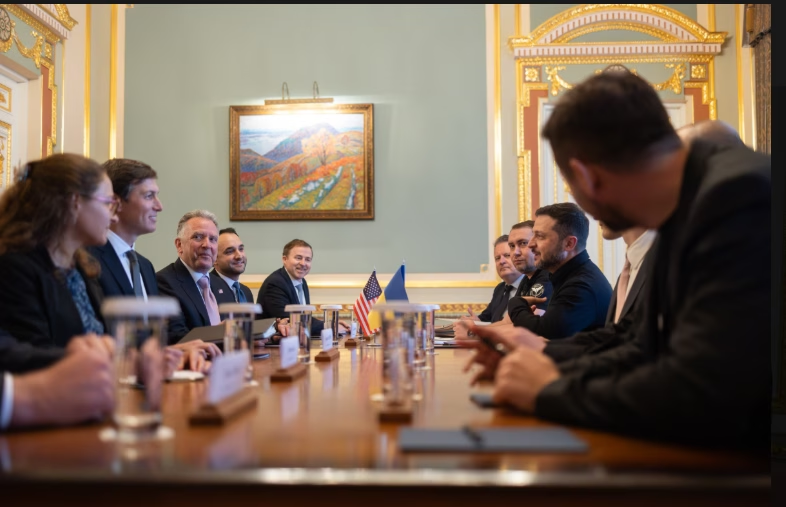
The September 6 Kyiv meetings were extensive. Zelenskyy said Ukraine discussed the possibilities for restarting negotiations after the American delegation’s talks with Putin. The Ukrainian president publicly thanked Witkoff, Kushner and the U.S. president for helping revive a negotiating process that had largely stalled.
Winter has become an immediate focus. Ukraine says it is willing to consider arrangements intended to reduce attacks against cities involved in the negotiating process, while Zelenskyy has emphasized the enormous humanitarian and infrastructure challenges Ukraine will face if the fighting continues through another winter.
But negotiations do not mean that the fundamental disagreements have disappeared. Territory remains one of the most difficult issues. Zelenskyy said questions of that magnitude ultimately require decisions at the leadership level, making direct high-level negotiations potentially unavoidable if diplomacy progresses.
Security guarantees are another central issue. Kyiv wants more than a temporary cessation of hostilities; it wants arrangements capable of deterring another Russian attack. Zelenskyy has repeatedly emphasized that maintaining a strong Ukrainian military must form part of any credible postwar security structure.
Economic reconstruction is being discussed alongside military security. The Kyiv talks included what Zelenskyy described as a prosperity plan and economic guarantees intended to help Ukraine rebuild after years of destruction. That makes the negotiations potentially much larger than a ceasefire discussion: they could eventually determine the framework for Ukraine’s reconstruction.
European governments are also part of the equation. The Kyiv discussions expanded beyond the Ukrainian and American delegations to include national-security representatives connected with France, Britain and Germany, reflecting Europe’s obvious interest in whatever security architecture emerges from a settlement.
Nothing yet constitutes a peace agreement, and Zelenskyy himself is warning against assuming that Russian willingness to talk means Russian willingness to compromise. Nevertheless, after years in which battlefield developments routinely overshadowed diplomacy, Washington has succeeded in getting senior American envoys into both Moscow and Kyiv within the same diplomatic mission. Whether that produces peace—or merely another unsuccessful round of negotiations—may become one of the defining questions of the coming winter.