Sheinbaum’s Quiet Diplomacy vs. Meloni’s High-Profile Politics
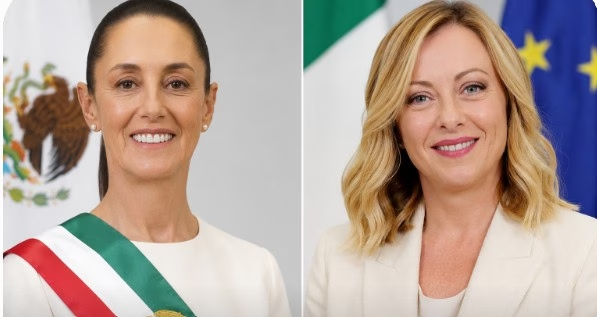
In international diplomacy, leadership is often judged less by public rhetoric than by the relationships a head of government is able to preserve during periods of geopolitical tension. Two of the world’s most prominent female leaders—Claudia Sheinbaum and Giorgia Meloni—have adopted notably different approaches to working alongside U.S. President Donald Trump. Those contrasting styles have become a subject of discussion among political observers on both sides of the Atlantic.
By SyndicatedNews | SNN.BZ
Since assuming office, President Sheinbaum has generally approached the U.S.-Mexico relationship with restraint. Although Mexico and the United States have continued to face difficult issues involving trade, border security, migration, and economic policy, the Mexican president has largely avoided turning those disagreements into public confrontations. Instead, her administration has emphasized direct dialogue and institutional cooperation, allowing negotiations to proceed with relatively little public commentary which is a measure of her political maturity.
Political analysts have noted that this measured style has helped preserve one of the world’s most important economic partnerships. As manufacturing investment continues to shift toward North America through nearshoring, Mexico has strengthened its position as a key economic partner of the United States while expanding its diplomatic influence throughout Latin America. Rather than seeking attention through public disputes, Sheinbaum’s government has generally projected an image of stability and predictability.
Prime Minister Giorgia Meloni, on the other hand has taken a more visible approach to international leadership. As one of Europe’s leading conservative voices, she has often addressed major geopolitical issues publicly while seeking to define Italy’s role within the European political landscape. Her supporters argue that this approach demonstrates decisive leadership and gives Italy a stronger voice in international affairs.
Critics, however, contend that a more confrontational public posture can make coalition-building within Europe more difficult. Italy remains a central member of both the European Union and NATO, yet political differences over migration, fiscal policy, and other issues have periodically created tensions between Rome and some of its European partners. Those disagreements reflect broader debates within Europe and are not attributable to a single policy or administration, but they have shaped perceptions of Italy’s diplomatic style.
The contrast between the two leaders is therefore less about ideology than about diplomatic method. Sheinbaum has generally favored quiet negotiations, carefully managed public messaging, and maintaining productive working relationships even when disagreements exist. Meloni has chosen a more outspoken and highly visible style that places political positions in the public arena more frequently.
Observers who compare the two leaders often point to Mexico’s growing regional influence. Through its close economic integration with the United States and its active role in regional diplomacy, Mexico has become an increasingly important voice in discussions affecting North America and, on many issues, Latin America as well. Sheinbaum’s willingness to work with Washington while minimizing public friction has contributed to perceptions of Mexico as a reliable regional partner.
Italy faces a different geopolitical environment. Its government must balance domestic political priorities with the collective decision-making processes of the European Union and NATO. That environment presents different diplomatic constraints and opportunities than those confronting Mexico. Supporters of Meloni view her willingness to stake out clear public positions as a strength, while critics argue that quieter diplomacy can sometimes yield broader consensus.
Ultimately, the comparison between President Claudia Sheinbaum and Prime Minister Giorgia Meloni illustrates two distinct philosophies of leadership.
One, President Sheinbaum’s is “old school.” Her style emphasizes discretion, institutional relationships, and negotiations conducted largely outside the public spotlight.
The other, Prime Minister Meloni’s, is “new school,” it relies more heavily on public engagement and visible political drama.
As global alliances continue to evolve, historians will likely evaluate both approaches by examining their long-term effects on national prosperity, diplomatic influence, and international standing rather than by the volume of public statements each leader made along the way.