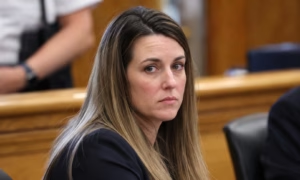
Dr. Sharon K. Breit, MD Busted Stealing Jewelry

Patients leaving messages on Facebook for this doctor not realizing the mess she's in.
She robbed a jewelry store at the DFW Airport – The Professional Fallout Could Reach Millions. Consider: What Insurance Company Would Be Willing To Offer Insurance To a Facility Where She Practiced?
By SyndicatedNews Legal Eagle | SNN.BZ
Public records confirm Dr. Sharon K. Breit, MD, is an OB/GYN who has practiced in New Mexico (including Las Cruces and Roswell affiliations with hospitals such as Memorial Medical Center) and previously in Wichita, Kansas.
Dr. Sharon K. Breit, who told officers she had been working long hours in underserved areas of New Mexico, was confronted at a cell phone charging station, initially denied taking anything, then claimed exhaustion after 36 straight hours awake. The items, complete with store tags and matching SKU numbers, were recovered from her bag. She was charged with theft of property and the jewelry was returned.
What began as a retail theft case quickly escalated beyond a simple misdemeanor because the suspect is not an ordinary traveler. When a licensed medical professional is caught committing a crime on camera, every aspect of that person’s professional history becomes fair game for examination. Patients who once felt dismissed, rushed, or poorly treated during exams now have a public record of judgment failure to point to. Hospitals and clinics that granted her privileges face fresh questions about their credentialing and oversight processes.
The bodycam footage leaves little room for ambiguity. Store employees reported missing merchandise, surveillance showed the act, and the recovery of the exact items inside the doctor’s bag closed the loop. Her explanation—extreme fatigue from extended shifts—may humanize the moment, yet it does not erase the decision to walk out of a high-end airport shop with unpaid merchandise. For any physician, the bar for integrity is set higher than for the average citizen precisely because the public trusts them with life-and-death authority.
Once a professional crosses into criminal territory, the consequences multiply far beyond a single arrest record. Trial lawyers know that a documented act of dishonesty can be introduced to challenge credibility in future medical malpractice or negligence cases. A patient who previously walked away dissatisfied now has a concrete example of impaired judgment to present. Defense counsel for hospitals and practice groups must suddenly explain why privileges remained intact for a physician later caught on video committing theft. Hospitals and medical facilities carry negligence insurance and will not want to cover any professional whose theft episode is already on YouTube.
The financial exposure can climb into the millions. A single successful lawsuit alleging that a facility failed to properly monitor or remove a physician with known integrity issues can trigger large jury awards, settlement demands, and insurance premium spikes. Credentialing committees, medical staff leadership, and hospital risk managers all become potential defendants when a doctor’s off-duty crime collides with patient care claims. What starts as a $200 pair of earrings can snowball into six- and seven-figure legal exposure.
Dr. Breit’s stated work in underserved New Mexico communities only sharpens the contrast. Communities that rely on limited numbers of specialists place heightened trust in those who serve them. Any erosion of that trust—whether through criminal charges or the perception of impaired decision-making—can discourage patients from seeking care and invite closer regulatory scrutiny of the facilities that employed her.
Professionals in medicine, law, and finance operate under an unwritten contract with the public: elevated authority brings elevated accountability. A momentary lapse that an ordinary shopper might resolve with a citation becomes a career-defining event for a physician. Boards of medicine, hospital privilege committees, and civil plaintiffs all gain new leverage when bodycam evidence of theft enters the public domain.
The case stands as a blunt reminder. When a doctor is arrested for stealing, the examination does not stop at the airport terminal. It extends backward through every exam room, every hospital privilege file, and every past patient interaction that left someone feeling wronged. In the high-stakes world of medical practice, the true cost of a single dishonest act is rarely measured in the price of the merchandise. It is measured in the lawsuits, the privilege reviews, and the damaged trust that can follow for years.