Jimmy Savile and Jeffrey Epstein Both Sexual Predators
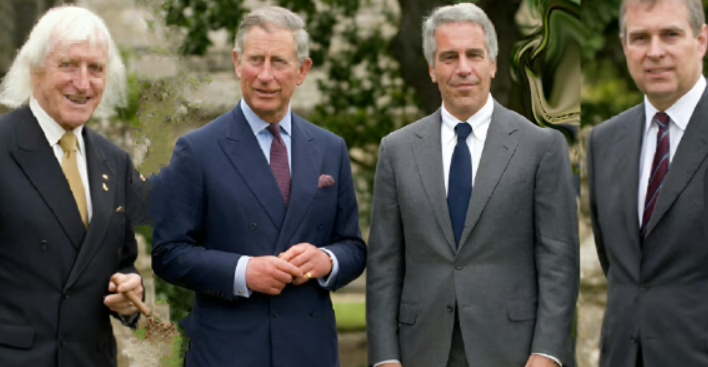
JIMMY SAVIILE, KING CHARLES, JEFFREY EPSTEIN, ANDREW MOUNTBATTEN
But Both Men Were Best Friends to Charles and Andrew, Two Prince Brothers of the UK Royal Family
By SyndicatedNews UK Barrister | SNN.BZ
Decades ago in England, Jimmy Savile emerged as one of the country’s most notorious sexual predators. He was later revealed to have committed widespread abuse, including against vulnerable and immobilized minors—often disabled patients—in hospitals across the nation.
Despite this hidden reality, Savile cultivated a longstanding and well-documented friendship with the then-Prince Charles (now King Charles III). The two corresponded over many years, and Savile was regarded by some in royal circles as a source of straightforward advice.
Queen Elizabeth II herself is said to have valued his counsel on occasion, viewing him as a man of common sense and practical insight. Their relationship, evidenced by preserved letters spanning decades, reflected a level of familiarity and trust that only became deeply troubling in hindsight once the full extent of Savile’s crimes came to light after his death.
Here is a clear, balanced comparison. The chart highlights the striking similarities in how Jimmy Savile and Jeffrey Epstein leveraged power, status, and institutional access to enable and conceal their abuse of vulnerable women and children over decades by forming strong friendships with both King Charles and his brother Andrew.
| Aspect | Jimmy Savile | Jeffrey Epstein |
|---|---|---|
| Public Persona & Power Base | Beloved BBC celebrity, entertainer, and major charity fundraiser who raised millions for hospitals and good causes. Knighted and showered with honors. | Wealthy financier and socialite who cultivated an image as an elite investor and philanthropist with vast properties and a private jet. |
| Method of Access to Victims | Exploited unrestricted, unsupervised access to hospitals (e.g., own bedroom and flat at Stoke Mandeville and Broadmoor), BBC premises, and children’s institutions. Targeted vulnerable, often disabled or immobilized patients. | Used luxurious private homes, a Caribbean island (Little St. James), private jet (“Lolita Express”), and a network of recruiters to lure and traffic underage girls, many from disadvantaged backgrounds. |
| Scale & Nature of Abuse | Hundreds of victims (estimates over 500 reports), mainly girls and young women aged 13–15 but ranging from 5 to 75. Included assault of patients in beds, sometimes while immobilized or recovering from surgery. Allegations of abuse on corpses. | Dozens of confirmed victims, primarily underage girls trafficked for sex. Operated a systematic “pyramid” recruitment scheme involving massages that escalated to sexual acts, often with powerful associates. |
| Exploitation of Vulnerability | Preyed on sick, disabled, and immobilized minors in medical settings where victims felt powerless and complaints were dismissed or ignored. | Targeted financially vulnerable or aspiring young girls with promises of modeling opportunities, education, or career help. |
| Protection Through Elite Networks | Longstanding friendship with royalty (decades of correspondence and advice-seeking from Prince Charles; valued by Queen Elizabeth II for “common sense”); close ties to BBC, NHS, government ministers, and Margaret Thatcher. | Deep connections to presidents (Clinton, Trump mentions), royalty (Prince Andrew), billionaires, academics, and celebrities. Many flew on his jet or visited his island. |
| Institutional Cover & Impunity | Institutions (BBC, NHS hospitals) granted him extraordinary access and turned a blind eye for decades despite rumors; complaints were ignored due to his fame and influence. | Received lenient 2008 plea deal despite evidence; continued associating with elites post-conviction. Powerful friends and legal maneuvering shielded him until later investigations. |
| Use of Charity/Image Laundering | Charitable work provided a “halo effect” and access to vulnerable populations while enhancing his untouchable status. | Philanthropic donations and funding to universities and scientists helped maintain a respectable facade among the global elite. |
| Duration of Impunity | Abused over six decades (1950s–2011), only fully exposed after death. | Operated trafficking network for years (at least 1990s–2000s), with significant protection until 2019 arrest. |
Both men thrived by embedding themselves within powerful institutions and elite social circles, using their status to gain unparalleled access to vulnerable victims while rendering complaints ineffective. Their cases illustrate how fame, wealth, royal or political proximity, and institutional deference can create near-impenetrable shields—until public exposure after the fact forces reckoning.
This comparison is drawn from official inquiries, court documents, and investigative reports.
It is therefore striking, in retrospect, that King Charles should now be expected to take the harshest possible stance against his own brother, Prince Andrew, for his association with Jeffrey Epstein when he had a parallel relatoinship with Jimmy Savile.
Having maintained a warm and enduring friendship with Savile over decades—despite the monstrous reality that later emerged—Charles’s measured and relatively restrained response to Andrew’s situation may reflect a certain reluctance to apply standards of retrospective moral condemnation that he himself was spared.
Unless the King had lost all powers of perception, it strains credulity to imagine that he noticed nothing untoward across those many years of close association. In that light, it seems inconsistent, even hypocritical, to demand that Prince Andrew be subjected to further punishment or public crucifixion beyond what he has already endured. What was deemed acceptable—or at least excusable—for Charles should, by the same measure, be acceptable for Andrew.
In the end, the British Royal Family is not British at all in its origins—descended from a thoroughly German lineage, the House of Saxe-Coburg and Gotha, a name indelibly linked to the very nation from which enemy bombers would later fly, faced a profound public relations crisis during the First World War.
Generations later, that same institution now invites fresh controversy, as it strikes many as outlandish that King Charles III could believe it acceptable to elevate his lifelong mistress, (the very married) Camilla Parker Bowles, to the throne after the well-documented unhappiness endured by Princess Diana throughout their marriage, and still expect the world to embrace this transition as though a deeply controversial figure could seamlessly replace what many viewed as Diana, the angelic People’s Princess.
That carefully orchestrated rebranding enabled a dynasty of German origin to preserve and re-inforce its rule and authority over Britain—a maneuver whose success has endured for generations.
Yet such transformations are not without limits, and history has shown that public perception, once stirred, is not easily quieted.
Should King Charles III remain unchallenged in the line of succession rather than yielding to Prince William, the underlying tensions may well resurface, because the false name change alone cannot indefinitely conceal what the world already perceives too plainly.