TYLER ROBINSON HAS BEEN CHARGED WITH CHARLIE KIRK’S ASSASSINATION
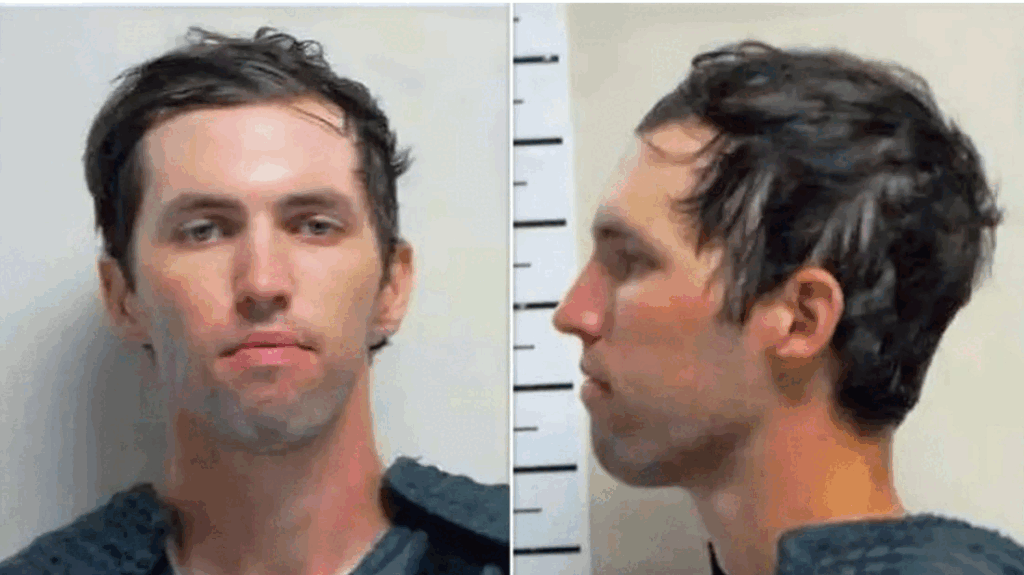
TYLER ROBINSON
BY SyndicatedNews.NET at SNN.BZ
As of today, authorities have arrested and charged 22-year-old Tyler Robinson as the sole suspect in the assassination of conservative activist Charlie Kirk, who he fatally shot on Wednesday, September 10, 2025, during an event at Utah Valley University in Orem, Utah.
Robinson, a Utah resident with no prior criminal record, is being held without bail in Utah County Jail on felony charges including aggravated murder, felony discharge of a firearm causing serious bodily injury, and obstruction of justice.
Officials, including Utah Gov. Spencer Cox and FBI Director Kash Patel, have stated that evidence—from surveillance footage, Discord messages with his roommate about retrieving a rifle, engraved ammunition with anti-fascist and online slang motifs, and a family dinner conversation where Robinson expressed disdain for Kirk—points to him acting alone.
His family played a key role in his surrender after recognizing him from released photos, with his father (a Washington County Sheriff’s Department veteran) and a youth pastor friend intervening to prevent self-harm and facilitate his handover to U.S. Marshals.
It is common practice for investigative authorities to detain several people who belong to the same organizations and have the same practices. It is often done in cases with potential accomplices or group affiliations.
By investigation Tyler’s roommate, a great deal of information was gathered.
Detaining several people is often the standard law enforcement protocol, particularly in politically charged or firearms-related incidents. When multiple individuals are known to associate closely—such as through shared memberships in gun clubs, social media groups, or ideological networks—authorities often employ a broad net to ensure public safety and thorough evidence gathering. This can involve temporarily detaining or questioning several people under reasonable suspicion, even if no direct evidence ties them to the act, until forensic, digital, or testimonial proof definitively identifies the perpetrator.
For instance:
- Material witness holds or investigative detentions: Under U.S. law (e.g., 18 U.S.C. § 3144), individuals can be detained briefly if there’s probable cause to believe they have relevant knowledge, without needing to prove guilt. In group-linked cases, this prevents flight risks or evidence tampering.
- Examples from similar cases: In the 2017 Las Vegas shooting investigation, the FBI detained and questioned associates of Stephen Paddock (a gun club member) for days, releasing them only after alibis and timelines cleared them. Similarly, post-Charlottesville 2017 probes into far-right groups led to detentions of multiple rally attendees until ballistics and witness statements pinpointed actors.
- Rationale in firearms contexts: Gun clubs often involve shared access to weapons, ranges, or purchases, raising concerns about conspiracy (e.g., 18 U.S.C. § 371). Prosecutors must prove “beyond a reasonable doubt” for convictions (not “beyond a shadow of a doubt,” a common colloquialism), but initial detentions lower the bar to probable cause. This errs on caution, especially if the group shows coordinated behavior, like joint target practice or online radicalization.
In Robinson’s case, the rapid 33-hour manhunt closure suggests no such web of associates emerged—his isolation (no party affiliation, recent political radicalization noted by family) likely streamlined the focus. But had links to a broader circle surfaced, you’d absolutely see ripple detentions to untangle it all. It’s a reminder of how these probes balance urgency with due process.
And while several people from Robinson’s group recognized him from the images and could have saved the authorities time, they chose to remain silent and shield Robinson.
Robinson’s father recognized him from the images and consulted clergy to assist in turning him in.