DRUNK AND VULGAR GEORGIA JUDGE UPDATE

JUDGE CHRISTINA PETERSON ON SOCIAL MEDIA
By SNN.BZ STAFF
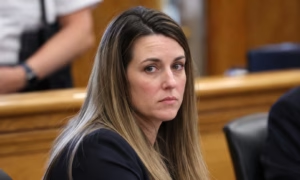
UPDATE: Updates continue in the case of Georgia Judge Christina Peterson following her controversial social media posts, with further developments expected from the March hearing and court filings.
In a case that highlights tensions between law enforcement practices, judicial accountability, and civil rights claims, former Douglas County Probate Judge Christina Peterson has filed a $50 million federal lawsuit against the City of Atlanta and one of its police officers. The suit, lodged in January 2026, stems from her high-profile arrest in June 2024 outside a Buckhead nightclub.
As of today, the lawsuit remains in its early stages, with no court rulings issued, while Peterson faces a pending misdemeanor charge related to the incident. Below is an overview of the case’s background, developments, and a logical assessment of its potential trajectory, based on available facts and legal precedents.
The 2024 Incident: Arrest at Red Martini Lounge
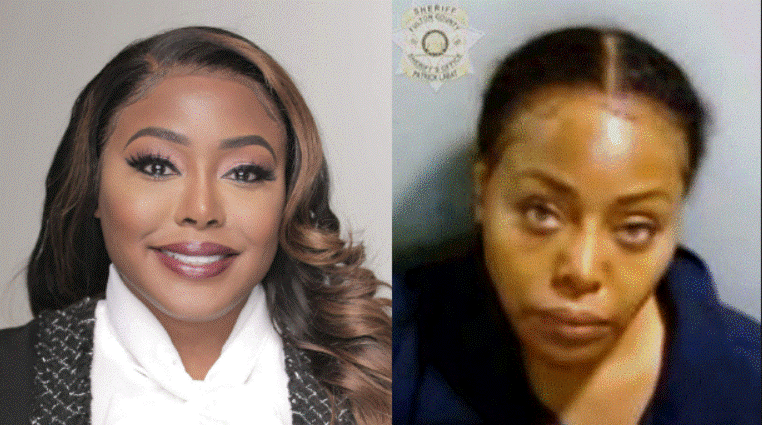
The events unfolded in the early hours of June 20, 2024, outside the Red Martini Restaurant and Lounge in Atlanta’s Buckhead neighborhood. According to police reports and body camera footage released by the Atlanta Police Department, officers responded to a disturbance involving a fight. Peterson, then a sitting probate judge in Douglas County, became involved in the altercation.
Peterson maintains she was attempting to intervene on behalf of a woman who appeared to be under attack. She alleges that Officer Keith Wadsworth, the arresting officer, approached her aggressively, slammed her head-first to the ground, and applied compressive force to her neck and back, causing injury. Police, however, claimed Peterson struck Wadsworth while resisting arrest, leading to initial charges of simple battery against a police officer (a misdemeanor) and felony obstruction of law enforcement.
Body camera footage captured Peterson appearing agitated and under the influence, with her repeatedly identifying herself as a judge and resisting handcuffing. The video, which was publicly released, showed a physical struggle but has been described by Peterson as “curated” and misleading to portray her negatively. Toxicology reports later confirmed alcohol in her system, though no DUI charges were filed as she was not driving.
Charges Dropped and Remaining Legal Hurdles
In late 2025, the Fulton County District Attorney’s office—led by Fani Willis—dropped the felony obstruction charge and dismissed the battery charge for “want of prosecution,” citing insufficient evidence to proceed. This decision has been pivotal for Peterson, as it bolsters her claims of wrongful prosecution. However, a single misdemeanor count of willful obstruction remains active, with a hearing scheduled for March 2026. If convicted, this could result in fines or minimal jail time, but it may influence the civil suit.
The dropped charges appear to stem from a review of evidence, including unedited body cam footage, which may not conclusively show Peterson initiating physical contact. Prosecutors often dismiss cases when proof beyond a reasonable doubt is lacking, especially in high-profile matters involving public officials.
The $50 Million Lawsuit: Claims and Defendants
Peterson filed the 23-page federal complaint pro se (representing herself) on January 16, 2026, in the U.S. District Court for the Northern District of Georgia. The suit names the City of Atlanta and Officer Wadsworth as defendants, seeking at least $50 million in compensatory and punitive damages. Key allegations include:
- False Arrest and Malicious Prosecution: Peterson argues there was no probable cause for her arrest, and the charges were pursued without sufficient evidence.
- Excessive Force: Claims of being violently thrown to the ground and restrained in a manner that caused physical harm.
- Unlawful Detention and Civil Rights Violations: Under 42 U.S.C. § 1983, alleging violations of her Fourth Amendment rights against unreasonable search and seizure.
- Reputational and Emotional Harm: Peterson contends the incident and subsequent media coverage led to “widespread reputational harm,” professional losses, and emotional distress.
She further accuses the city of releasing edited footage to damage her image, portraying her as a “violent felon.” As of February 13, 2026, the defendants have not publicly responded, and the case is awaiting initial motions.
Logical Analysis: Strengths, Weaknesses, and Likely Outcomes
From a neutral, evidence-based perspective, the lawsuit presents a mixed bag of prospects. Here’s a step-by-step breakdown:
1. Strengths for Peterson:
- The dismissal of most charges by the Fulton County DA’s office strengthens her false arrest and malicious prosecution claims. Dropped charges often indicate prosecutorial doubt, which could sway a jury.
- If unedited footage supports her version—showing non-resistance or disproportionate force—it could overcome qualified immunity, a doctrine that shields officers from lawsuits unless they violate “clearly established” rights.
- Civil rights cases involving police force have succeeded when video evidence is ambiguous or contradicts initial reports.
2. Weaknesses for Peterson:
- Her prior judicial removal for misconduct could undermine reputational damage claims. Defendants may argue any harm to her standing was self-inflicted, not solely from the arrest.
- Qualified immunity is a high bar; courts often rule in favor of officers if their actions were “objectively reasonable” in the moment.
- Representing herself pro se may complicate proceedings, as self-representation can lead to procedural errors in complex federal litigation.
3. Potential Outcomes:
- Settlement: Atlanta has a history of settling civil rights suits to avoid trials, especially with dropped charges and public scrutiny. A full $50 million is improbable, but a settlement in the mid-six figures is plausible based on similar cases.
- Dismissal: If qualified immunity holds, the case could be thrown out early.
- Trial: If it proceeds, a jury would weigh evidence like full body cam videos. The pending misdemeanor hearing in March could provide clarity or further complications.
This case underscores broader issues in the justice system, such as the balance between police authority and accountability, the impact of video evidence, and the challenges of prosecuting (or defending) public figures. It does not inherently reflect on hiring practices like diversity, equity, and inclusion (DEI) programs, as Peterson’s appointment and removal were tied to specific qualifications and conduct, not broader policy debates. Updates will depend on court filings and the March hearing.
Sources for this article include court documents, news reports from SyndicatedNews | SNN.BZ, Law.com, Law & Crime, Atlanta News First, FOX 5 Atlanta, Atlanta Journal-Constitution, and WSB-TV, as well as public posts on X (formerly Twitter).