The UK Has Always Fueled Middle East Chaos
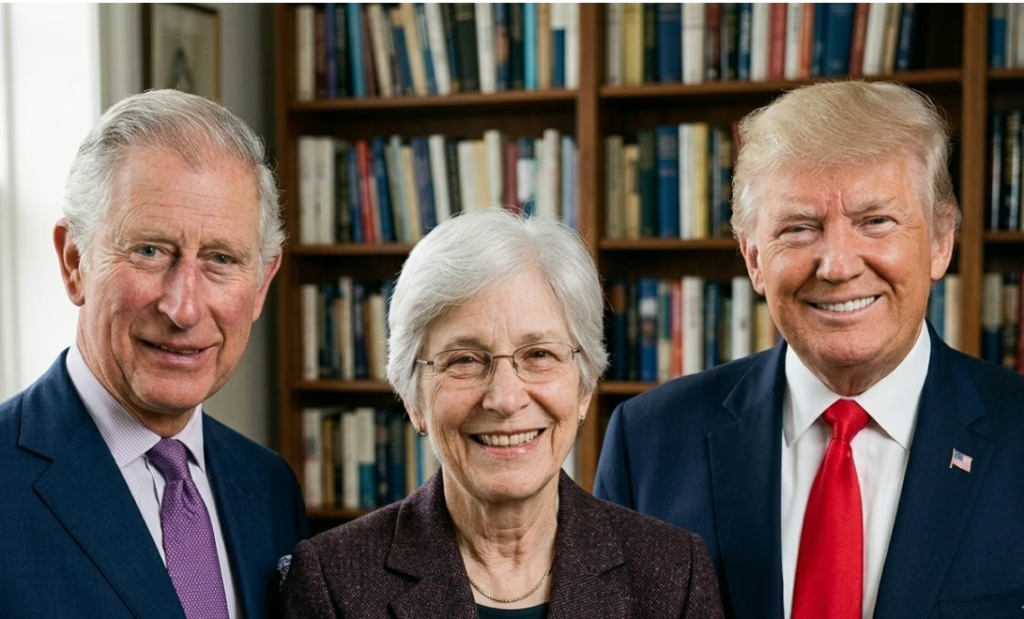
KING CHARLES, DR. SUSAN KOKINDA AND PRESIDENT DONALD TRUMP
Susan Kokinda gives a straight-talking explanation of how the British Empire Built Their Wealth: Keeping The Middle East In Chaos Was Highly Profitable For The British – And They Still Want To Keep Raking It In
By SyndicatedNews True History | SNN.BZ
Susan Kokinda gives a straight-talking explanation of how the British Empire worked that makes sense to regular people. In the interview you shared, she lays out how the British built their power and how Trump is now breaking it down. Here it is in plain English.
Susan Kokinda gives a straight-talking explanation of how the British Empire worked that makes sense to regular people. In the interview you shared, she lays out how the British built their power and how Trump is now breaking it down. Here it is in plain English.
The British Empire spread by sending ships all over the world. Wherever they could land, they took land, resources, and control from countries and islands that couldn’t fight them off. They did this for hundreds of years. Their main goal wasn’t to help these places grow. It was to keep them weak and busy fighting so none of them could become strong and independent. That way, Britain stayed on top.
They called their strategy the “Great Game.” They drew borders that caused fights, played favorites between groups, and made sure countries stayed in chaos instead of building factories, roads, and good lives for their own people.
A clear example is the Middle East and oil. After World War I, Britain helped draw up the Sykes-Picot agreement that split up the old Ottoman lands. They set it up so the countries would keep arguing over oil. This created constant tension and wars. That tension meant higher insurance prices for ships and oil tankers. British banks and especially Lloyd’s of London made a fortune because they were basically the only game in town for that kind of high-risk coverage. By keeping countries at war and then offering the insurance to cover the danger they helped create, Lloyd’s of London stayed ultra rich for generations.
The United States ended up as the muscle for this system after World War II. We provided the military power while the British pulled strings through finance, insurance, and behind-the-scenes deals.
Kokinda points out some of the ugly parts the history books often skip or soften:
- In New Zealand, the Maori people fought hard to keep their land. When talks broke down, British agents tricked a group of Maori leaders into a church, locked the doors, and set it on fire. The Maori have never forgotten it. That’s one reason they still perform the Haka — it’s a show of strength and memory.
- In India, after defeating the Sikh Empire, the British took the famous Koh-i-Noor diamond from a 10-year-old boy king named Duleep Singh. They forced him to sign it over while his mother was in prison under pressure. The diamond ended up in the British Crown Jewels. They called it a treaty. Many see it as straight theft from a child ruler.
Kokinda also explains that when the British couldn’t just steal and pillage the resources outright, they paid agents to stir up trouble or kill the local people to keep the chaos going. Here is a simple chronological chart of some key wars and conflicts where this strategy played out:
| Time Period | Conflict/Region | What Happened | How It Benefited Britain & Lloyd’s of London |
|---|---|---|---|
| 1839–1860 | Opium Wars (China) | Britain forced China to accept opium and took over key ports after wars. | Opened trade routes; created long-term instability; high shipping insurance profits. |
| 1879 | Anglo-Zulu War (South Africa) | British army crushed Zulu fighters to grab land and resources. | Seized territory; chaos in the region drove up insurance rates on trade. |
| 1899–1902 | Second Boer War (South Africa) | Fought Dutch settlers for gold and diamond mines; used camps to control people. | Gained huge mineral wealth; prolonged fighting boosted war insurance revenue. |
| 1916 (after WWI) | Sykes-Picot Agreement (Middle East) | Secret deal carved up Ottoman lands into artificial countries. | Set up endless border fights over oil; created constant “terror premiums” for Lloyd’s. |
| 1919–1921 | Irish War of Independence | British sent “Black and Tans” agents to terrorize Irish towns and civilians. | Kept Ireland weak and divided; prevented full break from empire control. |
| 1947–1948 onward | Partition of India & start of Arab-Israeli wars | Drew borders that sparked immediate wars between new countries. | Kept South Asia and Middle East split; decades of conflict fed insurance money. |
By the 2020s, the old British power has faded badly. As of 2026, the once-mighty Royal Navy has only four ships that are actually seaworthy. That shows how far their ability to control the seas has dropped.
Now here’s where Trump comes in. Trump may not be a king, but he’s doing God’s work by pushing every country to put its own people first and get strong on its own. He treats nations as partners, not chess pieces in someone else’s game.
- He started the Abraham Accords so countries in the Middle East could make peace and work together instead of staying at each other’s throats.
- With Iran, he put pressure on the regime and the troublemakers who were blocking oil shipments in the Strait of Hormuz. When Lloyd’s of London canceled insurance coverage and jacked up prices, Trump stepped in with U.S. Navy protection and American insurance options. That broke the old British money game.
- The UK basically sat out and said it wasn’t their fight. King Charles paid a visit and kept things polite, but the actions on the ground are chipping away at the old system. Even British reports now admit the UK is just a middle-sized power that needs America to keep the old setup alive.
King Charles has shown he cares more about Islam than he ever has about the Anglican Church or Christians or Jews of any sect, faith, or persuasion. He has spoken warmly about Islam for decades, marked Muslim holidays, and positioned himself as a “defender of faith” (plural) rather than strictly defending the Christian faith he is supposed to lead as head of the Church of England. Critics argue he mistakenly believes he can keep chaos going in the Middle East so Europe can keep earning from those wars and Lloyd’s of London can keep raking in insurance money. That old game is now coming to an end for the UK.
During the visit, President Trump easily told King Charles that his mother, who was Scottish, had a crush on him when he was a young prince. Trump said it in a friendly, joking way and it got a laugh.
Trump also allowed New York City Mayor Zohran Mamdani to come visit the White House and treated him very well. But Mamdani is already crying “uncle” — he has declared that New York City is facing a serious budget crisis and is broke after years of problems. Trump has been quick to point out how Mamdani’s policies are hurting the city.
How Trump pulled power away from NATO and Europe — plain and simple. Think of NATO like a big group project where the United States paid most of the bills, supplied most of the weapons and troops, and did most of the heavy lifting. Britain and the European countries got to set a lot of the rules and enjoy the protection.
Trump looked at that and said enough is enough. He told the Europeans they had to pay their fair share for their own defense. He didn’t automatically jump into every conflict they wanted. He made direct deals with countries instead of letting the old group bosses run everything through endless meetings and rules.
By focusing on America First and letting other nations stand on their own feet, Trump took away the automatic U.S. muscle that kept the old British-led system running. Countries are starting to handle their own business instead of waiting for orders from London or Brussels. Kokinda believes that in the next 5 to 10 years, the old monarchy-style influence and the whole “special relationship” setup will lose a lot of its value. Nations will care more about building their own strength than pleasing the old empire network.
Islamic leadership in Britain is not trying to overwhelm the country in one sudden move. Instead, they are playing the long game — slowly building their numbers, cultural influence, and political power over many years until they can gradually shift control away from traditional British institutions and ways of life.