Politicians Lie To Earn Cash And Perks
POLITICIANS LIE BECAUSE IT'S VERY PROFITABLE
It’s Why Americans Don’t Believe Anything Politicians Say
By SyndicatedNews | SNN.BZ
For decades, a pattern has repeated itself in American politics: ambitious candidates inflate, embellish, or outright invent key elements of their personal biographies—military heroism, academic credentials, ethnic heritage—to win votes. These were not innocent slips. They were calculated exaggerations that proved financially lucrative, propelling the tellers into high-paying offices with six-figure salaries, generous pensions, book deals, speaking fees, and lifelong influence. What cements public cynicism is the sequel: even when the lies are exposed, many of the offenders face no real consequence. They stay in power. That single fact—they got caught and kept the job—has done more to destroy trust in politicians than any single scandal.
The cases below, presented chronologically, form a clear timeline of how this erosion happened.
1950s: Douglas Stringfellow’s Phantom War Hero In his 1952 campaign for Utah’s 2nd Congressional District, Republican Douglas Stringfellow presented himself as a decorated World War II hero. He claimed he had been an agent for the Office of Strategic Services (OSS), parachuted behind enemy lines, and earned the Silver Star for gallantry. Voters loved the story. It helped elect him to the U.S. House of Representatives.
Only after he took office did Stringfellow confess: every word was fabricated. He had never served in the military at all. The exposure ended his congressional career, but the precedent was set.
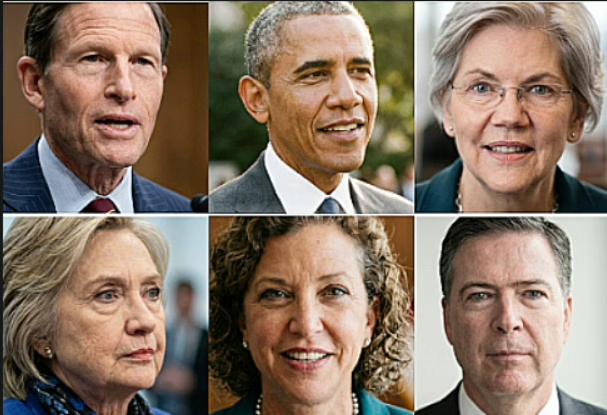
1986–1995 (and beyond): Elizabeth Warren’s Minority Listing While building her academic career, Elizabeth Warren listed herself as a “minority” or “Native American” in professional directories for roughly a decade. Universities accepted it at face value, helping her secure high-paying faculty positions at the University of Pennsylvania and Harvard Law School, along with research grants, speaking fees, and career advancement tied to diversity targets. She remains a U.S. Senator today.
2010: Mark Kirk’s Invented Navy Award and Iraq Service Republican Mark Kirk falsely claimed a prestigious Navy award and called himself an Iraq War veteran. He admitted the falsehoods but still won and served a full Senate term.
2010: Richard Blumenthal’s “Service in Vietnam” Democrat Richard Blumenthal repeatedly claimed he “served in Vietnam.” He was invited as a guest speaker to military events and veterans’ gatherings precisely because organizers believed he was a combat veteran. Video from a 2008 Norwalk event captured him saying, “We have learned something important since the days that I served in Vietnam.” He later called it “misspoken.” He has remained a U.S. Senator for fifteen years.
2022: George Santos’ Entire Résumé George Santos fabricated his education, Wall Street experience, and heritage. The lies helped him win a congressional seat. He was eventually expelled, but only after collecting the salary and benefits.
The Endless Pattern: Hillary Clinton and Debbie Wasserman Schultz Beyond these documented cases, two of the most prominent Democratic figures have come to symbolize decades of perceived deception. Hillary Clinton has been accused by critics of lying for decades about everything from Whitewater, Vince Foster, Benghazi (“What difference, at this point, does it make?”), her private email server, and the Clinton Foundation’s dealings. Whether in campaigns, as First Lady, Senator, Secretary of State, or two-time presidential candidate, the pattern of evolving stories and dismissals of scandals kept her in positions of immense power and financial reward for over 30 years.
Debbie Wasserman Schultz, the longtime Congresswoman and former DNC Chair, has been described by detractors as operating like a cobra — striking hard, then hiding for years, only to emerge again when the heat dies down. She faced intense backlash for rigging the 2016 DNC primary in favor of Hillary Clinton (as revealed by leaked emails), mishandling party funds, and multiple ethics controversies, yet she has repeatedly survived and returned to influential positions with her power and congressional salary intact.
The Common Thread—and Why It Matters Every one of these politicians used exaggerated or fabricated stories to gain an electoral or career edge. Military service, academic pedigree, minority status, or decades of shifting narratives—these became powerful emotional currency with voters. Once converted into votes, that currency translated directly into money: congressional paychecks of $174,000+, lifetime pensions, book deals, and influence.
The most corrosive element is the absence of consequences. Stringfellow was an outlier. Santos was expelled late. But Warren, Blumenthal, Hillary Clinton, and Debbie Wasserman Schultz all remain (or remained for decades) in positions of power and financial security long after their controversies. They were caught or exposed, they minimized or denied, and they kept the jobs and paychecks their stories helped them win.
When voters see this pattern repeated — lies that pay dividends, followed by survival and continued influence — they reach an obvious conclusion: the system does not punish deception at the top. It rewards it. Until consistent accountability matches the outrage, deep skepticism toward politicians will remain the only rational response. The American people did not lose faith by accident. They lost it because the record shows the lies worked — and the liars usually stayed.