Four Royal Families, Five Scandals
ROYAL ROGUES
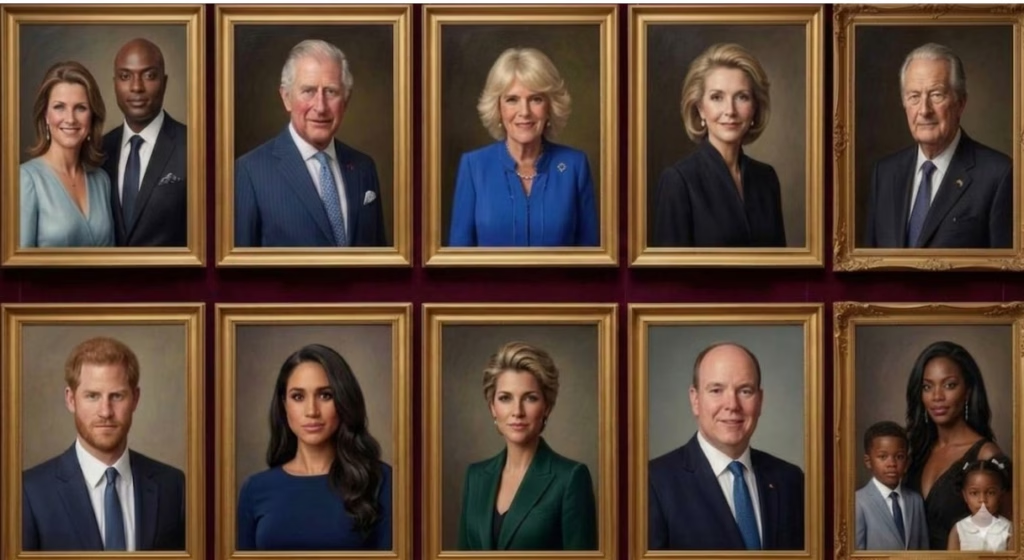
European monarchies in Norway, the United Kingdom, Belgium, and Monaco have all faced a modern reckoning—not through political upheaval, but through deeply personal revelations involving marriage, children, and public identity. From unconventional relationships in Norway, to a global royal exit in Britain, to legally confirmed paternity in Belgium, and acknowledged children in Monaco, four royal houses have each been forced to confront how private life reshapes public monarchy in the age of constant scrutiny.
European monarchies in Norway, the United Kingdom, Belgium, and Monaco have all faced a modern reckoning—not through political upheaval, but through deeply personal revelations involving marriage, children, and public identity. From unconventional relationships in Norway, to a global royal exit in Britain, to legally confirmed paternity in Belgium, and acknowledged children in Monaco, four royal houses have each been forced to confront how private life reshapes public monarchy in the age of constant scrutiny.
By Lady Arglwyddes Awbrey
European monarchies have long depended on tradition, continuity, and carefully managed public image. Yet in recent decades, even the most established royal houses have been forced to adapt to deeply personal developments that unfolded in full public view. In Belgium, Norway, the United Kingdom, and Monaco, royal families have each faced controversies that challenged long-standing expectations about duty, legitimacy, and private life.
In Norway, Princess Märtha Louise has become one of the most unconventional members of any European royal family. Following her divorce from author Ari Behn, she increasingly pursued a public identity centered on spirituality, alternative beliefs, and personal healing practices. Her relationship with Durek Verrett, an American spiritual teacher and self-described shaman, brought significant international attention.
Verrett, who is African American and has publicly stated that he is bisexual, has built a public profile around alternative spirituality and wellness teachings. He refers to himself as a shaman.
Their differing backgrounds, belief systems, and public visibility have generated sustained debate within Norway about the boundaries between royal status, personal identity, and commercial activity in modern monarchy.
In the United Kingdom, Prince Harry and Meghan, Duchess of Sussex, became global figures whose influence extended far beyond traditional royal roles. Their marriage was initially viewed as a modern evolution of the monarchy, but tensions soon developed around media scrutiny, institutional expectations, racism accusations and personal autonomy.
The couple ultimately stepped back from official royal duties, choosing to pursue independent professional and media ventures and moved to Montecito, California expecting to be recognized as some form of “notables.” Their continued public presence has ensured that debates about royal responsibility, privacy, and modern identity remain central to global discussion.
Prince Harry has argued in UK legal proceedings that he should be permitted access to police protection when visiting the United Kingdom under certain conditions, citing concerns related to his public profile and military service.
The UK government has maintained that security arrangements are determined by official royal status and assessed risk rather than birthright, and that such protections are not automatically extended to individuals who are no longer working members of the Royal Family. As a result, Harry and Meghan now fund their own professional and media activities independently while relying on private security arrangements rather than state-provided protection. “Access to police” to him not only means armed 24/7 police protection but that the public foot the bill. This demand is odd and hypocritical considering that neither Harry nor Meghan required armed guards when they wanted to travel to several foreign countries – they just got up and went (without the armed guards).
In Belgium, King Albert II faced long-standing legal and public scrutiny over a paternity claim brought by Belgian visual artist Delphine Boël. After years of legal proceedings, a court-ordered DNA test confirmed the biological relationship, and in 2020 Albert publicly acknowledged her as his daughter. She was subsequently recognized as Princess Delphine of Belgium, marking one of the most visible modern examples of a European monarchy formally adapting to a private family matter that became a matter of public record.
In Monaco, Prince Albert II has also faced public scrutiny over personal revelations that extend beyond traditional royal expectations. He has acknowledged two children born outside of marriage—Jazmin Grace Grimaldi and Alexandre Grimaldi—and their recognition has become part of the modern history of the Grimaldi dynasty. Their existence has contributed to broader discussions about inheritance, legitimacy, and the evolving nature of royal family structures in contemporary Europe.
Although each case is distinct, all four royal households reveal a shared reality: private life in modern monarchy is no longer private in any meaningful sense. Personal relationships, family structures, and individual choices are now subject to global scrutiny, often shaping public perception of the institution itself.
Public reaction remains divided. Some argue that monarchy depends on strict tradition and should resist change in order to preserve its symbolic authority. Others believe that royal institutions must evolve to reflect modern values, including personal autonomy, changing family structures, and greater transparency. These tensions reflect broader societal debates about identity, privilege, and accountability in public life.
What connects Norway, the United Kingdom, Belgium, and Monaco is not the similarity of their controversies, but the institutional challenge each one presents. Every monarchy has been required to interpret, respond, and adapt to circumstances that blur the line between private life and public duty. In doing so, they demonstrate that even centuries-old institutions are continually reshaped by the individuals within them.
Ultimately, these family histories suggest that modern monarchy is defined less by rigid tradition than by ongoing adaptation. Whether through unconventional partnerships, legal recognition of previously undisclosed family ties, or the redefinition of royal roles, each royal house illustrates a central truth: survival in the modern era depends on the ability to evolve while maintaining continuity.
NOTE: History has a way of repeating itself when its lessons are ignored. After his abdication, King Edward VIII and his wife, Wallis Simpson, sought to establish a parallel royal presence that some viewed as competing with the monarchy under Queen Elizabeth. Critics argue that granting Prince Harry and Meghan Markle additional privileges—such as publicly funded armed security—will enable the Sussexes to maintain a parallel royal role that competes with the future reign of King William and Queen Catherine.
“Furthermore, Andrew Mountbatten-Windsor—the former prince—was entirely stripped of his royal titles and evicted from his 30-room mansion. This downfall followed years of scandal, ignited when his mother, Queen Elizabeth II, funded a multimillion-dollar settlement to Virginia Giuffre. Giuffre, a survivor of a sex-trafficking ring run by Jeffrey Epstein and Ghislaine Maxwell, had filed a civil lawsuit against the royal.” [1, 2, 3, 4, 5, 6].