No New Pictures of Harry and Family with His Father
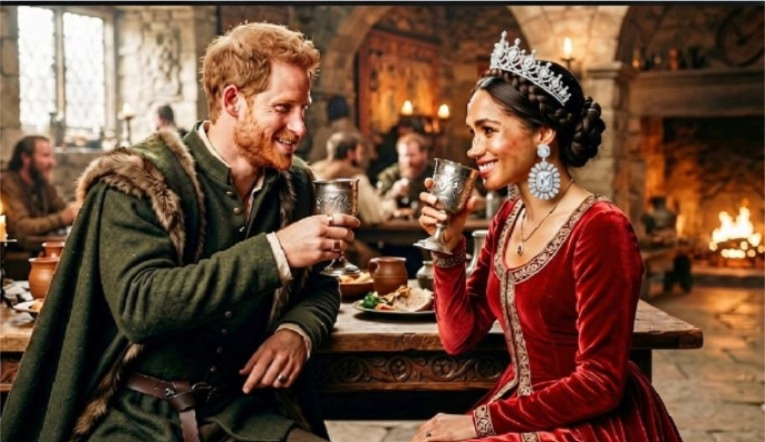
Eager to capitalize on the moment, publishers resorted to circulating old archival images of Prince Harry, his family, and his father, as no contemporary photographs were captured during the visit. Although King Charles capitulated to Meghan’s demands by personally funding their security, his advanced age and declining health suggest this will be the final opportunity for the couple to exploit the aging, cancer suffering monarch.
By SyndicatedNews | Lady Arglwyddes Awbrey, Royal Editor
Analysis of Harry’s Legal Setbacks Raise New Questions About the Sussexes’ Future
The Duke and Duchess of Sussex have spent years arguing that personal security concerns have shaped many of their decisions since stepping away from royal duties. Prince Harry has repeatedly maintained that the loss of publicly funded police protection placed his family at greater risk and has pursued multiple legal challenges concerning his security arrangements. This is clearly been proven untrue by the reality that both Harry and Meghan have traveled to other locations that offered no such protection.
Whether one agrees with those arguments or not, recent developments suggest that Harry and Meghan’s strategy has produced diminishing returns. To some royal historians and commentators, the situation has drawn comparisons to the relationship between King Edward VIII, who abdicated the British throne in 1936, and Wallis Simpson, the American divorcée he married after his abdication. While the historical circumstances are different, the comparison centers on the lasting separation from the core of the British Royal Family and the profound personal and constitutional consequences that followed.
Most recently, Prince Harry suffered another significant defeat in the UK High Court when his claims against Associated Newspapers were dismissed. The court ruled that the claimants failed to prove their allegations of unlawful information gathering in the articles at issue. The ruling represents another legal setback in a years-long campaign against sections of the British press and may expose the claimants to substantial legal costs.
The Cost of Litigation
Litigation is always expensive, particularly when conducted over many years and involving multiple appeals and high-profile legal teams.
Regardless of one’s opinion of Prince Harry’s motives, every unsuccessful lawsuit creates additional financial pressure while potentially weakening public confidence in future legal claims. Reports indicate that Associated Newspapers intends to seek recovery of significant legal costs following its victory.
The Monarchy Continues Without Them
Some constitutional commentators and royal observers have argued that, given Prince Harry’s public disputes with the Royal Family, his prolonged residence outside the United Kingdom, and his repeated criticism of the institution, Parliament should remove Harry from the line of succession.
Supporters of that view contend that the line of succession should reflect those who remain actively committed to the constitutional role of the monarchy. Others disagree, arguing that the line of succession is governed by established constitutional law and should not be altered based on personal or family disagreements.
As matters currently stand, Prince Harry remains in the line of succession under British law. Any change to that status would require legislation by the United Kingdom Parliament and, because the succession is shared among the Commonwealth realms, would likely involve consultation and coordinated action under long-established constitutional conventions.
History has shown, however, that circumstances once considered politically or constitutionally unthinkable can change. Few expected Prince Andrew’s association with Jeffrey Epstein to result in the sweeping consequences that followed. He lost the use of his “His Royal Highness” style in an official capacity, lost his honorary military appointments and royal patronages, and has faced ongoing scrutiny over his residence at Royal Lodge. While his place in the line of succession was unaffected, his experience demonstrates that significant constitutional and royal precedents can evolve when extraordinary circumstances arise.
Credibility Matters
Unfortunately, court proceedings often bring private communications into public view.
Recent reporting following the High Court judgment has focused on journalist Charlotte Griffiths, who disputed portions of Prince Harry’s testimony regarding the nature and duration of their acquaintance. Griffiths published messages and other evidence she says contradict aspects of Harry’s account. Prince Harry has not accepted those characterizations, and readers should recognize that differing interpretations remain part of the public debate but she had irreputable proof – where he did not
Whenever public figures become involved in legal proceedings, credibility becomes one of their most valuable assets. If witnesses or documentary evidence appear inconsistent with prior statements, public confidence erodes regardless of whether any legal wrongdoing is established.
The Pill Allegation
One allegation receiving significant attention involves Griffiths’ account that Prince Harry placed a small white pill onto her tongue during a 2011 gathering and allegedly remarked, “Now I know I can trust you.”
Griffiths herself reportedly believed it was probably an ordinary painkiller such as paracetamol (the UK equivalent of acetaminophen) and said she discreetly removed it rather than swallowing it.
No evidence has been presented publicly that the pill was an illicit substance, a sedative, or a so-called “date rape drug.” It would therefore be inappropriate to conclude that it was anything other than what Griffiths herself suspected it likely was. However, the risk an adult (he was 27 at the time) takes with someone else’s sense of safety is not a debatable point.
However, even accepting her account at face value raises legitimate questions about judgment.
Giving any unidentified pill to another person without first identifying it and obtaining clear consent would strike many people as inappropriate today, particularly between individuals who had only recently met. Modern social expectations place a high value on informed consent and personal autonomy.
The broader issue is therefore not necessarily what the pill was, but whether such conduct—if accurately described—demonstrated sound judgment.
Poisoning throughout British history
The Wars of the Roses (1455–1487)
During the struggle between the Houses of York and Lancaster, distrust among nobles was extreme. Banquets and diplomatic meetings were occasions where people genuinely feared being poisoned. While there is no well-documented incident of a king deliberately placing two drinks before someone and saying, “One is poisoned,” the fear itself was very real.
The Tudor Court (1485–1603)
This is probably the era most associated with poison in England.
Under Henry VIII, accusations of poisoning circulated frequently. The king feared assassination, and food tasters became an important part of royal life. Poisoning was considered so serious that in 1531 Parliament passed a law making murder by poison an act of high treason, punishable by being boiled alive.
Courtiers often suspected rivals of using poison, although many accusations were never proven.
The Stuart Period (1603–1714)
Poisoning remained a common fear, especially amid political and religious intrigue. Again, documented cases of rulers presenting two cups as a “test” are lacking, but nobles frequently worried about poisoned wine or food.
Where the “Choose a Drink” Scene Comes From
The famous version is actually from literature. In William Goldman’s novel and the film adaptation of The Princess Bride, the character Vizzini must choose between two goblets, one of which supposedly contains poison. It is one of the most famous poison scenes in cinema.
Another influence comes from stories surrounding the Italian Renaissance, especially the notorious Cesare Borgia and Lucrezia Borgia, whose family became legendary—though often exaggerated—for political poisonings.
Did Anyone Ever Force Someone to Choose?
There are scattered historical anecdotes across Europe of rulers or nobles forcing prisoners or rivals to drink from one of several cups as a loyalty or courage test. However:
- Most are poorly documented.
- Many originated in later chronicles rather than contemporary records.
- Historians generally regard many of these stories as legends or embellishments.
Was It Ever a Loyalty Test?
Yes, but usually in a different form. Rather than saying “one cup is poisoned,” rulers more commonly demonstrated trust by:
- Drinking from the same cup first.
- Having a servant or food taster sample the drink.
- Exchanging cups unexpectedly.
- Inviting a guest to drink first.
These practices were intended to reassure—or sometimes intimidate—those present.
So, if a film showed a British sovereign placing two drinks on a table and announcing that one was poisoned, it is probably inspired by the atmosphere of political intrigue and genuine fears of poisoning in medieval or Tudor courts, but there is no famous, well-documented British historical incident in which a monarch is known to have done exactly that. The scenario is best understood as a dramatic device rooted in real historical anxieties rather than a recorded event.
Security Versus Public Perception
Prince Harry has consistently argued that inadequate security has endangered his family.
Yet public sympathy often depends upon credibility.
Legal defeats, disputed testimony, continuing litigation, and fresh controversies all compete with the original message about security. Instead of focusing on protection concerns, media attention increasingly shifts toward courtroom losses and personal controversies.
That may ultimately undermine the very objective the Duke has sought to achieve.
Looking Ahead
The Sussexes remain internationally recognized figures with substantial media influence. However, influence and reputation are not identical. Reputation is built slowly and can be diminished through repeated legal setbacks, public contradictions, or controversies that distract from core messages.
For King Charles and the working Royal Family, constitutional duties continue regardless of litigation.
For the Sussexes, rebuilding public confidence now depends less on courtroom battles and more on demonstrating consistency, transparency, and a clear direction beyond disputes with the press. Only time will determine whether that transition occurs but Vegas odds? Their game was long lost.