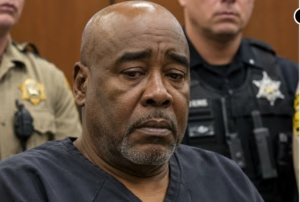
SENATOR MITCHELL GUILTY OF ROBBERY

SENATOR BURGLARIZED FATHER'S WIDOW
BY SNN.BZ STAFF
Minnesota State Senator Nicole Mitchell Found Guilty of Felony Burglary and Possession of Burglary ToolsIn a case that has gripped Minnesota’s political landscape, Democratic State Senator Nicole Mitchell was found guilty on July 18, 2025, of felony first-degree burglary and possession of burglary tools following a five-day trial in Detroit Lakes, Minnesota.
The verdict, delivered after just three hours of jury deliberation, marks a significant moment for Mitchell, a first-term senator from Woodbury, and could alter the delicate balance of power in the Minnesota Senate, where Democrats hold a razor-thin 34-33 majority. The conviction stems from an April 22, 2024, break-in at her stepmother’s home, an incident that sparked intense debate about ethics, intent, and political consequences.
The Case: A Family Dispute Turned Criminal
The trial centered on Mitchell’s actions in the early hours of April 22, 2024, when she was arrested in the basement of her stepmother Carol Mitchell’s home in Detroit Lakes, approximately 220 miles northwest of her Woodbury residence. According to the criminal complaint, Carol Mitchell called 911 to report a burglary after encountering Nicole, who was dressed in all black and carrying a flashlight covered with a sock. Police found a black backpack stuck in a window, containing two laptops, a cellphone, Senate identification, and Tupperware. A blue crowbar was also discovered near an egress window, identified as a potential burglary tool.
Mitchell, a former TV meteorologist and Air National Guard lieutenant colonel, pleaded not guilty, claiming she entered the home to conduct a welfare check on her stepmother, who she said suffers from Alzheimer’s disease.
She testified that her father’s death in 2023 and a subsequent rift with Carol over his ashes and possessions prompted her concern. Mitchell admitted to entering without permission and told police she was seeking sentimental items, such as her father’s flannel shirt, but denied any intent to steal. Her defense argued she would have pleaded guilty to trespassing, emphasizing her actions were driven by familial care, not criminal intent. “A burglar runs,” defense attorney Bruce Ringstrom Jr. argued. “A concerned child stays.”
Prosecutors, led by Becker County Attorney Brian McDonald, countered that Mitchell’s attire, tools, and statements to police—such as “I know I did something bad” and “Clearly, I’m not good at this”—indicated a planned intent to steal. McDonald emphasized that Minnesota law doesn’t require actual theft for a burglary conviction, only the intent to commit a crime upon unauthorized entry. Bodycam footage showing Mitchell in the basement and her admissions to police were pivotal in the prosecution’s case, despite defense claims of police mishandling evidence, such as failing to seize the crowbar properly.
The Trial: Emotional Testimony and Contrasting Narratives
Over the course of the trial, jurors heard emotional testimony from both Mitchell and her stepmother. Carol Mitchell, who struggled to recall details due to her Alzheimer’s, testified that she felt “extremely violated” by the break-in and denied a close relationship with Nicole. Mitchell, taking the stand for over five hours, described Carol as a mother figure but admitted lying to police about seeking her father’s possessions to avoid escalating her stepmother’s paranoia. Character witnesses, including Carol’s son Jonathan Kuehl and Mitchell’s aunt Nancy Lund, supported the defense’s narrative of Mitchell’s caregiving nature and Carol’s mental decline.
The prosecution’s case leaned heavily on Mitchell’s inconsistent statements and the suspicious nature of her actions—parking down the road, entering through a window at 4:45 a.m., and carrying tools like the sock-covered flashlight. McDonald dismissed the welfare check claim, arguing, “The defense has repeatedly classified this as a welfare check. What does your reason and common sense tell you?” The jury, consisting of nine men and three women, ultimately agreed with the prosecution, finding Mitchell guilty on both counts.
Political Fallout: A Senate in Limbo
The guilty verdict has far-reaching implications for Minnesota’s political landscape. Mitchell faces a maximum sentence of 20 years for first-degree burglary and three years for possession of burglary tools, though she remains free pending sentencing, with no date yet announced. Her defense attorney, Dane DeKrey, indicated plans to appeal, citing the strength of their case despite the outcome.
Senate Majority Leader Erin Murphy (DFL-St. Paul) and Governor Tim Walz have called for Mitchell’s resignation, noting she had pledged to step down if convicted. Senate Minority Leader Mark Johnson (R-East Grand Forks) went further, stating her continued presence “leaves a stain” on the Senate, particularly given her tie-breaking votes on DFL-backed legislation. If Mitchell resigns or is expelled, the Senate would be deadlocked at 33-33 until a special election, which Walz is expected to call soon. Mitchell’s district, a Democratic stronghold where she won 59% of the vote in 2022, is likely to remain in DFL hands, but the timing could disrupt legislative priorities when the session reconvenes in February 2026.
Public and Political Reaction
The verdict has sparked varied reactions. On X, posts celebrated the conviction, with users like @JeffDensmore87 and @Ruoho4SenateMN highlighting the jury’s decision, while @BackOnMyBSToday mocked Mitchell’s choice to go to trial, suggesting her status as an attorney should have prompted better legal judgment. Republicans have long pushed for Mitchell’s expulsion, with failed attempts to oust her since her arrest, while Democrats, reliant on her vote, had only stripped her of committee assignments. The case’s resolution brings clarity but also pressure for swift action to maintain the DFL’s Senate majority.

A Legal Misstep with Broader Consequences
From a legal perspective, Mitchell’s decision to go to trial appears to have been a gamble driven more by political considerations than legal merit. Her admissions to police, captured on bodycam, and the physical evidence—black attire, a crowbar, and a sock-covered flashlight—presented a formidable challenge for the defense. Legal analysts, such as Twin Cities attorney Joe Tamburino, suggested a plea to a lesser charge like trespassing could have avoided a felony conviction, implying Mitchell’s choice to fight the charges may have been to preserve her Senate seat. This mindset underestimated the prosecution’s ability to prove intent, a key element of burglary under Minnesota law, and overlooked the emotional weight of her stepmother’s testimony, despite Carol’s memory struggles.
Mitchell’s case highlights the risks public figures face when personal disputes spill into criminal territory. Her narrative of familial concern clashed with the optics of a pre-dawn break-in, making her defense a tough sell to jurors in a county that voted heavily for Donald Trump in 2024. The con
A Cautionary Tale for Public Servants
Nicole Mitchell’s guilty verdict closes a chapter on a saga that has roiled Minnesota politics for over a year. The case, rooted in a family dispute over a late father’s legacy, has morphed into a high-stakes legal and political drama with consequences for the state’s legislative balance. As Mitchell faces sentencing and potential appeals, her promised resignation looms large, with the DFL’s Senate majority hanging in the balance. The trial serves as a stark reminder that personal actions can have profound public repercussions, particularly for those entrusted with public office. Whether Mitchell’s story ends with resignation or a fight to retain her seat, it will undoubtedly leave a lasting mark on Minnesota’s political landscape.