Airlines Pay Employees to Penalize Passengers
Federal Senate investigators documented $26 million in baggage-fee enforcement incentives. A Florida lawsuit and court filings raise questions about impartiality at the boarding gate.
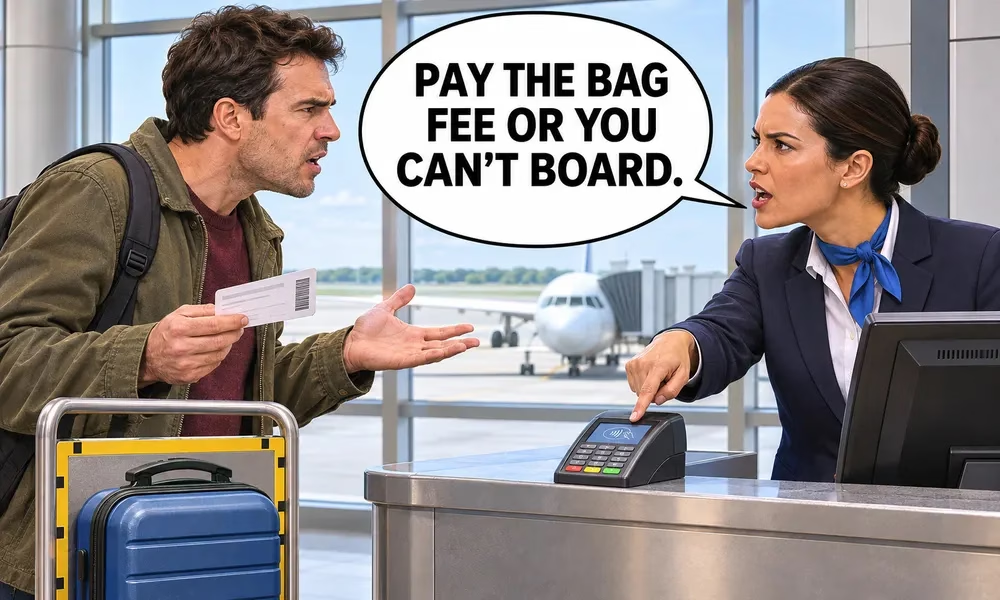
AI-generated editorial illustration of a carry-on fee dispute at a boarding gate.
Consumer Affairs | November 10, 2026
An airline passenger reaches the boarding gate with a ticket and a small piece of luggage. Moments before departure, a gate employee declares the bag too large and demands an additional payment. The passenger must pay, resolve the disagreement or risk missing the flight. What many travelers may not realize is that some airlines have financially rewarded the employees making those determinations.
A November 2024 U.S. Senate investigation documented that Frontier Airlines and Spirit Airlines paid more than $26 million in incentives during 2022 and 2023 to gate agents and other personnel for collecting baggage and other fees. Frontier personnel could earn as much as $10 for each qualifying bag; Spirit offered up to $5 per reported bag-policy violation. The findings raised a question that applies far beyond baggage: should employees responsible for enforcing rules personally profit when passengers incur additional charges?
The question also reached federal court. On June 29, 2023, Florida resident Amira Hamad filed a proposed class-action lawsuit against Frontier Airlines in the United States District Court for the Middle District of Florida, Orlando Division, Case No. 6:23-cv-01209. The complaint alleged that Frontier advertised a free personal item measuring no more than 14 by 18 by 8 inches while using gate baggage sizers that were smaller than the advertised dimensions. Hamad alleged that she was charged $100 and that Frontier offered bonuses to gate employees who collected baggage fees. These were allegations in a civil complaint, not judicial findings of fraud.
The case’s procedural history is equally important. In a September 9, 2024 order, U.S. District Judge Wendy W. Berger dismissed the class allegations and most of the claims at that stage but held that the remaining breach-of-contract count was sufficiently pleaded. The court also ordered the plaintiffs to address whether it had subject-matter jurisdiction. A public docket index lists the case as terminated on September 25, 2024. The precise basis for its final termination could not be independently established from the court documents reviewed, and the September 9 order did not find that Frontier had defrauded passengers.
Unlike the claims in that lawsuit, the existence of employee incentive programs was independently documented by Senate investigators, who examined internal airline records. The report also recorded the airlines’ position that bag-policy enforcement was legitimate and that they disputed accusations of abuse. An employee’s receipt of an incentive does not, by itself, prove that the underlying baggage fee was improper.
The controversy is international. In August 2025, Ryanair announced plans to increase its bonus for identifying oversized cabin bags from €1.50 to €2.50 per bag and eliminate an €80 monthly cap. Ryanair chief executive Michael O’Leary defended the practice as a way to encourage compliance and orderly boarding. News coverage of the announcement described criticism of the financial incentive as well as the airline’s response. That announcement is evidence of the policy at the time; it is not proof that every baggage-charge dispute involves a bonus.
Confrontations over baggage dimensions and charges have been widely shared on YouTube and other social platforms. Individual recordings can illuminate passengers’ frustrations, but they do not necessarily establish an inaccurate measurement or prove that the employee involved received a commission. Airlines have a legitimate interest in enforcing published size limits, preserving cabin space and ensuring timely departures. Passengers have a corresponding interest in consistent measurements and impartial treatment.
The financial stakes extend beyond the boarding gate. Senate investigators found that American, Delta, United, Frontier and Spirit collected approximately $12.4 billion in seat-selection fees between 2018 and 2023. These ancillary charges can make a low advertised airfare considerably more expensive once travelers add optional services. Although charging separately for services is not inherently unlawful, transparent pricing is essential to informed consumer choice.
Passengers disputing a baggage assessment can photograph their luggage in an approved size checker, retain their boarding pass and receipts, note the time and circumstances of the dispute, and submit a written complaint to the airline or, for U.S. airline consumer complaints, the Department of Transportation. The fundamental issue remains straightforward: when an employee stands to gain financially from imposing a fee, how can the passenger be assured that the decision is entirely impartial?
Federal Court Documents and Primary Sources
Original federal complaint — Hamad v. Frontier Airlines (June 29, 2023, PDF)
Federal court order — Judge Wendy W. Berger (September 9, 2024, PDF)
Public federal case docket — Justia
U.S. Senate investigation — The Sky’s the Limit (November 26, 2024, PDF)
U.S. Senate hearing and executive testimony (December 4, 2024)
Ryanair staff-bonus announcement — The Guardian (August 2025)