AI Has Rewritten The Rulebook For Audio Production
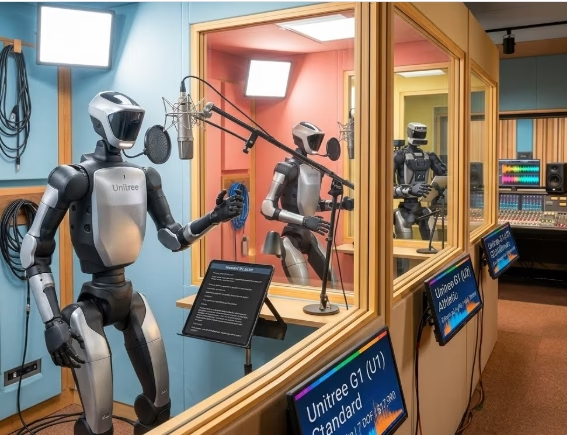
The day of the traditional voice actor is fading.
By SyndicatedNews Technology | SNN.BZ
Artificial intelligence has completely rewritten the rulebook for audio production. Digital soundtracks now routinely replace humans with synthetic vocal generators. All voice work is executed without a single human actor in the room, managed solely by recording engineers who digitally dictate the final product.
For decades, the voice-over industry was defined by the legendary vocal talents of iconic performers. Stars like Tara Strong, Mark Hamill, and Nolan North built entire generations of beloved animated and gaming characters through raw emotion and nuanced performance. These artists relied on years of finely tuned dramatic training, breath control, and character development to breathe life into scripts.
Today, those emotional nuances have been codified into algorithmic data points. Modern generative AI platforms synthesize speech by analyzing thousands of hours of vocal recordings. Rather than relying on a human to attempt an accent or a funny pitch, a sound engineer simply manipulates a digital dial. In mere seconds, they can choose the exact gender, voice tone, and regional dialect.
This technological leap fundamentally eliminates the casting process. Studios no longer need to schedule grueling recording sessions, negotiate talent contracts, or handle union residuals. Instead of paying human talent a single dime for their time, producers simply generate the requested audio from text-to-speech programs. The entire process is executed completely in-house.
The impact of this shift is heavily felt across global markets, particularly in film dubbing and video game localization. Companies have realized they can drastically cut overhead by swapping human dubbing actors for AI programs, which deliver consistent, highly scalable synthetic voices in multiple languages. This evolution has sparked significant controversy and labor disputes, with organizations like SAG-AFTRA fighting to protect actors from uncompensated vocal cloning and job displacement. They’ve added clauses to their contracts that address AI.
Despite the efficiency of synthetic voices, a fierce debate rages over the loss of true human artistry. Industry professionals—ranging from veteran actors to dubbing directors—argue that artificial intelligence still struggles to replicate the “happy accidents,” spontaneous improvisations, and emotional subtext that human actors naturally provide. Critics argue that AI-generated deliveries can quickly sound flat, repetitive, and immersion-breaking.
Yet, the technology continues to advance at a rapid pace. Startups are constantly refining algorithms to capture breaths, stutters, and whispers, aiming to bridge the gap between human warmth and machine efficiency. With major streaming services actively testing AI-assisted and automated dubbing models, the technology is undeniably reshaping the financial realities of the entertainment sector.
Ultimately, the voice-over landscape has been permanently transformed. As artificial intelligence becomes the standard for routine content, the industry is forcing a reevaluation of what it means to be a voice performer. The era of generating fully tailored, human-sounding characters on command is here, ushering in a new chapter where human actors must navigate a largely digitized auditory world.