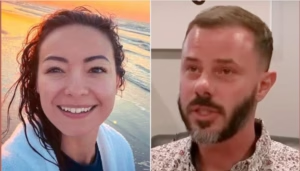
Il mio vero obiettivo nella vita è educare i miei figli…

Cesare Aiello, a true father.
Al diavolo la polmonite… Cesare Aiello, Senior
By Ruthie DiTucci | SNN.BZ
In the biting heart of Rochester, New York—where the wind off Lake Ontario could slice through bone and the thermometer plunged into the cruel single digits—there lived a man who carried himself like a European movie star from the golden age of Hollywood, yet he bent his back to the blue flame of a welding torch every day of his life.
Cesare Aiello arrived in America as a very young man, his face so strikingly handsome that people paused in the street, mistaking him for some leading man that had stepped off the silver screen. But Cesare was no actor.
He was a builder, a mender of steel, one of the finest professional welders North America would ever know. He took that talent and polished it here in the USA, in the shadow of Kodak’s sprawling empire, where structures stood or fell on the integrity of many joints he fused. Many do not realize or remember that he did welding jobs for Eastman Kodak, Xerox, the University of Rochester, Bausch & Lomb and what used to be Strong Memorial Hospital.
There wasn’t a large corporation that didn’t have to be serviced by Cesare Aiello. He made no fuss, told no one, kept his nose down and was the epitome of discretion.
It was that discretion that led project managers to secretly hire Cesare Aiello to work on US Government Private Contracts at Niagara Falls such as the Niagara Power Project (on the American side) and the Lewiston Pump Generating Plant (on the Canadian side) and no one was the wiser.
His wife, Edda—warm, steadfast Edda—became my dear friend when our children played and learned together at Sacred Heart Cathedral Elementary School. Over the years, our families wove themselves into each other’s lives, the way good friends do in a city that demands you huddle close against the cold.
I never loved Rochester winters. Those mornings when the radio crackled with corporate decrees—“Stay home, stay safe”—I marveled at anyone who dared defy them. But Cesare… Cesare was different.
I remember one such day, the kind where breath froze in the air and the world turned brittle. Most of the city shuttered itself indoors. Yet there we were in their kitchen: Edda, Cesare, and me, cradling mugs of scalding coffee that barely touched the chill. I glanced at Cesare. His eyes were distant, his face etched with something deeper than thought—almost like prayer. But Cesare was not a religious man.
“What are you thinking?” I asked softly.
He looked at me, steady, unflinching. “I’m going to work.”
I watched him rise, pull on his heavy jacket, march toward the door like a soldier answering a call only he could hear. Outside, the wind howled. I followed him to the car, heart pounding.
“Cesare, you don’t even look well. Why go out in this? It’s dangerous.”
He stopped, turned to me, and in a low voice—first in English, then the Italian that carried the weight of his soul—he whispered the secret he had guarded so fiercely:
“I know it’s cold. I have pneumonia. Don’t you dare tell Edda.”
The words struck me like a blow. Pneumonia. In single-digit hell. I pleaded with him—he could worsen, collapse on the job site, never come home. But Cesare only shook his head, eyes burning with a fire no fever could extinguish.
“Il mio vero obiettivo nella vita è educare i miei figli… Al diavolo la polmonite.”
My true purpose in life is to educate my children… To hell with the pneumonia.
It was not bravado. It was a vow carved into his marrow. A father’s oath spoken as though from the lips of heaven itself. He made me swear silence. I carried that secret in my chest for decades, a quiet, aching treasure, until today—when I finally laid it at the feet of his own children, Cesare and Isabel, so they might know the measure of the man who raised them.
Cesare was more than handsome. He possessed a strength of spirit that humbled everyone who knew him. He built himself a “man cave” long before the term became fashionable—a sanctuary with a fridge full of cold beer, a roaring sound system, a television glowing in the dim light. He played hard, as European men of his generation did, but he worked harder still. He knew exactly who he was, and he lived without apology to meet his own uncompromising standards.
At Kodak, when great engineers scratched their heads over crumbling structural joints near the lake—joints that refused to hold despite the finest alloys—Cesare, the mere welder, dared to speak. He said the problem lay not in the mixture the bosses had chosen, but in the very metals themselves, the percentages of ore hidden in their composition. Higher-ups scoffed. Years passed. Then the truth emerged in black and white: Cesare had been right all along. Not because he had a degree on the wall, but because in his quiet hours he studied global ores, their sources, their secrets. He never stopped learning. He never stopped caring.
And he never stopped going to work.
Two, three times he dragged himself to the job site with pneumonia burning through his lungs, face pale as winter, body screaming for rest. Yet he walked out into the frozen dawn as if nothing were wrong—because to him, nothing was more wrong than failing his children. Every weld, every freezing step, every labored breath was payment toward their education, their future, their chance at something better. That was his sacred promise. That was his life.
Yesterday, Cesare left us.
The world is colder now, emptier without him. But in my heart—and I pray in the hearts of his children, his beloved Edda, all who loved him—he remains exactly as he was: a man who looked like a Hollywood movie star, worked like a titan, and loved his family like a saint. A father who stared down death itself and said, “Not yet. Not until my children are secure.”
I will carry his words until my last breath.
“Al diavolo la polmonite.”
To hell with the pneumonia.
And to heaven with Cesare Aiello—the finest professional welder and father I ever knew. Rest now, dear friend. Your children are well educated and secure, thanks to you. You kept your promise. Your legacy burns brighter than any welding torch you ever held.
We will never forget. And yes, John Travolta became famous because he looked like Cesare Aiello.