Website Shutdowns: Who Profits?
Hosting companies can suspend customer websites for security reasons while also selling remediation services. FTC and SEC records illuminate security obligations and historical financial incentives, without proving deliberate sabotage.
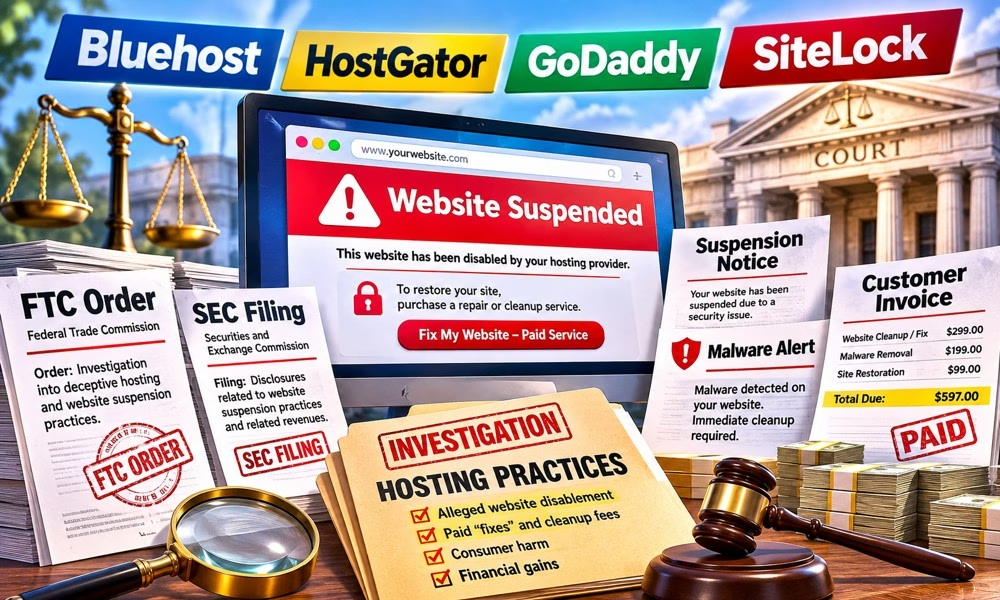
AI-generated editorial illustration. The notices, invoice, and regulatory documents shown are mockups.
A website owner wakes up to find a business, publication or online store suddenly unavailable. The hosting provider reports malware, excessive server use or another security problem. Restoring service may involve buying additional protection, professional cleanup or a more expensive hosting plan. The arrangement raises a legitimate consumer-protection question: when the same industry controls access to a website and sells remedies for taking it offline, what safeguards prevent financial incentives from influencing those decisions?
Bluehost describes website suspension as a response to malware or excessive resource consumption. Its published guidance, updated October 28, 2026, says affected customers may be permitted to correct the issue or upgrade to a dedicated server. Some suspensions may cover only a directory; others affect an entire site. A suspension may be justified, but a customer still needs to know what technical evidence supports the provider’s finding.
HostGator likewise states that accounts may be suspended for nonpayment, malware or policy violations. Its official suspension guidance recommends a malware-protection product when infections are detected. Hosting companies have sound reasons to isolate genuinely compromised websites, particularly where neighboring sites share a server. The concern is whether an affected customer receives a verifiable diagnosis and a reasonable opportunity to obtain an independent assessment.
Financial relationships are not hypothetical. In its 2019 annual report filed with the Securities and Exchange Commission, Endurance International Group—the former parent company of Bluehost and HostGator—disclosed revenue from SiteLock product sales and fees paid by SiteLock on services it sold directly to Endurance customers. The disclosure establishes a historic revenue-sharing relationship. It does not, by itself, establish that either company deliberately caused an outage or fabricated a malware detection.
A more pointed account appeared in February 2017, when independent website-security business White Fir Design described what it said was an erroneous Bluehost/SiteLock malware finding. According to the firm, files flagged as infected were cached copies of material from another website, not an infection of the affected customer’s site. That is a documented account by an outside service provider, not a court judgment; it illustrates why independent technical review matters before allegations are treated as established facts.
The federal government has separately scrutinized hosting security claims. The Federal Trade Commission issued a formal complaint against GoDaddy and finalized a decision and order on May 21, 2025. The agency alleged shortcomings in the company’s website-hosting security program and misleading representations about security protections. The order requires stronger safeguards and outside review. GoDaddy neither admitted nor denied the complaint’s allegations, apart from jurisdictional facts. The FTC matter was not a finding that GoDaddy intentionally disabled customers’ websites to charge repair fees.
Current service arrangements also change. In September 2026, Bluehost announced that SiteLock was no longer available as a service through its partnership, with existing subscriptions no longer renewing at their next renewal dates. HostGator posted a similar notice. Historic revenue relationships must therefore not be presented as proof of those companies’ present arrangements.
For a customer who suspects an unjustified shutdown, the most useful evidence is not a general accusation but a dated suspension notice, server and access logs, the exact files or URLs flagged, a malware scan report, a copy of the hosting contract, any proposed repair charge, and the provider’s written explanation. A second opinion from an independent security specialist can help distinguish a false positive from a genuine compromise. In a dispute over motive, the sequence of notices, technical findings and sales solicitations is particularly important.
Website security is a legitimate service, and emergency suspension can be necessary. Yet customers deserve transparent explanations when businesses disappear from the internet—and clarity about whether the company requiring the remedy will also earn money from supplying it. The public records establish security enforcement, referral economics and past complaints; they do not, at this stage, establish an industrywide scheme of deliberate sabotage. That more serious allegation requires case-specific evidence.
Primary Legal Documents and Source Records
FTC complaint against GoDaddy (PDF)
FTC final decision and order, May 21, 2025 (PDF)
FTC case record and procedural timeline
Endurance International Group 2019 Form 10-K (SEC filing; SiteLock disclosures)
White Fir Design’s 2017 account of an alleged false positive
Editorial note: Any accompanying feature image is an AI-generated illustration. Depicted invoices, regulatory paperwork and dollar amounts are illustrative, not reproductions of actual documents.