Seabirds Multiply After Chilean Island Restoration
Nearly 90,000 breeding pairs of Peruvian diving petrels were estimated on Choros Island after decades of protection and habitat restoration.
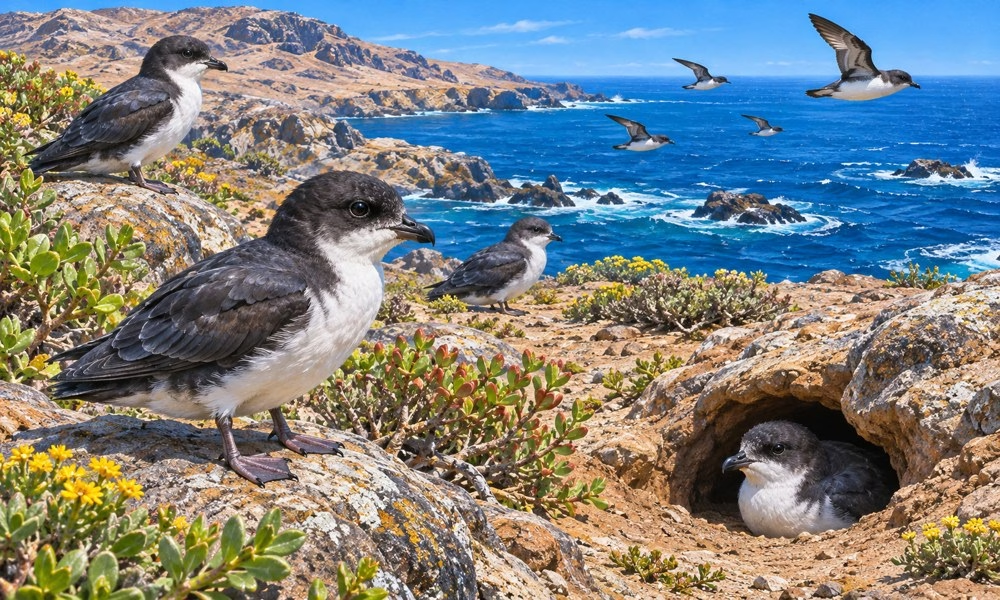
AI-generated illustration inspired by the seabird recovery on Choros Island, Chile; not a documentary photograph.
By Arthur Reed — SyndicatedNews.NET at SNN.BZ
CHOROS ISLAND, Chile — A seabird colony has rebounded on a protected Chilean island, with researchers estimating nearly 90,000 breeding pairs of Peruvian diving petrels in a November 2024 census.
The study, published October 15 in Marine Ornithology, estimated 89,876 breeding pairs—about 7.5 times the 2013 population. Island Conservation highlighted the findings in a November 3 announcement.
The recovery followed decades of habitat protection and the removal of invasive European rabbits in 2013. Rabbits had damaged nesting burrows and degraded ground used by the birds, according to the conservation organization.
With that pressure removed, nesting habitat recovered. Island Conservation reports that the colony’s occupied area nearly doubled between 2013 and 2024, while the estimated breeding population rose from 11,934 pairs.
Researchers Marián A. Méndez, Nicolás Luna and Guillermo Luna-Jorquera describe habitat protection and rabbit eradication as central to the recovery. Their study emphasizes the value of conservation maintained over several decades.
The figures are population estimates, rather than a count of every bird. The researchers put the 2024 breeding population between approximately 81,000 and 99,000 pairs at a 95 percent confidence level.
Choros forms part of the Humboldt Penguin National Reserve, managed by Chile’s National Forestry Corporation, CONAF. Its long-term protection supported the restoration effort, undertaken with Island Conservation and partners.
Continued protection remains necessary. The study warns that proposed nearby mining and port development could threaten the gains. For now, the island offers a documented example of wildlife recovering after sustained work to restore its breeding grounds.
Sources: Marine Ornithology: original study; Island Conservation: November 3 announcement.