Prince Harry Declares Ukraine Will Win—Who Authorized Him to Speak?
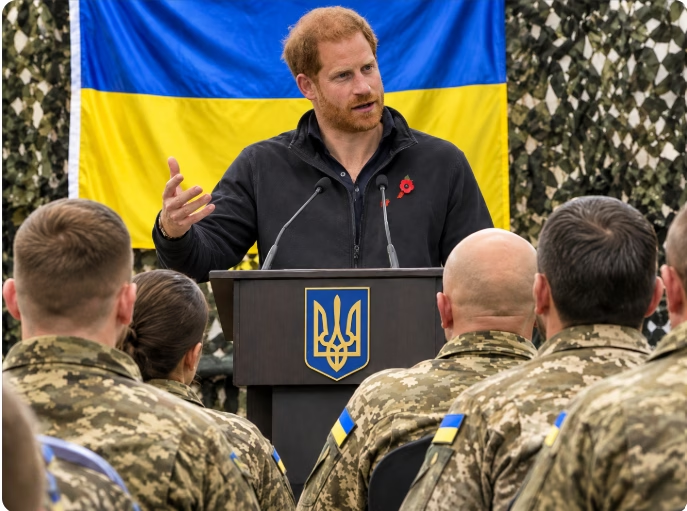
“Prince Harry declares Ukraine will win. But who does he represent?”
Arthur Reed – Down the Middle
SNN.BZ | November 16, 2026
Prince Harry, Duke of Sussex, told an audience in Lviv, Ukraine, that the country would win its war against Russia. Yet Harry holds no official British diplomatic or military position. His appearance in a war-torn country, and his public declaration concerning the outcome of an active conflict, raise an important question:
On whose authority was he speaking?
According to Reuters, Harry addressed a medical conference organized by the Superhumans rehabilitation centre during his November visit. He expressed confidence that Ukraine would emerge victorious. Such statements carry particular significance when made by someone who retains a British royal title, especially given the Royal Family’s longstanding convention of avoiding political and diplomatic controversy.
The Associated Press reported that Harry also met wounded Ukrainian veterans connected with the Invictus Games, the international sporting competition he founded in 2014. Harry served approximately ten years in the British Army, including deployments to Afghanistan. His military background and charitable activities explain his involvement with injured service personnel. They do not confer diplomatic authority.
In 2020, Harry stepped away from his duties as a working member of the British Royal Family. Although he retains the title Duke of Sussex, he does not represent the Crown in an official capacity. He is neither an accredited British diplomat nor a serving military commander. His royal title does not authorize him to establish foreign policy or speak on behalf of the British government.
Visiting wounded soldiers, supporting rehabilitation programs, and encouraging military veterans are legitimate humanitarian activities. Harry does not require a British diplomatic appointment to undertake such private work. However, publicly predicting victory in an ongoing international war introduces a different consideration: whether audiences clearly understand that his remarks represent personal opinions rather than official British policy.
There is no verified evidence that Harry claimed to represent the British government during his visit. Nor has the reporting established that he possessed an official diplomatic mandate. These distinctions are essential. His statements should not be presented as British government declarations, and his visit should not be characterized as unauthorized merely because he holds no diplomatic appointment.
Nevertheless, questions remain concerning the arrangements surrounding his appearance. Who invited Harry to Ukraine? Who coordinated his security? Did British diplomatic authorities participate in organizing the visit? Was he introduced exclusively as the founder of the Invictus Games, or was his royal title emphasized? These are reasonable questions of transparency and public accountability.
Harry’s remarks may have been intended to encourage Ukrainian soldiers recovering from serious injuries. That humanitarian purpose deserves recognition. But the outcome of a war involving sovereign nations is a matter of international security, not simply personal optimism. When a prominent individual retaining a royal title speaks publicly about military victory, clarity concerning his status and authority becomes particularly important.
Editorial Opinion: Prince Harry’s appearance in Ukraine underscores a serious constitutional question: Should someone who no longer performs official royal duties continue holding titles associated with the British monarchy while making high-profile statements about an active international war? This episode strengthens the case for Parliament to examine whether the continued use of such titles creates confusion about who legitimately represents the Crown. Removing a hereditary peerage would require an appropriate legal process, but the question of whether Harry should retain his Duke of Sussex title deserves public examination.
Prince Harry has every right to express his personal opinions. He does not however have authority to speak for Britain simply because he remains a duke.
The public deserves to know precisely whom he represents when addressing military personnel in a country at war. The distinction between private humanitarian advocacy and official diplomatic representation must remain unmistakable.