Veteran Threatened Under Repealed Law
A veteran’s Waveland police encounter raises questions over a repealed Mississippi vagrancy law and First Amendment rights.
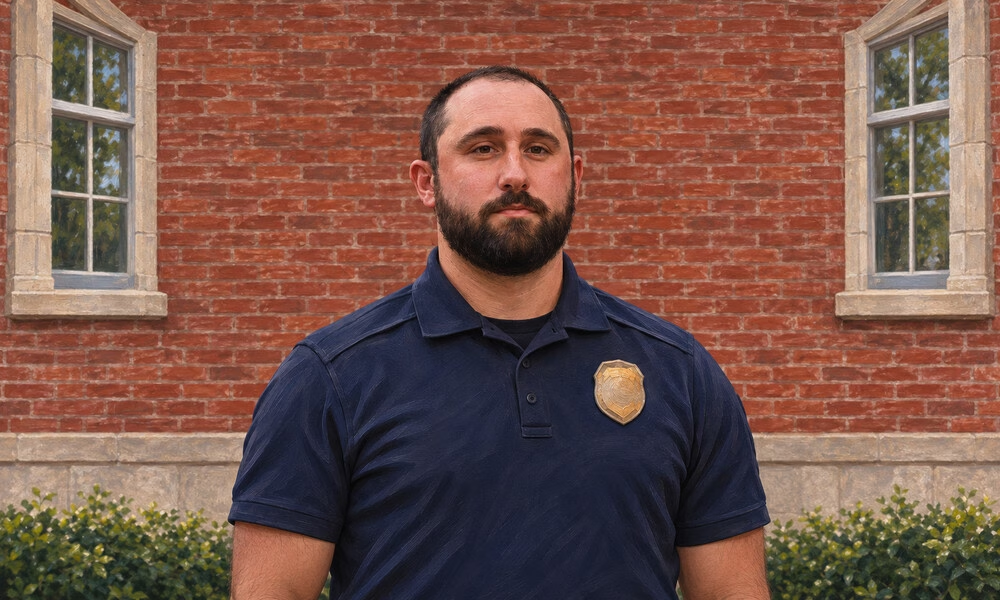
AI generated for illustrative purposes. Based on reference imagery supplied to SNN.BZ; not a documentary photograph of the encounter.
Arthur Reed – Down the Middle
An Army veteran’s confrontation with Mississippi police raises questions about constitutional rights, police authority and a vagrancy law abolished five years before the encounter.
A United States Army veteran standing outside a Mississippi city hall with a cardboard sign supporting homeless veterans faced the threat of arrest during an encounter with police. The confrontation involving civil rights advocate Jeffrey Gray has attracted attention because an officer invoked vagrancy—an offense whose underlying state statutes had been repealed years earlier.
On May 30, 2023, Gray stood on a public sidewalk outside Waveland City Hall holding a sign supporting homeless veterans. Gray, who operates the YouTube channel HonorYourOath Civil Rights Investigations, routinely visits public locations to document how government officials respond to peaceful demonstrations. His activities are
The Waveland confrontation involved Police Sergeant Joseph Joffrion. Gray reported that the sergeant demanded identification and threatened him with jail if he refused to comply. Gray maintained that he was exercising constitutionally protected rights on a public sidewalk. Local television station WLOX subsequently investigated the incident and interviewed Gray about his treatment by police.
The legal problem is substantial. Mississippi’s House Bill 668, signed into law in March 2018 and effective July 1 of that year, repealed numerous state provisions concerning vagrancy and people legally classified as tramps. Consequently, the state’s repealed vagrancy provisions could not themselves provide legal authority for an arrest in May 2023. Whether officers possessed some other lawful basis for intervention is a separate question.
Waveland officials offered a different perspective. Then-Mayor Jay Trapani said he requested police involvement because Gray’s behavior outside City Hall had made employees uncomfortable. According to the mayor, Gray occasionally looked through a window toward employees working inside. That explanation provides context for the police response, but discomfort alone does not automatically establish a criminal offense or justify an arrest.
The constitutional principles extend beyond Mississippi. In its landmark 1972 decision Papachristou v. City of Jacksonville, the U.S. Supreme Court struck down a Florida vagrancy ordinance for vagueness. The justices found that the ordinance failed to provide adequate notice of prohibited conduct and permitted arbitrary enforcement. The ruling remains an important safeguard against broad laws that allow police excessive discretion over otherwise innocent activities.
Gray eventually pursued the matter in federal court. On May 29, 2024, he filed a civil rights lawsuit against the City of Waveland, Sergeant Joffrion and Officer Williams Andress. Filed in the U.S. District Court for the Southern District of Mississippi, the action alleged violations of federal civil rights protections. The allegations were contested, and filing a lawsuit did not itself establish that the defendants acted unlawfully.
The case was subsequently resolved in 2025. According to Gray’s publicly released statement, his Mississippi disputes were settled, the resolutions did not prevent his return to the public forums involved, and the police departments had undertaken or agreed to undertake First Amendment training. The financial terms were not publicly disclosed, and the resolution should not be characterized as a judicial finding of misconduct.
The larger issue is the distinction between enforcing the law and invoking authority that the law does not provide. Police officers have legitimate responsibilities to investigate complaints and protect public safety. Citizens, including military veterans, retain constitutional protections when speaking peacefully in public places. Gray’s encounter illustrates why accurate knowledge of existing law—and the limits of police authority—matters to both officers and the communities they serve.