TRESPASSERS, DOG OWNERS AND POOP LAWS
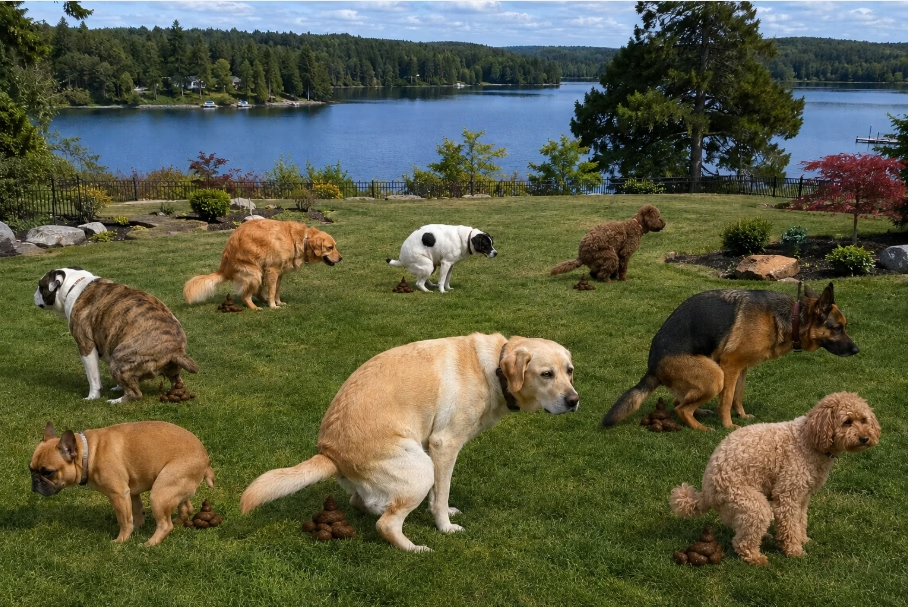
Whether loose or on a leash - this is TRESPASSING
Deciding to allow or encourage your pet to defecate on a neighbor’s yard can come back to haunt you.
By Ruthie DiTucci | SNN.BZ
WHEN A PET DEFECATES: IT LEAVES THE FOLLOWING…
- Brucellosis: Is a bacterial disease in dog feces that causes flu-like illness in humans.
- Campylobacteriosis: This bacterial infection can be spread to humans via contact with feces from both dogs and cats carrying the bacteria.
- Leptospirosis: The common clinical signs reported in dogs include fever, vomiting, abdominal pain, diarrhea, refusal to eat, severe weakness and depression, stiffness, or severe muscle pain.
- Rabies: Being bitten by a rabid animal is only one method for your dog to contract rabies. Coming in contact with the saliva, feces or urine of an infected animal (whether it is dead or alive and whether the saliva is dry or wet) is the easiest way to contract rabies which can enter your dog’s system through its eyes, nose, mouth or an open wound or scratch. It’s most commonly contracted right through paw pads and between their toes.
- Ringworm: Dogs spread ringworm through direct contact with the fungus. This can happen when a dog comes in direct contact with an infected animal or person or touches a contaminated object like a couch, comb, food bowls, bedding, or carpeting.
- Salmonella: Spreads mainly through feces from infected individuals and infects new individuals via the mouth. Dogs can become infected through contaminated food and contaminated water. International veterinary publications indicate the feeding of raw meat as the most common route of transmission in dogs.
- Giardiasis: This is a parasitic infection that can cause diarrhea, gas, abdominal cramps, nausea, and vomiting in humans and dogs. It can be spread through contact with contaminated water or soil that contains dog feces.
- Hookworms: These are intestinal parasites that can infect dogs and humans through the skin. They can cause anemia, weight loss, skin irritation, and intestinal bleeding in dogs, and skin rashes, abdominal pain, and diarrhea in human.
- Toxocariasis: This is a disease caused by roundworms that can infect dogs and humans. In dogs, it can cause diarrhea, vomiting, weight loss, and poor growth. In humans, it can cause fever, cough, wheezing, abdominal pain, and eye damage .
- What are other diseases caught from dog poop? E. Coli, and Campylobacter are bacteria that are excreted in the feces of even healthy dogs!
EXPECTATION OF PRIVACY IN PUBLIC DOES NOT EXIST
There is no expectation of privacy when people are in public spaces. People are often observed and recorded by others without their consent. And during the act of trespassing – ALL BETS ARE OFF… If a trespasser is captured on surveillance cameras while trespassing on private or commercial property, the property owner owns the footage and may use the footage as evidence of the trespassing. Same holds true for walking on the street.
In general, a trespasser does not have any expectation of privacy while on someone else’s private property, especially if they had been asked to leave and even if they did not know that they were being recorded.
Some pet owners carry life and accident insurance for their pets, medical insurance for veterinary care and even traveler’s insurance for when they take their pets on vacation. Refer to this “Paw Policy” page for pet related insurance offerings. The Pawlicy Wizard page features METLIFE, EMBRACE, ASPCA, PUMPKIN, FETCH, HEALTHYPAWS, WAGMO and METLIFE as pet insurance choices.
Many pet owners even refer to their pets as “fur babies” or “their children”. Keep in mind that while a pet owner may love his or her pet – the pet is not a human being and has no significance in the law other than the value it has as property. In reality, once the pet (your property) has roamed onto private property, the property owner’s rights supersede your rights as the owner of the dog and your beloved pet, has no rights – it is defined as property under the law. No more – no less.
Take precautions and do not hide behind a Pet Insurance policy either. When you examine your pet insurance policy carefully, you will find that the majority of the policy is unenforceable on someone else’s private property.
TRESPASSER’S IMAGES WILL BE PUBLISHED
In our Florida neighborhood, we have asked people not to bring their animals onto our property to defecate or pee because feces and urine, burn grass severely. We have seen very good cooperation, but a few spirited people still appear on our surveillance equipment with their dogs.
After carefully studying local ordinances, and learning that the property owner owns all images of people on their property, we decided to publish the images of the willful people that continued to bring their dogs to defecate after being told not to.
Pet owners should know that property owners are within their legal rights to publish all and any of the photographs and videos their surveillance cameras capture of people parading their dogs on private property.
NIGHT-TIME TRESPASSERS (TWO MALES)
The night of Saturday September 16, 2023 at exactly at 11:41 PM, these two trespassers walked right onto private property with a flashlight like a pair of burglars! You can clearly hear them say that they are concerned that “somebody’s watching them.” The possibility that they’re breaking the law by ignoring all the ‘PRIVATE PROPERTY – NO TRESPASSING” signs doesn’t cross their minds. Do you recognize either of these men?
NIGHT-TIME TRESPASSERS (MALE AND FEMALE):
The night of Saturday September 30, 2023 at exactly at 4:57 AM these: two trespassers walked right in with an open can of beer in his hand on the right side of the screen but if you look at the upper left side of the screen you can see his female companion just getting out of their car. On their departure, with his open can of beer in hand, they return to their white car parked on the sidewalk. Drinking and driving. Do you recognize the male or the female?
The non-emergency number for the Orange County, Florida Sheriff’s Department is: 407 836 4357. We were able to reach a well educated Sheriff that is highly familiar with Florida’s trespass laws. He clearly identified himself and gave his assurance that trespasser’s pictures may be posted on the Internet and even billboards (and our lawyers all agree).
And it turns out, that when a trespasser continues trespassing by bringing their dogs on to private property repeatedly, their photographs and videos alone will be sufficient to file a trespass law violation against the dog’s owner (and the dog too). The property owner does not even have to know the trespasser’s name! On occasion, pet owners have found themselves being hauled off to jail and theie dogs are hauled off to the dog pound.
Most communities have a non-emergency police number. You should call your neighborhood’s non-emergency police number to find out what your community’s poop laws are so that your pet ownership winds up being a joyful pleasure instead of a legal courtroom nightmare.
DID YOU KNOW THAT TRESPASSING CREATES A CRIMINAL RECORD?
When a person willfully walks onto someone else’s private property, that person does so at his or her own risk. Under Florida law, criminal trespass is defined as the willful entry into or remaining upon property without the express or implied permission of the owner or an agent. Trespass in a structure or conveyance that carries penalties that may include jail, probation, and a permanent criminal record.
THE WORD “WILLFUL” HAS A LEGAL DEFINITION
What defines willful? The legal dictionary defines the word willful as: “having or showing a stubborn and determined intention to do as one wants, regardless of the consequences or effects.”
The home owners do not even have to be home to tell you to get off their property. If the property has signs on it that say POSTED or NO TRESPASSING or PRIVATE PROPERTY, the property owner has met his or her legal obligation to “warn” people not to trespass.
In today’s highly technological world, property owners have cameras videotaping all their properties whether the owners or tenants themselves are present or not. That means that if you choose to ignore the signage and walk onto private property and the property cameras record your visit, the property owner need not even contact you after the fact or even bother to learn your name.
PROPERTY OWNERS ONLY NEED AN IMAGE
Delivering the photograph to local law enforcement (police or sheriff) is all a property owner needs to do in order to file a “Trespasser Complaint”. And that’s not a little thing. Getting a trespass complaint off your formal record is difficult because a trespass record is permanent.
After the owner of the property has made it known to the trespasser that he or she is not welcome on the property, and the trespasser does it “again”, the trespasser has just given the authorities all they legally need to file a trespassing case. That photograph (yes, your image) is the first step towards a legal trespass case.
This matter has little to do with poop or pee – it has to do with the trespass laws in your community and the respect you offer your neighbors! Having your animal use your neighbor’s property as a toilet is the most efficient way of communicating that you don’t care about your neighbor


You should also know that the photographs in this dog “Walk of Shame” parade does not mean the human is about to be charged with trespassing; it only means that “the person is on notice.” Those that repeat the behavior, will be trespassed because we do not have to watch out for you – surveillance cameras do that for us.
It is not a coincidence that the trespassers are mostly the same people who repeat the offensive behavior even though each of them lives in a home with front and back yards where their dogs can easily poop and pee.
TRESPASS LAWS APPLY TO EVERYONE
One gal, after being asked repeatedly not to come uninvited (and certainly not with her dogs) agreed to stop (while within earshot of her spouse). But unable to take no for an answer, she returned twice again “demanding to assert her dog’s right to shit on private property.”
Our response was, “Your dog has no right to shit where it wants – you’re its owner. You hold and guide its leash. Your dog will go wherever you take it.” She showed up again the next day but avoided confrontation by taking her dog to an adjoining neighbor’s property, having it defecate there and enjoyed trespassing that adjoining property instead.
It’s a perfect example of “willful” trespass. Well, she came back! And in spite of how nice her husband is, we will trespassed her as well.
Dog walkers and dog walking services can be sued individually or jointly. The dog owner may ultimately wind up paying the dog walker’s and the dog walking business’s legal fees for violating trespass laws.
The act of trespassing does not require the property owner to stop the trespasser to discuss “whether or not” the trespasser violated the property on purpose or by mistake – it does not matter. The property owner’s recorded image or a video of the person trespassing speaks for itself.
CRIMINAL VERSUS CIVIL TRESPASS
Anyone walking a pet on private property that does so in spite of the signage, has already entered the wrong side of the law. You can easily be charged with criminal trespass or civil trespass and you should learn the difference because a property owner can charge you with either criminal or civil trespass, or both. Read the trespass law here…
The property owner need not chase you down the street or even bother to contact you. You have basically handed the authorities the evidence against yourself by willfully or carelessly trespassing.
The difference between criminal and civil trespass in the State of Florida is:
- Criminal trespass is prosecuted by the municipality where the crime was committed, and the law is enforced by police and prosecuting attorneys. If convicted, you may face jail time, pay fines (or both).
- Civil trespass is pursued by the aggrieved land owner, and a private citizen enforces the law by bringing a lawsuit. If you lose the lawsuit, you typically have to pay the other person money, court costs, attorneys fees and the case may not come off your record for years (if ever).
LANDSCAPING CHEMICALS ARE TOXIC TO PETS
Some people willfully continue to walk their dogs on private property even when they know the property owners don’t like it. Land owners that don’t care for dog crap have learned to chemically landscape their properties. Those compounds won’t just make your pet sick, landscaping chemicals can actually be lethal to your pet!
CIVIL OR CRIMINAL TRESPASS RECORDS ARE PERMANENT
Most people have not yet realized that many property owners with RING service have already authorized their local police departments to view their home video security systems. Many communities share their home and business security cameras with their local authorities. In Orange County Florida, the Sheriff’s Department will ask for the property owner’s permission before they view home cameras.
If you’re a home or business owner in Orange County Florida, register your private security cameras with the Orange County Sheriff’s Office.

Imagine having a great laugh with your partner as the two of you trespass your neighbor’s property and your photographs wind up at your local police station with a civil or criminal trespass complaint filed against you or your photographs wind up in the FDLE database.
Having a civil or criminal trespass action filed against you could haunt your professional life or interrupt it entirely. Imagine a corporation offering you a management position with a huge pay raise and when they run the mandatory background check on you, that pesky trespass event shows up.
MOST PETS ARE LOCKED UP AT HOME ALL DAY
The deep-rooted guilt that the majority of “working” pet owners experience, blinds them from respecting leash laws, private property signs and even the rights and safety of children and the elderly. Unless a dog owner uses a dog walking service, dog owners leave for work every morning and usually lock their dogs in their homes where their pets remain all day – alone.
The pet owner is well aware that he or she does not properly exercise their animal as they should. When these dog owners come home from work, they want to alleviate their guilt by taking their dogs out and letting them run loose and free to poop wherever the dog wants to go.
Sadly, but realistically speaking, people who lock their dogs up indoors all day should not own pets at all. The guilt dog owners experience transforms a normally reasonably behaved good neighbor into an unapologetic “bad dog behavior” enabler.
Rather than apologize for their pets pooping and peeing and keeping the friendship with fellow neighbors, some dog owners will try to stand behind an embarrassingly weak excuse to justify their trespassing behavior.
One neighbor that lived a mere block away from our property brought his dog to our property for months and I learned he had been doing that for years. I politely asked the very professional looking young man not to let his dog poop on the property anymore.
We reminded him that what he was doing was an act of trespass. He became visibly angry and let the leash out an additional 6 feet so that his dog could go poop further into the property. I told him that it was disrespectful since I had just asked him to remove the dog. He replied, “No, my dog will shit wherever he wants to. I’ll pick it up.” We do not accept that as a solution.
‘WILL YOUR EMPLOYER APPRECIATE IT WHEN YOU FAIL YOUR DUE DILIGENCE BACKGROUND CHECK?’
A Small Act of Trespass, A Lasting Lesson in Character
I will not identify the law firm involved, except to say that it is a highly respected firm based in Orlando, Florida. This is a true story about a promising young attorney whose ambitions of becoming a partner were ultimately derailed—not by a serious criminal conviction, a drunken-driving incident, or an episode of domestic violence during his college years—but by something seemingly far less significant.
It began with a dog, a neighbor, and a young man’s unfortunate determination to have his own way.
The attorney, then in his late twenties, had developed a habit of taking his dog onto a neighbor’s property to relieve itself. Despite repeated requests to respect the property boundaries, he continued. What may have begun as a petty amusement became a deliberate pattern of antagonizing an elderly neighbor who simply wanted to enjoy the peaceful use of his own property.
To the young lawyer, it may have seemed like harmless mischief—an insignificant neighborhood disagreement that would soon be forgotten. But sometimes the smallest actions reveal the most about a person’s character.
Years later, when the attorney was being considered for partnership, that long-forgotten conduct came back into focus.
The firm’s senior partners reportedly viewed the incident quite differently. Their concern was not merely about a dog or a property boundary. It was about judgment, respect, and the willingness to honor obligations even when doing so was inconvenient.
Their reasoning was straightforward: If a prospective partner could not respect something as fundamental as his own neighbor’s property rights, how confidently could the firm trust him to respect its partnership agreements, professional responsibilities, and obligations to others?
The young attorney did not receive the partnership he had hoped for.
What he had dismissed as a minor neighborhood incident had become a significant question about his professional character. The stubbornness that once entertained him had ultimately worked against his own ambitions.
There is a lesson here worth remembering: Character is not measured solely by how we conduct ourselves in a courtroom or a corporate boardroom. It is also revealed in the ordinary moments of everyday life, particularly in how we treat people who have asked us, quite reasonably, to respect their rights.
A Practical Word About Trespassing
For homeowners dealing with repeated trespassing, especially involving individuals who allow their dogs onto private property without permission, the sensible course is to document the incidents and contact local law enforcement.
Security camera footage can be especially useful. Clear photographs or video showing the individual, the dog, and their presence on your property can help authorities establish what occurred. Whether the dog is leashed or unleashed, the important question is whether the individual had permission to enter the property.
Never take the law into your own hands. Allow your local police or sheriff’s department to determine whether a violation has occurred and what enforcement measures are appropriate under local law.
In our own neighborhood, the County Sheriff’s Office issued a trespass warning to one particularly persistent individual several months ago. Despite repeated requests to respect private property, the conduct had continued until law enforcement became involved.
Unfortunately, we may now be facing a similar situation involving a woman who appears equally unwilling to respect those boundaries. If the conduct continues, the appropriate authorities will once again be asked to address it.
The underlying principle remains simple: Respecting your neighbor’s property costs nothing. Refusing to do so, however, can sometimes carry consequences far beyond what anyone anticipated.