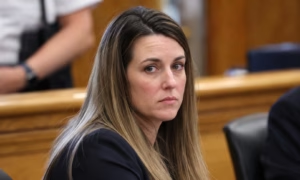
The Feeding Our Future Scandal

AIMEE BOCK, MINNESOTA FRAUDSTER
Unraveling Minnesota’s Largest Pandemic Fraud Scheme
By SyndicatedNews | SNN.BZ
In the shadowy underbelly of pandemic-era relief programs, where desperation met opportunity, one woman’s ambitious nonprofit became the epicenter of what federal prosecutors have called the nation’s biggest COVID-19 fraud case. Aimee Bock, a 45-year-old former educator and daycare worker from Minnesota, founded Feeding Our Future in 2016 with the stated goal of providing meals to underserved children.
But beneath the veneer of altruism lay a web of deceit that siphoned off nearly $250 million in taxpayer dollars—funds meant to feed hungry kids during a global crisis. Convicted in March 2025 after a gripping five-week trial, Bock now awaits sentencing, her story a cautionary tale of greed, betrayal, and systemic vulnerabilities that left Minnesotans reeling.
The Rise of Aimee Bock: From Humble Beginnings to Alleged Mastermind
Bock’s journey began innocently enough. With a background in education and child care, she positioned Feeding Our Future as a sponsor under the U.S. Department of Agriculture’s (USDA) Federal Child Nutrition Program. The nonprofit partnered with sites like restaurants and community centers to distribute meals, claiming to serve millions of children across Minnesota. During the COVID-19 pandemic, relaxed regulations—intended to speed aid to those in need—allowed for rapid expansion. Feeding Our Future’s reimbursements skyrocketed from modest pre-pandemic levels to hundreds of millions in federal funds.
Prosecutors painted Bock as the cunning architect of the scheme. According to court documents and trial testimony, she allegedly oversaw the submission of fraudulent claims for meals that were never served. Sites under her umbrella reported serving absurd numbers—tens of thousands of meals per day at single locations, far exceeding plausible capacities. Witnesses described how Bock enforced compliance, cutting off operators who balked at inflating numbers and wielding accusations of racism to deflect scrutiny from state regulators. In one chilling detail, internal emails revealed staff confronting Bock as the FBI closed in, with one employee warning her that “you’d be surprised who turned on you.”
Bock personally profited handsomely. She was accused of pocketing over $1 million through kickbacks, including a $310,000 bribe for enrolling a site into the program and funneling $900,000 to her then-boyfriend for dubious maintenance work on the nonprofit’s offices. Luxury items followed: a 2013 Porsche Panamera, designer clothes, jewelry, and electronics—all seized by authorities.
In December 2025, a federal judge ordered her to forfeit $5.2 million, including cash from her accounts and the value of her high-end possessions. Bock maintains her innocence, claiming in a jailhouse interview that she was scapegoated and that the program was simply overwhelmed, not fraudulent. “I wish I could go back and do things differently,” she told CBS News, her voice laced with regret amid the cold reality of her conviction on charges including wire fraud, conspiracy, and bribery.
Co-defendant Salim Said, a 36-year-old restaurant owner of Somali descent, was convicted alongside her on 20 counts, including money laundering. Said’s Safari Restaurant became a key hub, allegedly distributing phantom meals while laundering funds. The pair’s trial exposed a network of 78 defendants—mostly from Minnesota’s Somali community— with over 60 pleading guilty or convicted by late 2025.
The scheme’s scale was staggering: fake invoices, shell companies, and laundered money funneled into luxury cars, real estate, and overseas transfers. Prosecutors estimate the total loss at up to $300 million, making it a pivotal chapter in Minnesota’s broader fraud epidemic, which has seen billions vanish from welfare programs.
Tangential Ties: Ilhan Omar and the Political Ripple Effects
The scandal’s tendrils reached into Minnesota’s political sphere, drawing scrutiny to U.S. Rep. Ilhan Omar (D-Minn.), a prominent Somali-American congresswoman representing much of Minneapolis. Omar, known for her fiery advocacy on social justice issues, supported the 2020 MEALS Act—a bipartisan bill she co-sponsored to ease USDA rules during the pandemic, allowing more flexible meal distribution to combat child hunger. While the legislation helped feed millions nationwide, critics argue its loosened oversight created loopholes exploited by fraudsters like those in Feeding Our Future.
Omar has repeatedly condemned the fraud, calling it a “deep concern and disappointment” in a 2022 letter to Agriculture Secretary Tom Vilsack. She demanded accountability, urging investigations to prevent future misuse. However, her campaign received donations—totaling around $5,400—from individuals later charged in the scheme, including Abdihakim Ahmed and Ahmed Ghedi. Omar’s team stated the contributions were returned upon learning of the allegations, and she has not been accused of any wrongdoing. In December 2025, amid renewed national attention, Omar told reporters she has “absolutely no regrets” about the MEALS Act, emphasizing it “did help feed kids” despite the abuses.
Adding another layer of intrigue, Omar’s husband, Tim Mynett—a political consultant and venture capitalist—has faced separate fraud allegations unrelated to Feeding Our Future. Mynett’s firm, E Street Group, received nearly $3 million from Omar’s 2020 campaign for consulting services, a legal but ethically questioned arrangement cleared by the Federal Election Commission. More recently, a 2024 lawsuit accused Mynett and his partner of fraud in a California wine venture, eStCru, alleging they misused $3.5 million from an investor. The case was settled with a $1.7 million judgment against them, but no criminal charges ensued.
Mynett’s other business, Rose Lake Capital, saw its value surge to between $5 million and $25 million in 2024 disclosures, contributing to the couple’s reported net worth of up to $30 million—a dramatic rise from modest figures just years prior. This wealth explosion has prompted House Republicans to launch an investigation via the Oversight Committee, probing potential ties to Minnesota’s fraud scandals. Omar dismisses the scrutiny as politically motivated, stating in interviews that any fraud-terrorism links (amid claims some funds reached al-Shabaab in Somalia) represent a “failure of the FBI.” Mynett’s firm quietly removed team bios from its website in late 2025, fueling speculation, though no direct connection to the Feeding Our Future case has been established.
A Broader Crisis: Minnesota’s Fraud Epidemic and Lingering Questions
The Feeding Our Future debacle is part of a larger storm in Minnesota, where fraud in welfare, Medicaid, and child care programs may total $9 billion or more since the pandemic. Daycare scams, sham vendors, and money laundering have led to surges in federal agents and calls for denaturalization of convicted immigrants. President Donald Trump has seized on the scandals, targeting Minnesota’s Somali community and Omar in rhetoric calling the state a “garbage” hub of abuse.
Yet, amid the thriller-like twists—raids, bribes, and luxury seizures—the human cost is stark. Funds meant for vulnerable children vanished, leaving real hunger unaddressed. Bock’s conviction marks a victory for justice, but with appeals pending and more trials ahead, the full story remains unfolding. As one prosecutor noted, this was no victimless crime; it eroded trust in systems designed to protect the innocent.
In a state gripped by these revelations, the scandal serves as a riveting reminder: where power and money intersect, shadows often hide the truth.