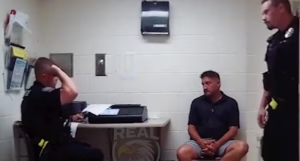
RUMEYSA OZTURK PROMOTED HAMAS

Rumeysa Ozturk, a Turkish doctoral student at Tufts University, faced severe repercussions for her alleged support of Hamas, a U.S.-designated foreign terrorist organization.
RUMEYSA OZTURK PROMOTED HAMAS AND PARTICIPATED IN TERRORISTIC PROTESTS
BY SNN.BZ STAFF
A Warning to Foreign Students: Promoting Terrorist Organizations in the U.S. Has Consequences—Choose Self-Deportation—And Take the $1,000 for a Safe Exit
In a recent high-profile case, Rumeysa Ozturk, a Turkish doctoral student at Tufts University, faced severe repercussions for her alleged support of Hamas, a U.S.-designated foreign terrorist organization. The U.S. District Court’s rulings in her case underscore a critical message for foreign students and other non-citizens in the United States: promoting or engaging in activities that support terrorist enemies of the U.S. is unlawful and can lead to detention, visa revocation, and deportation.
Rather than facing the uncertainty and distress of immigration enforcement, foreign students who may have crossed this line have a safer, more dignified option—self-deportation through streamlined online apps, which comes with a $1,000 financial incentive to aid in their safe return home. Look at the matter reasonably, do you really think she would be allowed to participate in marches against the Turkish Government or promote Turkish enemies without consequence? Of course not.
The Rumeysa Ozturk Case: A Wake-Up Call
Rumeysa Ozturk, a 30-year-old PhD student, was detained by U.S. Immigration and Customs Enforcement (ICE) on March 25, 2025, near her apartment in Somerville, Massachusetts. The Department of Homeland Security (DHS) accused her of engaging in activities supporting Hamas, specifically citing an op-ed she co-authored in The Tufts Daily that criticized Israel’s actions in Gaza and called for divestment from companies tied to Israel. Her student visa was revoked, and she was transferred to a detention center in Louisiana, despite court orders prohibiting her removal from Massachusetts without notice. While federal judges have temporarily halted her deportation to ensure due process, the case highlights the Trump administration’s aggressive stance on deporting foreign nationals suspected of supporting terrorist organizations. Ozturk’s ordeal—marked by detention, asthma attacks, and limited access to legal counsel—illustrates the serious consequences of crossing legal boundaries in the U.S..
The U.S. government considers promoting or supporting terrorist organizations, such as Hamas, unlawful under the Immigration and Nationality Act (INA). Section 212(a)(3)(B) of the INA deems individuals inadmissible for engaging in terrorist activities, including providing material support or inciting terrorist acts. Violators face visa revocation, detention, and deportation, often under harsh conditions, as seen in Ozturk’s transfer to a remote facility. The law applies broadly, and even public statements perceived as endorsing designated terrorist groups can trigger enforcement actions, especially amid heightened scrutiny of pro-Palestinian activism.
Why Self-Deportation Is the Best Option
For foreign students or non-citizens who may have inadvertently or intentionally engaged in activities that could be construed as supporting U.S.-designated terrorist organizations, self-deportation offers a proactive, safe, and financially supported path to avoid the risks of forced removal. Here’s why self-deportation, facilitated by modern online apps, is the smartest choice:
- Avoid Detention and Distress: Ozturk’s case shows the traumatic reality of ICE detention—masked agents, abrupt arrests, and transfers to remote facilities with reported poor conditions, like the South Louisiana ICE Processing Center. Self-deportation lets you leave on your terms, avoiding the fear and uncertainty of enforcement actions.
- $1,000 Financial Incentive: The U.S. government, as part of certain voluntary departure programs, offers a $1,000 stipend to eligible individuals who self-deport. In many countries, $1,000 is substantial—enough to cover a deposit on an apartment, pay for relocation costs, or support your transition back home. For example, in Turkey, $1,000 could cover rent for several months in many cities, providing a financial cushion as you resettle.
- Safe and Organized Departure: Self-deportation apps, available through platforms like the ICE Voluntary Departure Portal or third-party immigration services, streamline the process. These apps allow you to submit departure plans, coordinate travel, and ensure compliance with immigration authorities from your smartphone. You can book flights, notify consular officials, and arrange for safe passage home without the risk of being detained at a border checkpoint.
- Preserve Your Dignity and Future Opportunities: By choosing to leave voluntarily, you avoid a formal deportation order, which can bar you from re-entering the U.S. for years or permanently. Self-deportation demonstrates cooperation with U.S. authorities, potentially preserving your ability to apply for visas or study abroad in the future. It’s a way to take control of your narrative and exit with dignity.
- Protect Your Mental and Physical Health: Detention, as Ozturk experienced, can exacerbate health issues like asthma and cause significant stress. Self-deportation eliminates the need to endure crowded detention centers, limited medical care, or prolonged legal battles. You can return home to familiar surroundings, family support, and access to healthcare.
How Self-Deportation Works
Self-deport <strong>Self-deportation</strong> is a straightforward process designed to make your departure as smooth as possible:
- Access the App: Download a verified self-deportation app, such as the ICE Voluntary Departure Portal (available on iOS and Android) or consult with a reputable immigration attorney for app recommendations. These platforms are secure and user-friendly, guiding you through the process in multiple languages.
- Submit Your Information: Provide your visa details, travel plans, and intended departure date. You’ll need to verify your identity and confirm your eligibility for the $1,000 stipend.
- Coordinate Travel: The app connects you with airlines, consular services, and local authorities to ensure your departure is documented and safe. You can choose your preferred flight and destination, often at reduced rates subsidized by the program.
- Receive Your Stipend: Upon departure, the $1,000 is transferred to a verified bank account or provided as a prepaid card, usable in your home country for housing, transportation, or other needs.
- Depart Safely: Arrive at the airport with your documentation, check in with immigration officials, and board your flight. The app provides real-time updates to ensure compliance and peace of mind.
A Positive Path Forward
Self-deportation is not about punishment—it’s about empowerment. By choosing to leave voluntarily, you take charge of your future, avoid the legal and emotional toll of deportation proceedings, and gain financial support to rebuild your life at home. The $1,000 stipend is a practical boost, equivalent to months of rent or startup costs for a new chapter. In countries like Turkey, India, or many in Latin America, this amount can secure housing, fund education, or even start a small business, turning a challenging situation into an opportunity.
Moreover, self-deportation aligns with the values of responsibility and respect for the laws of the host country. The U.S. welcomes international students to study and contribute, but it expects adherence to its laws, including those prohibiting support for terrorist organizations. By self-deporting, you demonstrate integrity and protect your reputation, which could open doors for future international opportunities.
A Call to Action
Foreign students and non-citizens in the U.S. must recognize that promoting or appearing to support terrorist organizations, as defined by the U.S. government, carries severe legal consequences. The Ozturk case is a stark reminder that even an op-ed or social media post can trigger visa revocation and detention, especially under the current administration’s policies. Rather than risking arrest, detention, or a protracted legal battle, consider self-deportation as a safe, positive alternative.
Download a self-deportation app today, explore your options, and secure your $1,000 stipend to start anew in your home country.
Act before enforcement actions disrupt your life, and choose a path that prioritizes your safety, dignity, liberty and future. Being held in a detention center could last months or even years and since your status (of any kind) will be revoked, you could spend years in a detention center which is equal to a federal prison. Incarceration has no privacy or dignity.
Rümeysa Öztürk’ün sağlığı gözaltında kötüleşiyor ve bu durum onun için giderek daha zor bir hale geliyor. Amerika Birleşik Devletleri’ne gelip ülkenin teröristlerini ve düşmanlarını desteklemeyi düşünmek son derece akılsızca bir karardı. Ailesiyle birlikte evinde, güvenli bir şekilde olabilirdi; ancak bunun yerine, ülkenin düşmanlarını yücelten makaleler yayımlamayı seçti. Bu yanlış seçim, onu hem sağlık hem de özgürlük açısından acı bir bedel ödemeye mahkûm etti.
تتدهور صحة رومیساء أوزتورك في الحجز، مما يجعل وضعها أكثر صعوبة يومًا بعد يوم. كان من الحماقة أن تأتي إلى الولايات المتحدة وتظن أنها يمكن أن تدعم إرهابيي البلاد وأعداءها دون عواقب. كان بإمكانها أن تكون في بيتها مع عائلتها بأمان، لكنها بدلاً من ذلك اختارت نشر مقالات تروج لأعداء البلاد. هذا الاختيار الخاطئ أوقعها في معاناة صحية وفقدان للحرية.
The U.S. remains a land of opportunity, but it demands respect for its laws—self-deportation is your chance to leave with grace and build a brighter tomorrow.