Noel Clarke Faces Criminal Charges
By SyndicatedNews UK | SNN.BZ
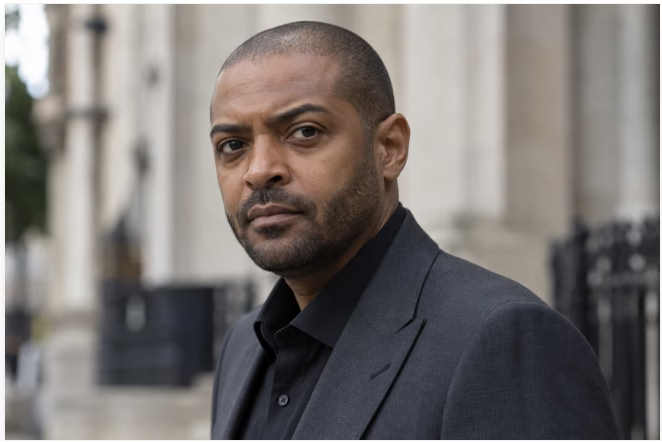
British actor, writer and filmmaker Noel Clarke has been charged with six sexual offences involving five women, opening a new criminal chapter in a controversy that previously produced one of Britain’s most detailed recent libel judgments. The Crown Prosecution Service announced the charges on September 9, 2026: two counts of sexual assault, three counts of voyeurism and one count of exposure. The alleged offences date from 2007 through 2016. Clarke, 50, is due to appear at Westminster Magistrates’ Court on October 21. He has not been convicted of these charges, and the criminal allegations remain to be proved in court.
The criminal prosecution follows years of litigation over accusations first reported publicly in 2021. Clarke sued Guardian News and Media Ltd for libel over seven articles and a podcast reporting accusations of sexual misconduct and professional abuse. That litigation resulted in a six-week High Court trial before Mrs Justice Steyn in March and April 2025 and a remarkable 224-page judgment handed down on August 22, 2025. Clarke lost the case. The court held that the Guardian had established its defense of substantial truth, while also finding that publication was protected by the public-interest defense.
The judgment goes substantially further than merely recording that Clarke lost. Mrs Justice Steyn reviewed individual accusations and made factual findings after hearing witnesses and examining documentary evidence. In paragraphs 855 through 859, the judge addressed the Guardian article’s characterization of Clarke as a “serial abuser of women.” She concluded that the evidence established instances of harassment, bullying, unwanted sexual contact, sexually inappropriate conduct, professional misconduct and the non-consensual taking or sharing of explicit material. The judge ultimately found the Guardian had produced more than sufficient evidence to establish that the central meaning of its first article was substantially true.
Among the findings were cases of unwanted kissing, touching or groping involving several women identified either by name or pseudonym in the judgment. The court also found sexually inappropriate conduct or comments involving numerous women over a lengthy period. In another detailed section, the judge accepted evidence from a woman referred to as “Maya” that Clarke chased her around a table, grabbed her from behind and kissed her neck. The court also found that he pressured her to remove her underwear while filming a scene and rejected portions of Clarke’s evidence about those events as untruthful.
The judgment also examined accusations involving cameras, photographs and explicit footage. Mrs Justice Steyn found that Clarke had covertly filmed two women identified in the judgment as Johannah Whyte and “Florence,” showed covert footage to another woman, showed or shared explicit photographs, and showed explicit photographs of fans to another witness. The judge wrote that these acts occurred, or could reasonably be inferred to have occurred, without consent. Those findings formed part of the evidence supporting the Guardian’s truth defense.
Importantly, the judge did not accept every accusation presented to the court. In one example involving actress Jing Lusi, Mrs Justice Steyn accepted much of Lusi’s account, including that Clarke propositioned her and persisted with graphic sexual descriptions after being rejected, but the judge was not satisfied that Clarke threatened her career. In another portion involving “Maya,” the court found that the Guardian had failed to establish one particular allegation concerning Clarke’s conduct during the actual filming of a sex scene. The distinctions matter: the judgment is not a blanket acceptance of every allegation but a lengthy allegation-by-allegation assessment.
Clarke also challenged the Guardian’s journalism itself. That argument failed. The court examined how editor-in-chief Katharine Viner and other editors considered whether publication was justified. Evidence showed that the Guardian held editorial and legal discussions, assessed Clarke’s responses and the credibility of sources, reviewed public-interest memoranda and obtained legal advice before publishing. Mrs Justice Steyn found that Viner genuinely believed publication was in the public interest and held that the articles concerned legitimate questions about workplace power, treatment of women in the film industry and the industry’s ability to protect employees.
The distinction between that civil judgment and the 2026 criminal case is critical. The High Court proceedings determined whether the Guardian could legally defend what it published; they were not a criminal trial and did not convict Clarke of sexual offences. The new prosecution must now be determined under criminal-law standards, with Clarke entitled to the presumption of innocence. The CPS has specifically warned that proceedings are active and that publication or commentary must not prejudice his right to a fair trial. For publishers, that means the extensive 2025 judgment may be reported as established findings of the civil court, while the six newly filed criminal charges must continue to be described strictly as allegations unless and until a criminal court determines otherwise.
Primary documents for SNN.BZ readers: 224-page High Court judgment — [2025] EWHC 2193 (KB) · Official court judgment page · Official court press summary · 2025 Court of Appeal judgment — EWCA Civ 164 · CPS announcement of criminal charges · Metropolitan Police charge announcement