NO JAIL OR DUI RECORD FOR DRUNK COPS
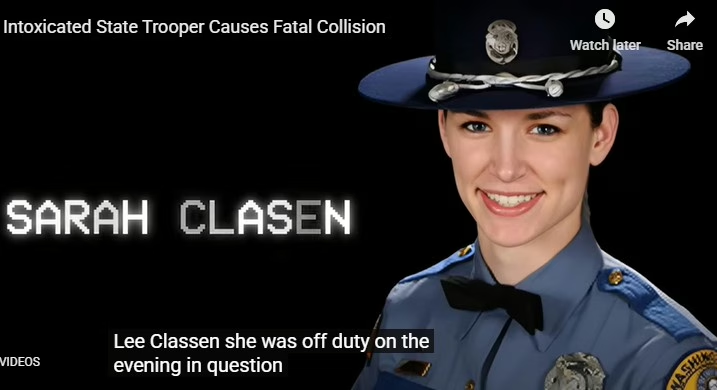
DRUNK TROOPER IS NOT CHARGED
By SyndicatedNews | SNN.BZ
The “Swerve and Protect” exposé on Florida’s lenient handling of off-duty police DUIs isn’t an isolated tale—it’s part of a nationwide pattern where officers caught drunk behind the wheel often dodge the full weight of justice that crushes civilians.
From evaded arrests to slap-on-the-wrist suspensions, these cases erode public trust and highlight systemic favoritism. Drawing from investigative reports, academic studies, and recent headlines, here are five striking examples of similar scandals across the U.S., where badges shielded officers from accountability.
New York’s “No-Arrest” Culture: State Police Crash, Colleagues Cover
In a 2021 Orchard Park incident, off-duty New York State Police investigator Ronald W. Wilson slammed into another car after a night of drinking, leaving the scene reeking of booze with glassy eyes. Responding officers—spotting his badge—chose “no arrests,” opting for an internal probe instead of criminal charges. Wilson got a 10-day suspension and kept his job. This mirrors a broader trend: A trove of over 10,000 disciplinary files from half of New York’s agencies revealed officers crashing squad cars, hitting pedestrians, and showing up to shifts intoxicated—yet rarely facing DWI prosecution. Experts like criminology professor Geoffrey P. Alpert slam it as unequal justice: “If you’re suspected of a crime, you should be treated like everyone else.”
Georgia’s Revolving Door: 290 DUIs, Only 30 Revocations
Over five years, Georgia saw 290 certified officers arrested for DUI, but the Peace Officer Standards and Training Council revoked just 30 certifications—leaving most to patrol with a warning. In Atlanta, arrested officers get “administrative duty with pay” during probes, no squad car access, but often return unscathed. One study of national police arrests found “professional courtesy” rampant: Colleagues frequently wave off arrests, and even convicted officers rarely lose jobs. For civilians? License suspensions, job loss, and sky-high fines.
Ohio’s On-Duty Outrage: Responding While Hammered
In September 2025, Walbridge Police Officer David Ervin answered a 911 call—while blackout drunk in his cruiser. Dispatchers rerouted help after his slurred speech raised alarms; a breath test clocked him at 0.168% BAC—twice the limit. He was fired, but only after endangering responders. A Bowling Green State University analysis of 780 police DUI arrests nationwide showed 13.6% happened on-duty, often in take-home vehicles, with hit-and-runs and evasions common—yet convictions were the exception.
Tennessee’s Repeat Offender: Sober Arrests, Cop Cover-Ups
Nashville-area Officer Jonathan Werner made headlines in 2024 for arresting a sober driver for DUI—his third such botched bust in a year, per WSMV4’s probe. One victim, bodycam footage in hand, sued after being cuffed despite blowing zeros. While not a direct DUI scandal, it underscores the flip side: Officers skirt their own violations while falsely nailing innocents. Middle Tennessee departments dismissed multiple “sober DUIs” in 2023, fueling cries for oversight.
National “Blue Wall”: From Crashes to Cover-Ups
A landmark study of U.S. police DUIs (2005–2010) uncovered 780 arrests, including 106 on-duty, with officers 2.5 times more likely to crash impaired than civilians. In Buffalo, the “blue line” explicitly protected off-duty cops from arrests, per 2012 reporting. Even high-profile cases, like West Virginia coach Bob Huggins’ 2023 Pittsburgh DUI (while not a cop, it spotlighted elite leniency), echo the theme. Firearm bans loom for felonies, but misdemeanors? Often just counseling and a demotion—if that.
These scandals, fueled by “professional courtesy” and lax internal probes, reveal a double standard: Officers enforce DUI laws by day but evade them by night. As in Florida, reform calls grow louder—from mandatory criminal referrals to civilian oversight. Until then, the blue wall stands tall, but cracks are showing.