Karmelo Anthony Denied New Trial: Parents Now Talking
By SyndicatedNews Legal Eagle | SNN.BZ
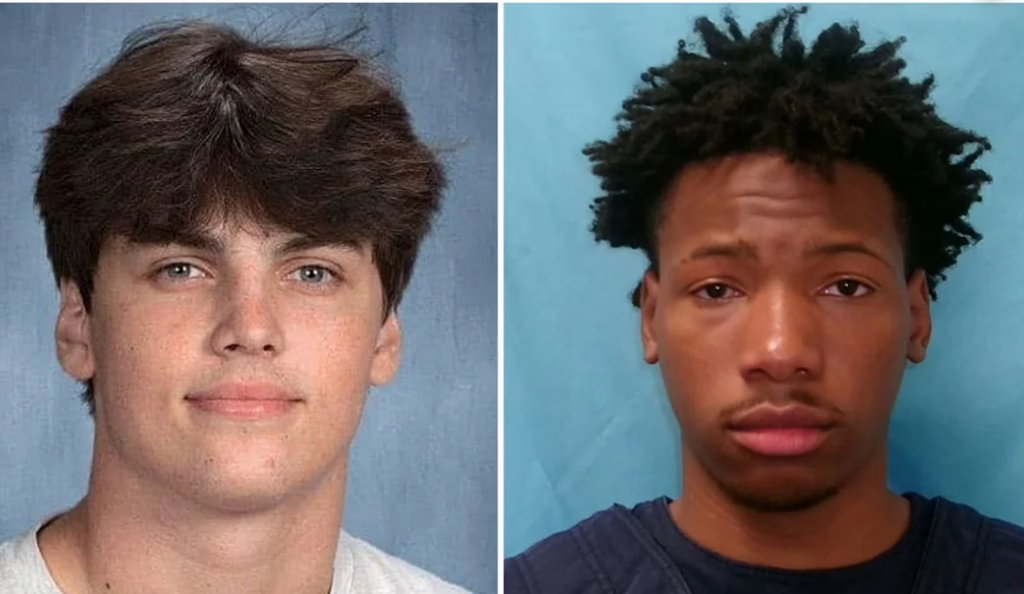
One of the most consequential revelations following Karmelo Anthony’s conviction concerns evidence the jury never heard. During the August 2026 proceedings on Anthony’s request for a new trial, attorneys publicly discussed an informal understanding—repeatedly described as a “gentlemen’s agreement”—under which prosecutors and defense lawyers sought to keep potentially inflammatory character evidence concerning both Anthony and Austin Metcalf out of the murder trial.
The apparent objective was straightforward: try the case on what happened beneath the track-team tent rather than turn the courtroom into a trial of everything either teenager had previously done.
The agreement benefited both sides. Prosecutors possessed a substantial collection of material concerning Anthony’s disciplinary history, cellphone communications and alleged behavior before the stabbing. At the new-trial hearing, prosecutors presented previously excluded evidence that included school disciplinary records and disturbing communications involving violence and weapons.
Some allegations involved Anthony’s conduct toward a former girlfriend. Other material reportedly included violent statements involving guns, knives and stabbing. None of that was evidence the murder jury had been asked to consider when deciding whether Anthony acted in self-defense.
The defense, however, possessed damaging information concerning Metcalf as well. Evidence disclosed during the post-trial proceedings included a juvenile graffiti incident involving Austin and his twin brother, Hunter, and racist and antisemitic material.
Reports from the hearing say the brothers received 12 months of juvenile probation in connection with the incident. Additional allegations concerning Metcalf’s behavior were also among the character material the defense did not introduce at Anthony’s murder trial.
That means fairness requires telling readers about both sets of excluded evidence. Anthony’s disturbing communications cannot properly be presented as though prosecutors alone possessed a secret history that might have changed the trial.
Likewise, Metcalf’s juvenile misconduct cannot properly be presented as proof that he deserved what happened to him or necessarily initiated the fatal confrontation. Neither conclusion follows. Prior misconduct is not automatic proof of what somebody did during a later encounter.
The excluded evidence nevertheless matters enormously because Anthony claimed self-defense. The jury had to decide who escalated the confrontation and whether Anthony reasonably believed deadly force was necessary. Character and prior-act evidence is subject to important evidentiary restrictions precisely because jurors might use it improperly—deciding that someone acted a certain way on one occasion simply because he behaved badly on another.
The arrangement also became intertwined with Anthony’s decision not to testify. Former trial attorney Toby Shook testified that the defense expected the agreement to permit Anthony to explain his self-defense claim without opening the door to damaging character evidence. Shook described Anthony’s testimony as potentially crucial because Anthony himself was the person capable of explaining what he believed was happening immediately before he used the knife.
But the defense became concerned that the understanding was unraveling and that putting Anthony on the witness stand could expose him to the very evidence the agreement had been designed to exclude. Anthony ultimately did not testify.
The trial record shows that he personally told the judge he did not want to take the stand after having an opportunity to consult his lawyers and family. Thus, the issue is more complicated than saying Anthony was simply prohibited from testifying: his lawyers argue that the circumstances surrounding the disputed agreement materially affected that decision.
The irony is difficult to miss. An arrangement apparently intended to produce a cleaner and more focused murder trial ultimately became one of the principal arguments for throwing out its result. Anthony’s new lawyers argued that the breakdown of the agreement affected their client’s ability to present his self-defense case effectively.
Prosecutors maintained that Anthony received a fair trial and that the jury properly decided the case from the admissible evidence concerning the killing itself.
Judge Michael Chitty ultimately rejected Anthony’s request for another trial. That does not make the newly disclosed information disappear. It means that, at least at this stage, the court was not persuaded that the arguments concerning the agreement and other alleged errors justified vacating the murder conviction. Anthony’s lawyers intend to continue pursuing appellate remedies.
For the public, there is a valuable distinction to maintain. The jury convicted Karmelo Anthony without hearing the damaging background material concerning either young man. Readers learning that material now possess information the jurors deliberately did not have. It may alter how individuals perceive Anthony or Metcalf, but it should not be retroactively described as evidence upon which the jury based its verdict.
That distinction also protects Austin Metcalf from an equally unfair conclusion. His involvement in racist or antisemitic misconduct does not mean that killing him was justified. Conversely, excluding Anthony’s disturbing prior statements and alleged conduct does not make them nonexistent. Both young men’s histories can be reported accurately without pretending either history independently answers the legal question of what happened beneath that tent.
In fact, the disclosure gives the public a clearer understanding of why experienced attorneys wanted the backgrounds excluded in the first place. Had everything been admitted, the trial risked becoming a referendum on which teenager was the worse person rather than whether the prosecution proved murder beyond a reasonable doubt and disproved Anthony’s claim of self-defense under Texas law.
That is why the evidence deliberately withheld from the jury now belongs prominently in any comprehensive account of the Karmelo Anthony case—but with a warning attached. The public can now know what the jury did not know, but it should also understand why the law did not necessarily entitle that jury to hear it.
The extraordinary post-trial disclosure tells us considerably more about both young men. Whether any of it should have changed the verdict is a separate legal question, and one Anthony’s appellate lawyers are likely to continue asking.