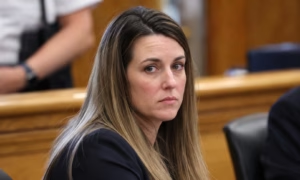
Judge Burroughs: Stay in Your Lane
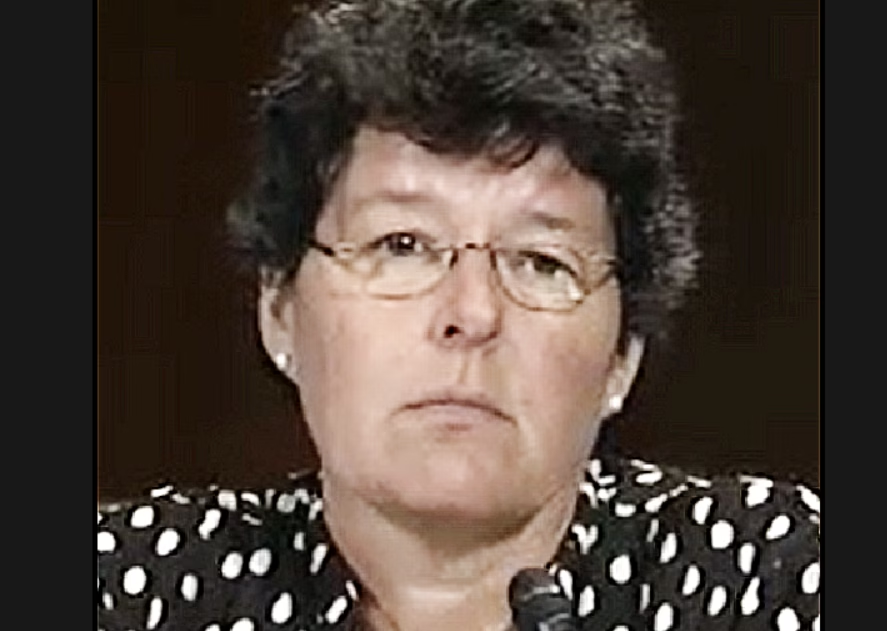
Congressional Resolution Already Introduced but There comes a point when Americans are entitled to ask a very simple question of the federal judiciary:
By SyndicatedNews Legal Eagle | SNN.BZ
Where does judging end and governing begin? U.S. District Judge Allison Dale Burroughs stepped directly into that controversy when she temporarily prevented the Department of Homeland Security from terminating Temporary Protected Status for Somalia.
Whatever one’s personal feelings about immigration, Somalia or President Trump’s policies, federal judges are appointed to decide cases under the law—not to become a substitute Department of Homeland Security or to substitute President Trump’s wishes when she doesn’t like his rulings.
The Constitution deliberately divided the federal government’s powers. Congress writes immigration laws. The executive branch administers and enforces them. Courts determine whether government officials have acted within the law and Constitution. Those checks are indispensable, particularly when an administration exceeds its authority. But judicial review does not confer an unlimited license to manage immigration policy from the bench. When the Supreme Court has spoken about the limits of judicial review, lower federal courts must take that direction seriously.
Burroughs initially blocked the administration’s termination of Somalia’s Temporary Protected Status in March. After the Supreme Court subsequently curtailed judicial review of DHS efforts to terminate TPS designations, Burroughs continued the temporary block while considering whether the challengers could proceed under theories the Supreme Court had not addressed. On August 14, however, she lifted the block and cleared the way for DHS to terminate Somalia’s TPS designation. That subsequent ruling matters and should be acknowledged fairly.
But the larger controversy does not disappear merely because the ultimate order went the administration’s way. Americans should be able to debate whether lower federal courts have become too willing to place nationwide or consequential restraints on executive policies while litigation proceeds. Judges have an enormously important job, but importance is not the same thing as supremacy. The robe does not transform one federal judge into an immigration secretary, legislator or president.
Temporary Protected Status also deserves to be described accurately. TPS is a humanitarian immigration protection created by federal law for eligible nationals of countries experiencing specified dangerous conditions. Ending Somalia’s TPS designation does not mean that every Somali living in America is automatically deported, nor does it mean that Somali Americans who are U.S. citizens somehow become removable. It means that people whose legal protection depends upon that particular TPS designation may lose that protection and could become subject to immigration enforcement unless they possess some other lawful basis to remain.
That distinction actually strengthens the argument for judicial restraint. Immigration cases involve real human beings and serious consequences, which is precisely why decisions should be governed by law rather than political emotion—from either side. Courts should protect constitutional rights vigorously when those rights are genuinely threatened. But courts must exercise equal discipline in recognizing powers that Congress has assigned to exeutive officials. A judge’s personal assessment of whether an immigration policy is wise, compassionate or popular cannot replace the statutory judgment entrusted to another branch.
Judge Burroughs ultimately recognized the changed legal landscape and lifted her order. She deserves to have that fact included in any fair account of this controversy. At the same time, Congress has every right to scrutinize the conduct of federal judges, just as courts scrutinize presidents and Congress scrutinizes executive agencies. The separation of powers works in every direction. No president is above the law, no Congress is above the Constitution—and no federal judge is beyond legitimate criticism or constitutional oversight.