Jonathan Rinderknecht of Melbourne, Florida charged with Lachman Fire in California arson that Killed 12 and destroyed 6,800 homes and buildings

CALIFORNIA ARSONIST IS FROM MELBOURNE, FLORIDA
By SyndicatedNews at SNN.BZ
In the velvet hush of a New Year’s midnight, when champagne flutes should clink and resolutions whisper promises, Jonathan Rinderknecht chose chaos. A 29-year-old Uber driver, adrift in the glow of his iPhone screen, hiked into the skeletal embrace of Pacific Palisades’ Skull Rock Trailhead. There, fueled by an “agitated and angry” haze from a night of ferrying strangers and looping a French rap track whose video glorified arson’s pyre, he struck a match—or whatever devilish spark his malice conjured. What began as the innocuous Lachman Fire, a mere eight-acre whisper quickly smothered by firefighters, slithered underground like a serpent in the roots. It waited. It hungered. On January 7, 2025, gale-force winds tore it free, birthing the Palisades Fire—a ravenous beast that devoured 23,448 acres, claimed 12 irreplaceable lives, and reduced over 6,800 homes and structures to ash-smeared ghosts. More than 1,000 others bear the scars of its fury.
Rinderknecht didn’t just light a fire; he unleashed Armageddon on a coastal Eden of multimillion-dollar estates and humble bungalows alike. Celebrities like Mel Gibson and Paris Hilton watched their fortresses crumble, but it was the everyday souls—the mentors, the surfers, the child actors chasing faded dreams—who paid the ultimate price. These weren’t statistics; they were flesh and fire, their final moments etched in the acrid smoke of one man’s unhinged whim. Let their names echo as a dirge: Mark Shterenberg, 80, the trailblazer who likely perished first, his body a silent sentinel in the blaze’s cradle; Betty O’Meara, 94, a steadfast elder who refused to flee her lifelong haven; Annette Rossilli, 85, the unyielding matriarch who clung to her Pacific Palisades nest; Jeffrey Takeyama, 69, whose quiet dignity ended in flames; Rory Sykes, 32, the former child actor from “Kiddy Kapers,” blind and battling cerebral palsy, yet defiant in his Malibu estate; Elizabeth Morgan, 79, found in the ruins of Aloha Drive; Diana Webb, 82, a victim of the inferno’s indiscriminate rage; Victor Shaw, 66, discovered clutching a garden hose like a talisman against the apocalypse; Paul Simoneau, the hang-glider whose wings of freedom couldn’t outrun the heat; the anonymous surfer, waves his eternal playground now traded for an ocean of embers; the unnamed mentor, dispenser of “old-timey family values” to wayward youths; and the unidentified woman, co-founder of Malibu’s cherished cinema, her silver screen dreams silenced forever.
Twelve names. Twelve voids. Over 6,800 structures obliterated—mansions turned to matchsticks, family albums to cinders, lifetimes of labor erased in a whoosh of wind-whipped wrath. Rinderknecht fled that night, dialing 911 in futile bursts of feigned remorse, only to slink back later to film the conflagration like a twisted tourist. Cell towers pinned him there, his digital breadcrumbs a trail of torment: obsessive streams of fire-laced music videos, a ChatGPT fever dream from July 2024 conjuring a “dystopian painting” of fleeing crowds amid a burning forest—a prophetic sketch of the hell he would author.
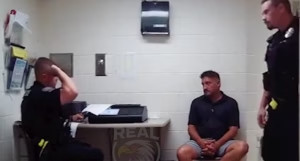
Fast-forward to October 7, 2025: Florida’s sun-kissed sprawl shatters under federal cuffs. Rinderknecht, now a Melbourne ghost, faces the gavel in California’s Central District Court. The charge? Destruction of property by means of fire—a felony arson rap that mandates at least five years in the federal pen, with a ceiling of 20. But here’s the gut-punch that should curdle the blood of every would-be firebug nursing grudges in the dark: federal arson has no statute of limitations. None. Zip. Zilch. That spark you tossed into the brush on a lark? It doesn’t fade with time. Investigators, armed with tireless algorithms and tireless grudges of their own, can resurrect it decades later. Rinderknecht’s folly simmered for nine months before erupting into handcuffs—proof that justice doesn’t sleep; it smolders.
Think you’re clever, hiding behind alibis and almanacs? Arson isn’t some petty misdemeanor that dissolves after a few calendar flips. Under 18 U.S.C. § 844(f), when it scorches federal land—like the Mountains Recreation and Conservation Authority’s trails where Rinderknecht played Prometheus—prosecutors have eternity to hunt you. No five-year clock ticking down like a bad bet; no decade-long amnesty for the forgetful felon. Your DNA on a singed twig, a pixelated photo from your burner phone, a witness’s hazy recollection sharpened by time’s cruel clarity—they all endure. Rinderknecht’s ChatGPT hallucination? A smoking gun from half a year prior, now Exhibit A in the gallery of gotcha. In California, where wildfires aren’t acts of God but invitations to human hubris, state laws echo this ruthlessness: no limitations for willful fire-starting that claims lives or ravages public domain.
This isn’t hyperbole; it’s harbinger. Rinderknecht, once a Pacific Palisades native peddling rides for pennies, now embodies the arsonist’s archetype: the isolated everyman, marinated in digital despair, whose one reckless glow-up birthed biblical devastation. His passengers glimpsed the storm brewing—agitation bubbling like gasoline on a pilot light—yet society shuttled on, oblivious. We all did. Until the winds howled, and the reaper reaped.
So, to the disgruntled dreamer eyeing the treeline, the heartbroken hiker with a lighter in pocket, the rage-fueled road warrior: pause. That fleeting catharsis? It’s a lifetime lease on regret. Arson’s statute isn’t measured in months or years—it’s infinite, a shadow that lengthens with every gust. Jonathan Rinderknecht’s legacy isn’t freedom in Florida; it’s a federal cellblock, a federal charge that whispers: you can run, but the fire remembers. Heed the pyre of Palisades. Twelve souls demand it. Over 6,800 ruins enforce it. And the law? It burns eternal.