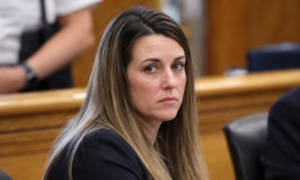
HOMELAND SECURITY VS. MAYOR OF LA

TOM HOMAN DIRECTOR OF HOMELAND SECURITY'S POWER FAR OUTWEIGHGS KAREN BASS'S MAYORAL POWER.
“Many believe that getting caught partying at an African wedding while California burned is just one of several humiliating scandals pushing Karen Bass into these desperate and pathetically theatrical displays of power.”
BY SNN.BZ STAFF
LA Mayor Karen Bass vs. Homeland Security’s Tom Homan’s Authority
The election of Karen Bass as Mayor of Los Angeles in 2022 was a significant moment for the city, marking her as the first woman and second Black mayor in its history. However, despite her prominent role and vocal opposition to federal immigration raids, the mayor’s authority is totally limited when confronting federal powers, particularly those wielded by the Director of Homeland Security, currently Tom Homan under the Trump administration.
Bass’s mayoral position holds no authority over federal immigration enforcement and how Homan’s role as Director of Homeland Security grants him far greater authority in his position.
The Limited Scope of Mayoral Power
As mayor, Karen Bass oversees local governance, including city budgets, public safety, and municipal services. Her authority is rooted in California’s state constitution and Los Angeles’ city charter, which grant the mayor executive power over city departments like the Los Angeles Police Department (LAPD) and influence over local policies, such as the city’s sanctuary ordinance.
This ordinance, codified in December 2024 as Los Angeles Administrative Code Section 19.190, prohibits city resources, personnel, or property from being used for federal immigration enforcement, a policy reinforced by Bass’s Executive Directive No. 12 in July 2025.
However, these local powers do not extend to overriding federal authority. The U.S. Constitution’s Supremacy Clause (Article VI, Clause 2) establishes that federal law supersedes conflicting state or local laws. Immigration enforcement falls under federal jurisdiction, managed by agencies like U.S.
Immigration and Customs Enforcement (ICE) and Customs and Border Protection (CBP), both overseen by the Department of Homeland Security (DHS). Bass’s actions, such as signing executive directives or joining lawsuits against federal raids, are symbolic and protective at the local level but cannot legally halt federal operations.
For instance, her confrontation with Border Patrol agents at MacArthur Park on July 7, 2025, led to a temporary withdrawal of agents after she demanded their departure, but this was a fleeting victory with no lasting impact on federal policy.
Bass’s sanctuary city policies, including LAPD’s Special Order 40, which prohibits officers from initiating action solely to determine immigration status, can limit local cooperation with ICE. However, cities are not required to assist federal agents but cannot obstruct them either.
Legal experts, like UC Berkeley Law Dean Erwin Chemerinsky, note that while cities can refuse to share information or assist ICE, they cannot prevent federal agents from conducting raids.
Bass’s efforts, such as filing Freedom of Information Act (FOIA) requests for raid details or joining ACLU lawsuits alleging unconstitutional practices, are attempts to challenge federal actions indirectly, but they lack the power to stop them outright.
Tom Homan’s Authority as DHS Director
In contrast, Tom Homan, as the Director of Homeland Security (often referred to as the “border czar” in media), holds significant federal authority. The DHS, established post-9/11, oversees ICE, CBP, and other agencies responsible for immigration enforcement, border security, and national security.
Homan’s role grants him the ability to direct large-scale operations, such as the immigration raids in Los Angeles that began in June 2025, targeting areas like MacArthur Park and Ventura County.
Homan’s power stems from federal statutes, including the Immigration and Nationality Act, which authorizes DHS to enforce immigration laws, conduct deportations, and detain individuals suspected of immigration violations.
The Trump administration’s 2024 campaign promise of mass deportations has translated into aggressive enforcement actions, with Homan overseeing operations involving thousands of federal agents and National Guard troops.
His authority was underscored by Border Patrol Chief Gregory Bovino’s response to Bass’s demands at MacArthur Park: “I don’t work for Karen Bass… We’re going to be here until that mission is accomplished.”
The federal government’s ability to federalize the National Guard, as seen in Los Angeles in June 2025, further amplifies Homan’s reach. President Trump’s use of a rarely invoked federal law to deploy troops without Governor Gavin Newsom’s consent highlights the federal government’s supremacy over local and state objections. Homan’s operations are backed by significant resources, with estimates suggesting a $315 billion one-time cost for mass deportations, far beyond the budgetary scope of any municipal government.
The Power Disparity in Action
The clash at MacArthur Park on July 7, 2025, exemplifies this power imbalance. Bass’s presence and demand for agents to leave resulted in a temporary retreat, but no arrests were halted, and federal operations continued unabated. The Trump administration’s lawsuit against Los Angeles, filed on June 30, 2025, accused the city’s sanctuary policies of obstructing federal immigration enforcement, further illustrating the federal government’s legal dominance. While Bass joined a counter-lawsuit with the ACLU, alleging unconstitutional arrests and racial profiling, the legal outcome remains uncertain, and federal raids have persisted.
Homan’s public statements, such as those reported by Politico, emphasize targeting “drug traffickers, MS-13 gang members, convicted rapists,” though Bass and others argue the raids disproportionately affect non-criminal immigrants, sowing fear in communities. Regardless of the moral or political debate, Homan’s authority to deploy federal resources, including armored vehicles and National Guard troops, far outweighs Bass’s ability to resist through local ordinances or public protests.
Political and Practical Implications
Bass’s opposition, while resonating with Los Angeles’ immigrant communities and progressive base, has drawn criticism from conservative voices. Social media posts on X, for instance, accuse her of prioritizing “illegal immigrants” over taxpayers, reflecting a broader political divide. Her actions, such as offering cash assistance to affected families, aim to mitigate the raids’ economic impact but do not alter the federal government’s legal right to operate.
Conversely, Homan’s role positions him as a key executor of a national policy, with the full backing of the Trump administration. His ability to mobilize federal agents and military resources, as seen in the deployment of Marines and National Guard troops, underscores a structural advantage that no mayor can counter. Even Bass’s legal efforts, supported by California’s 10th Amendment arguments, face significant hurdles, as federal courts have historically upheld federal supremacy in immigration matters.
While Karen Bass’s election as mayor symbolizes local leadership and advocacy for Los Angeles’ diverse communities, her authority is dwarfed by the federal powers wielded by Tom Homan as Director of Homeland Security. The Supremacy Clause, combined with DHS’s vast resources and legal mandate, ensures that federal immigration enforcement can proceed despite local resistance.
Bass’s efforts to protect illegal aliens through sanctuary policies, lawsuits, and public confrontations are commendable but limited to moral and symbolic gestures. In the face of federal raids, her mayoral power lacks the legal or practical weight to challenge Homan’s directives, highlighting a stark dispar ity between local and federal authority in the realm of immigration enforcement.