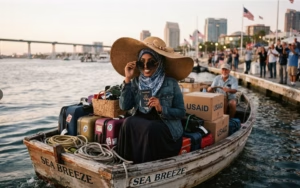
Harry and Meghan: Assessing The Damage They’ve Done To The British Monarchy and to the US State Dept
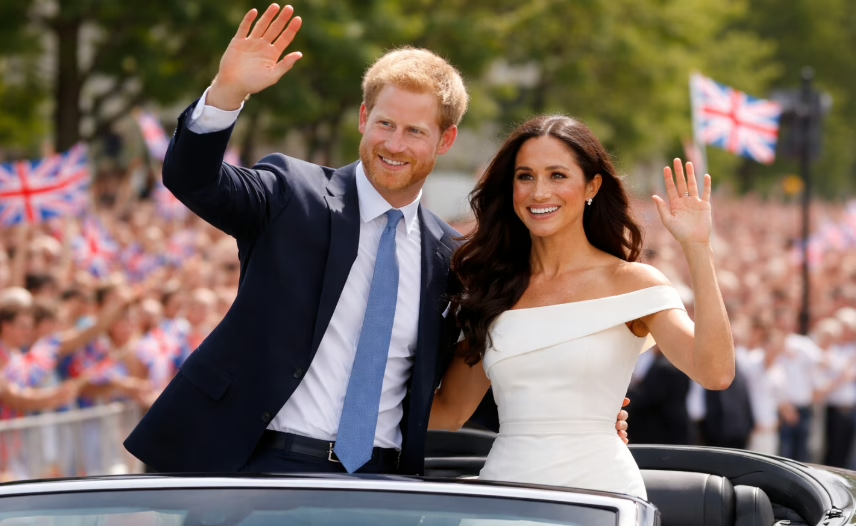
THE FAKE ROYALS
Despite being unsponsored and uninvited, the couple have visited Mexico, Colombia, Nigeria, Jordan and now Australia. Harry does not represent the United Kingdom and Meghan certainly does not represent the United States.
BY LADY ARGLWYDDES AWBREY
Impact on the British Monarchy and the United States
In recent years, Prince Harry and Meghan Markle have undertaken a series of high-profile international visits—to countries such as Mexico, Colombia, Nigeria, Jordan, and Australia—without formal sponsorship or diplomatic mandate. While framed as humanitarian or advocacy-driven engagements, these trips often resemble quasi-royal tours, complete with media coverage, meetings with local figures, and speeches on global issues like mental health and international cooperation.
A Historical Parallel: Edward VIII and Wallis Simpson visiting nazis in Germany

The challenge is not that private individuals travel or advocate—it’s that their royal titles and global recognition create ambiguity. Audiences, particularly abroad, may reasonably assume they are acting on behalf of either the British monarchy or even, by extension, Western political interests. In reality, they represent neither officially.
For the monarchy, the issue is one of brand integrity and constitutional neutrality. The royal family operates under strict conventions: senior working royals represent the state, avoid political commentary, and act only with government alignment. And the United States never elected or chose Meghan Markle as an Ambassador.
When Harry and Meghan speak on international relations or social policy without that framework, it risks:
- Diluting the monarchy’s neutrality: Their statements can be misinterpreted as reflecting royal positions.
- Creating diplomatic awkwardness: Host nations may treat these visits as semi-official, leading to confusion or tension.
- Undermining hierarchy and protocol: Official royal tours are carefully coordinated; unsanctioned ones disrupt that clarity.
This tension echoes earlier royal crises, particularly the legacy of Edward VIII.
After his abdication in 1936, Edward—later known as the Duke of Windsor—traveled internationally with Wallis Simpson, his American wife Wallis Simpson. Like Harry and Meghan, they occupied an ambiguous space: globally, socially influential, but constitutionally irrelevant.
Their travels, including controversial visits such as their 1937 trip to Nazi Germany, drew criticism for:
- Acting without official authority while leveraging royal status
- Engaging in politically sensitive environments
- Generating headlines that reflected back on Britain despite no formal role
The key similarity lies in perception versus reality. Both couples operated as high-profile figures whose presence carried symbolic weight far beyond their station and reality.
Implications for the United States
While Harry is British, Meghan’s American identity introduces another layer. When the couple speaks on global issues—especially topics like governance, public health, or social justice—they can be perceived as informal ambassadors of American values.
This creates several concerns:
- Unaccountable representation: They are not elected officials, diplomats, or policy experts.
- Policy ambiguity: Their statements may conflict with official U.S. positions or priorities.
- Soft power distortion: Influence without accountability can complicate how U.S. perspectives are interpreted abroad.
In essence, they operate in a space where celebrity intersects with geopolitics—without the guardrails typically required in that arena.
Expertise and Authority
Another criticism often raised is the gap between the subjects they address—such as mental health systems or international relations—and their formal training. While advocacy does not require academic credentials, sustained engagement on complex global issues typically benefits from deep expertise or institutional backing.
Without that, there is a risk of:
- Oversimplifying nuanced issues
- Promoting generalized solutions across vastly different cultural contexts
- Centering personality over substance
Symbolism, Celebrity, and Consequence
Ultimately, the comparison to Edward VIII is less about identical actions and more about structural similarity:
- Both couples leveraged global fascination with royalty
- Both operated outside official systems while still benefiting from royal association
- Both created diplomatic and reputational ripple effects for their home countries
The modern twist is the amplification effect of media and digital platforms. Where Edward and Wallis generated newspaper headlines, Harry and Meghan command instantaneous global attention.
Conclusion
The core issue is not travel or advocacy—it is ambiguity. When globally recognized figures with royal ties engage internationally without formal roles, they occupy a gray zone that can blur diplomacy, celebrity, and influence.
History shows, through figures like Edward VIII, that this ambiguity can carry lasting consequences. Whether the current situation reaches that level remains to be seen, but the parallels are strong enough to warrant serious reflection on the boundaries between private initiative and public symbolism.