Federal Law Not Optional: It’s The Law

Crowdfunding a Criminal Defense Needs Rules – it’s too flexible. It’s encouraging people to kill and collect cash to pay off their layers.
By SyndicatedNews Legal Eagle | SNN.BZ
There is an increasingly troubling distinction being lost in America’s political arguments: Americans have an absolute right to oppose a law, criticize a law, challenge a law in court, campaign against it and demand that Congress change it. What they do not have is a personal right to deliberately obstruct federal officers carrying out laws that remain legally in force. Political disagreement is protected. Conduct that satisfies the elements of a federal crime is not transformed into protected activity simply because the person engaging in it believes the underlying government policy is wrong.
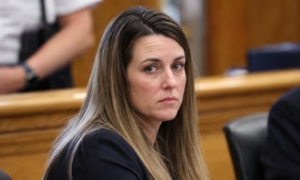
The recent federal prosecution of two former Utah court clerks illustrates that distinction. Jennifer Joma and Lauren Kelsey Morrow have not been convicted and remain entitled to the presumption of innocence. Federal prosecutors allege, however, that after learning an ICE officer was at the Logan City Municipal Justice Court, the women used court databases to identify people appearing on the docket, intercepted several noncitizens and helped them leave through a secure area and rear exit where the ICE officer would not see them. Joma is additionally accused of transporting individuals away from the courthouse. Read the U.S. Attorney’s announcement and allegations.
INDICTMENT
Those allegations are not simply about two employees disagreeing with the immigration policies of President Donald Trump, the Department of Homeland Security, ICE or Border Czar Tom Homan. The indictment invokes existing federal criminal statutes enacted by Congress. Among the charges announced by prosecutors are conspiracy to transport and harbor people unlawfully present in the United States, harboring, and obstruction of proceedings before federal departments or agencies. Whether prosecutors can prove those allegations beyond a reasonable doubt will be determined through the judicial process.
When the Conflict Reaches the Bench
The Utah case also follows another extraordinary confrontation between courthouse authority and federal immigration enforcement: the federal prosecution of former Wisconsin Circuit Court Judge Hannah Dugan. Federal prosecutors accused Dugan of interfering with ICE agents who had come to the Milwaukee County Courthouse to arrest Eduardo Flores-Ruiz. In December 2025, a federal jury convicted Dugan of obstructing a federal proceeding while acquitting her of a separate concealment charge.
Dugan’s case is important for reasons extending beyond one judge, one immigration defendant or one Wisconsin courthouse. Judges occupy positions of exceptional public authority. Their actions inevitably carry greater institutional significance than those of ordinary citizens. When a judge’s conduct involving federal immigration officers results in a federal obstruction conviction, it risks creating a profoundly damaging impression: that people working within the judicial system may decide for themselves when federal immigration enforcement deserves cooperation and when it deserves resistance.
That impression must be rejected. Judicial authority includes enormous power, but it does not include a personal veto over federal law. Judges can rule that government conduct is unlawful. They can suppress improperly obtained evidence, reject government arguments, issue injunctions when legally authorized and protect constitutional rights. Attorneys can challenge ICE actions. Citizens can protest immigration policy. Congress can change immigration law. Those are legitimate functions of a constitutional system. Secretly frustrating lawful federal enforcement, however, is an entirely different proposition when the conduct satisfies the elements of a federal criminal offense.
The concern raised by the Dugan prosecution therefore reaches directly into the allegations now confronting the former Utah clerks. A courthouse cannot develop two competing systems of justice—one contained in the statutes and judicial orders and another determined privately by judges, attorneys, clerks, bailiffs or other court employees according to their individual political or moral convictions. No one working inside a courthouse should conclude, If a judge can interfere with ICE, perhaps I can too. Dugan’s conviction should communicate precisely the opposite lesson.
Congress has already legislated in this area. 8 U.S.C. §1324 prohibits specified conduct involving knowingly or recklessly transporting certain people unlawfully present in the United States in furtherance of their unlawful presence, as well as concealing, harboring or shielding them from detection. The statute also addresses conspiracy and aiding or abetting. The precise elements matter, and merely assisting an immigrant does not automatically constitute a federal crime. Read 8 U.S.C. §1324 directly from the U.S. House of Representatives.
Federal obstruction statutes provide additional protections for federal proceedings and enforcement. 18 U.S.C. §1505, for example, criminalizes certain corrupt efforts to influence, obstruct or impede proceedings before federal departments and agencies. Again, prosecutors must prove every required element beyond a reasonable doubt. Political disagreement alone is not a federal crime. Read 18 U.S.C. §1505 directly from Congress.
That principle should transcend political parties. A government employee cannot decide that immigration law disappears because a Republican occupies the White House any more than another government employee could disregard federal law because a Democrat occupies it. Presidents change. Administrations change. Enforcement priorities change. The rule of law cannot depend upon whether an individual judge, clerk, attorney or bureaucrat personally approves of the administration charged with enforcing it.
There is a related but legally distinct public-policy debate surrounding crowdfunding for people accused or convicted of serious crimes. Karmelo Anthony, convicted of murdering Austin Metcalf, received substantial financial support through an online fundraiser for expenses that included his legal defense. Luigi Mangione has likewise attracted extraordinary financial support for his defense following the killing of UnitedHealthcare CEO Brian Thompson. These cases have understandably generated public anger and questions about whether crowdfunding platforms should be permitted to raise enormous sums surrounding notorious criminal prosecutions.
Congress is entitled to examine that issue, but any legislation must recognize an essential constitutional distinction. Every criminal defendant is entitled to legal representation, and an accused person remains presumed innocent unless and until convicted. Paying a lawyer to defend someone accused of murder is not equivalent to financing murder. Any federal restrictions on crowdfunding therefore would have to distinguish legitimate legal-defense expenses from money used to facilitate flight, concealment, witness intimidation, continued criminal activity or other unlawful conduct.
Congress should nevertheless examine whether America’s crowdfunding laws adequately address what happens to enormous defense funds after criminal proceedings end, how donors are informed about the ultimate disposition of unused money, whether organizers may personally benefit, and whether platforms should be required to provide greater transparency when campaigns raise substantial amounts for defendants accused of serious violent crimes. Those are legitimate questions of federal policy that can be addressed without compromising the constitutional right to counsel.
The same precision is necessary when considering punishment for courthouse interference with federal immigration enforcement. If Congress determines that existing penalties are inadequate, Congress has the constitutional authority to establish stronger prospective penalties. But punishment must attach to proved conduct, not political beliefs. No American should go to prison simply for opposing President Trump, Tom Homan or ICE. Conversely, opposition to those officials cannot confer immunity when prosecutors prove that someone’s conduct violated federal criminal law.
America therefore does not need a rule requiring everyone to agree with the President. It needs something considerably more fundamental: the law applies regardless of who agrees with it. Protest immigration policy. Challenge it in federal court. Petition Congress. Vote against the politicians responsible for it. Demonstrate peacefully. Write editorials condemning it. Those are American rights.
But a courthouse occupies a special place in that system. It is where Americans go expecting law to prevail over personal preference. A judge cannot create immigration policy through a back hallway. A clerk cannot rewrite federal law through a database search. An attorney cannot confer immunity through personal conviction. And a courthouse employee does not acquire authority to decide which federal laws deserve enforcement.
Judge Hannah Dugan’s case should therefore be remembered not as permission for others inside America’s courthouses to follow her example, but as a warning about the boundary between lawful opposition and unlawful obstruction. The Utah defendants will receive their opportunity to contest the government’s allegations, as the Constitution requires.
The larger principle, however, requires no political qualification: No judge, clerk, attorney, government official—or President—is above the law, and no individual gets a personal veto over federal law.