Eva Vekos, State’s Atty Shows Up DUI At Homicide Scene

Addison County State’s Attorney Eva Vekos Showed Up Drunk To a Scene Then Pulled Rank
By SyndicatedNews Legal Eagle | SNN.BZ
Addison County State’s Attorney Eva Vekos Refuses Cooperation During DUI Arrest at Suspicious Death Scene: Bodycam Footage, Lenient Sentence, and Lingering Questions About Prosecutorial Double Standards
On the evening of January 25, 2024, Eva Vekos— the elected State’s Attorney for Addison County, Vermont, responsible for prosecuting criminal cases including DUIs in her jurisdiction—drove her black Volkswagen Golf to the scene of a suspicious death investigation in Bridport. Vermont State Police troopers were already processing what would later be treated as a potential homicide scene when Vekos arrived to oversee or participate as the county’s top prosecutor.
Troopers immediately noticed an odor of intoxicants on her breath and observed slurred speech. Vekos admitted to having consumed “one gin and tonic with a burger about an hour earlier.” When asked to perform standardized field sobriety tests (SFSTs) and a preliminary breath test (PBT), she refused. One trooper, Ryan Normile, explicitly told her that refusal did not automatically mean arrest, but she responded skeptically: “Are you serious Ryan, can’t you just have a friend come and get me?” She was arrested on suspicion of driving under the influence and transported approximately 25 minutes to the Vermont State Police barracks in New Haven for processing.
Body-worn camera and dashcam footage released publicly in May 2025—following a court order in a records request by VTDigger—captures roughly two hours of the post-arrest interactions, primarily at the barracks. The recordings do not include every pre-arrest moment but clearly document Vekos’ uncooperative stance. Upon arrival, she immediately informed Sgt. Eden Neary that she would not answer questions, submit to an evidentiary breath test, or allow a mugshot. “Do you know that discretion is allowed?” Vekos asked, adding, “No photographs. My face is not going to go out in the paper.”
Neary replied that the department does not exercise discretion on DUIs. Vekos countered that there was “no DUI,” only “alcohol on the breath and alleged slurred speech,” and emphasized the professional fallout: “We’ve been working really hard with law enforcement to build a good relationship and this is gonna knock that really down and my office is going to suffer now.” Neary noted the irony, suggesting her “discretion would have been better used” by not driving after drinking. Vekos reiterated she had only one drink “an hour ago with a meal” and insisted it did not impair her. She refused the evidentiary breath test, which under Vermont law triggers an automatic civil license suspension (ultimately six months in her case). At one point, she sarcastically thanked officers about her towed vehicle: “just a little consideration.” The footage shows her upset and at times crying, but troopers observed no overt physical instability during the short walk to the cruiser.
Vekos was charged with misdemeanor driving under the influence of alcohol (23 V.S.A. § 1201(a)(2)). Because of the obvious conflict of interest—her own office could not prosecute her—the Vermont Attorney General’s Office took over the case. She was arraigned in February 2024 in Addison County Superior Court.
Eva Vekos Law License Suspended For Refusing To Turn Over Medical Records
The Resolution: A Deferred Sentence Over Prosecutorial Objections
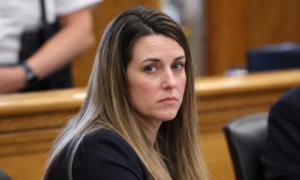
Nearly two years later, on December 16, 2025, Vekos appeared in Chittenden County Superior Court (Criminal Division) before Judge John Pacht. She changed her plea to no contest. Over the strong objections of the AG’s Office, the judge accepted the plea and imposed a six-month deferred probationary sentence. If Vekos complies with all conditions through approximately June 17, 2026, the conviction will be expunged from her record.
Standard probation conditions apply, plus a special condition: she must not drink alcohol to the extent it interferes with her own welfare, anyone else’s, or her employment. She reports to a Chittenden County probation officer. The AG’s Office had argued vigorously against a no-contest plea and deferred sentence, stating that Vekos “had failed to take responsibility for her actions” and that treating a predicate offense (one that could enhance future DUIs) with such leniency failed to account for “the serious harm that occurs when people drive while intoxicated.”
Judge Pacht reportedly noted factors weighing toward leniency, including the absence of observed erratic driving and the bodycam footage not clearly demonstrating impairment beyond her emotional distress. First-offense DUIs in Vermont frequently result in diversion or deferred dispositions to avoid permanent criminal records.
Fallout: Disciplinary Proceedings and Calls for Resignation
The case triggered immediate and ongoing professional consequences. Shortly after the arrest, Vekos faced a temporary law license suspension that was lifted after she cooperated with an investigation. In March 2026, the Vermont Supreme Court heard arguments on whether to impose an interim suspension pending full disciplinary proceedings by the Professional Responsibility Board. Prosecutors argued her actions—driving impaired to a death scene, refusing tests, and invoking her position—constituted a “serious crime” and an abuse of authority that undermined public trust in prosecutors. Her defense countered that a first-offense misdemeanor DUI has never warranted license suspension in Vermont and that a full hearing was required. No final ruling is detailed in available records as of April 2026.
Vermont State Police began routing major cases from Addison County to the AG’s Office immediately after the arrest to avoid conflicts. By March 2026, the AG’s Office had expanded that to new homicide and sex-crime prosecutions involving vulnerable victims.
What About Other DUI Cases in Her Court? Leniency Patterns Emerge in Internal Probe
A February 2026 internal investigation commissioned by the Vermont Department of State’s Attorneys and Sheriffs (conducted by an outside law firm) examined Vekos’ leadership and found “significant failures” in her ethical and legal obligations. The report explicitly concluded that her “lack of preparation, unreliable attendance and leniency regarding sentencing have definitely impacted numerous cases.”
While the probe does not single out DUI prosecutions by name, it documents a broader pattern: delayed or inadequate handling of cases leading to repeat offenses, victims left at risk, and dismissals due to her office’s inaction (e.g., a juvenile case dismissed after she failed to appear). Critics, including local media like the Addison Independent, had previously highlighted instances of allegedly insufficient sentences and poor treatment of victims and staff. The report also noted Vekos’ DUI conviction itself could undermine her effectiveness and reputation as a prosecutor.
There is no public evidence that ordinary DUI defendants in Addison County received identical deferred sentences or special treatment solely because of Vekos’ personal case. Vermont’s DUI system already favors diversion for many first offenders. However, the internal findings of systemic leniency in sentencing—coupled with Vekos receiving a deferred outcome despite the AG’s objection that it amounted to special treatment—have fueled perceptions of hypocrisy. As the state’s top local prosecutor, Vekos has long advocated for accountability in impaired-driving cases; her own refusal to cooperate and subsequent resolution have raised pointed questions about whether defendants in her courtroom receive the same prosecutorial vigor she faced (or, conversely, whether her office’s documented leniency extends across the board).
The Video and Public Scrutiny
The user-provided YouTube video (and official releases from NBC5 and others) shows the raw bodycam footage that became central to public debate. It captures not just the refusals but Vekos’ explicit references to her office’s relationship with law enforcement and requests for “discretion”—details that prosecutors later cited as evidence of poor judgment.
Vekos, a Democrat elected in 2022, has not resigned despite calls from Governor Phil Scott and others. As of April 2026, she remains in office pending further disciplinary outcomes, with her DUI record on track for potential expungement if probation is completed successfully.
The case underscores tensions in Vermont’s small-state justice system: the collision of personal accountability, prosecutorial discretion, and public trust. While Vekos’ supporters argue the resolution mirrors standard handling of first-offense DUIs, critics—bolstered by the internal investigation—see a pattern of leniency that has real-world consequences for victims and public safety, now compounded by the irony of the prosecutor herself benefiting from it.
Reminds me of Sandra Doorley (full name: Sandra J. Doorley), the District Attorney of Monroe County (which includes Rochester, New York). In April 2024, she was driving in Webster, NY (a Rochester suburb), and was clocked speeding at 55 mph in a 35 mph zone by Webster Police Officer Chris Crisafulli. Click the image to hear her use of the word f*ck.
Instead of pulling over when the officer activated his lights, she continued driving about a mile to her home, parked in her garage, and only interacted with him there. Bodycam footage showed her berating the officer, using profanity (including calling him an “a–hole”), repeatedly referencing her position as DA, telling him she didn’t care about speeding, calling the Webster police chief to complain and ask him to “leave [her] alone,” and refusing to follow directives. She later apologized in a video statement, saying she was “humbled by my own stupidity.”
Another entertaining pair of gals were Flanagan and her friend Veronica Hannan (a senior manager at PepsiCo, reports consistently identify her as a PepsiCo executive; had been out drinking. They were asked to leave the restaurant premises for reasons that aren’t fully detailed but appear tied to their behavior.
ention due to the “do you know who I am?”-style entitlement on camera, similar to other high-profile incidents involving officials and police. It does not match the Sandra Doorley case you asked about earlier (the New York DA who drove home during a traffic stop).