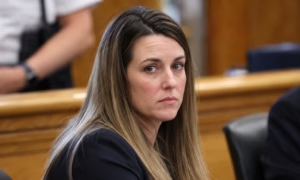
Criminally insane man sets a woman on fire

By SyndicatedNews | SNN.BZ
In the flickering underbelly of Chicago’s Blue Line, where the hum of steel on steel masks the whispers of the damned, a young woman’s life erupted into flames. It was November 2025, around 9:25 p.m., as the train idled at the Clark/Lake station—a nexus of hurried commuters oblivious to the specter lurking in the shadows.
Bethany MaGee, 26, sat unaware, her back turned to the abyss, scrolling perhaps through memories of sunnier days in Upland, Indiana, where she tended to animals with a gentle hand and found solace in the quiet pews of her church. She was the daughter of Emily and Dr. Gregory MaGee, sister to Mark and John— an ordinary soul woven into the fabric of family, faith, and quiet joys. But in that moment, ordinary became oblivion.
From the rear of the car slithered Lawrence Reed, 50, a figure etched in the annals of chaos, his eyes hollowed by 26 years of untreated paranoia and a criminal ledger spanning three decades. Over 70 arrests, 15 convictions—including eight felonies for arson and battery—marked his path, yet society, in its tender mercy, had deemed him redeemable. Time and again, the revolving door of compassion spun him back into the streets. Just months prior, in August 2025, Reed had lashed out at a social worker in the sterile confines of MacNeal Psychiatry Hospital in Berwyn, where he’d been held for his unraveling mind. A vicious slap left her with a corneal laceration, bruised optic nerve, concussion, nausea, memory loss, and a chipped tooth—wounds that screamed of a man beyond reason. Charged with aggravated battery, he was released on electronic monitoring by Cook County Judge Teresa Molina-Gonzalez, despite prosecutors’ desperate pleas: “He poses a real and present threat to the community,” they warned, citing his penchant for random, vicious assaults. The judge, echoing the era’s creed of equity over evidence, reportedly shrugged: “I can’t keep everybody in jail because the state’s attorney wants me to.”
Reed, homeless and haunted, had violated his curfew repeatedly in the weeks leading up to the attack, his ankle monitor a mere talisman against the inevitable. Earlier that evening, he’d filled a bottle with gasoline at a Garfield Park station, a ritual echoing his 2020 arson conviction for igniting flames outside the James R. Thompson Center—a cry for confinement that earned him only 24 months of mental health probation. He approached MaGee from behind, silent as sin, doused her in accelerant, and struck a lighter. Flames bloomed like malevolent flowers across her head and body, scorching 60% of her skin in an instant of hellish betrayal. She stumbled from the train as it halted downtown, collapsing in agony while Reed, singed on his hand, watched impassively before melting into the night. Passengers, frozen in the modern paralysis of self-preservation, did not intervene. The air reeked of charred innocence.
Bethany MaGee now clings to life in a hospital burn unit, her family issuing a haunting statement through ABC7: “Our hearts are shattered… Bethany is a fighter, but this evil has scarred her forever.” Dr. Gregory MaGee, her father, a pillar of quiet strength, embodies the silent vigil of those left to pick up the pieces of a system that failed spectacularly. Federal charges of terrorism now bind Reed—up to life in prison, or death if Bethany succumbs—after his arrest the next day, still clad in the soot of his crime, bellowing “burn alive” at officers. In court, his facade cracked further: repeated guilty pleas, demands for self-representation, wild claims of Chinese citizenship, and bursts of nonsensical song—”la-la-la-la”—a macabre serenade to his fractured psyche. Yet even here, the mystery deepens: Why was a man with documented decades of mental torment, prior fire-setting obsessions at City Hall and on Blue Line cars, ever free to wield fire as a weapon?
This is no isolated inferno; it is the ember of a greater conflagration, one fueled by society’s sanctified delusion: the criminally insane must not bear the stigma of their affliction. In our zeal to destigmatize mental illness—a noble pursuit twisted into folly—we have unshackled monsters under the guise of humanity. Reed’s 17 years of intermittent treatment at psychiatric facilities, his paranoia-fueled violence, his endless cycle of battery charges (six alone in Cook County since 2017), all point to a predator whose mind is a prison far crueler than any cell we could build. But to label him “criminally insane,” to commit him to the full custody of fortified hospitals—echoes of the asylums shuttered in the deinstitutionalization wave of the 1970s and ’80s—invites accusations of cruelty, of echoing eugenics’ ghosts. So we release them, monitor them loosely, probation them into oblivion, and whisper platitudes about “community integration” as the body count rises.
Transportation Secretary Sean Duffy’s voice cuts through the smoke: “This would NEVER have happened if this thug had been behind bars,” he thundered, blasting Chicago’s “carelessness.” On X, the digital coliseum roars with fury: “70 prior arrests but he was free to set a woman on fire,” laments one user, while another demands, “When will these judges with no judgment be held accountable?” Justice for Bethany communities swell online, a 2,300-strong chorus praying for a miracle while indicting the machine that let Reed roam. Illinois’ Pretrial Fairness Act and SAFE-T bail reforms, born of good intentions, now stand accused as enablers of atrocity, prioritizing the perpetrator’s “presumption of innocence” over the public’s right to breathe unburned air.
Lurking beneath this tragedy is the unspoken horror: How many more Bethanys smolder in silence, their flames yet to be lit? Reed’s history is a roadmap of missed interventions—fires set, batteries unleashed, a social worker maimed in a psych ward—each a flare gun signaling the need for containment. Yet we recoil from the label “criminally insane,” fearing it revives the lobotomy-scarred past, ignoring that true stigma lies in the blood on our streets. The criminally mentally ill are not villains of their own volition; they are victims of a brain betrayed, and we, their unwitting jailers, compound the crime by loosing them upon the innocent.
It is time—past time—to reclaim the shadows. We must build anew: fortified hospitals for the criminally insane, not as dungeons of despair but as sanctuaries of enforced healing, where the deranged find walls that protect both them and us. Echo the ghosts of Bedlam and Broadmoor, but enlightened—staffed with compassion, secured with steel, funded without apology. No more electronic leashes snapping like dry twigs. No more judges playing god with incomplete dossiers. Society’s insistence on half-measures has birthed this mystery of recurring mayhem; only bold recommitment can quench it.
As Bethany MaGee fights from her ICU bed, her family’s plea hangs like acrid smoke: “Please, for her, demand better.” In the dim corridors of the CTA, where echoes of that fateful lighter flick still reverberate, the question lingers like a chill wind: How many more must burn before we light the way to true safety? The rails whisper no answers, but the flames do not lie.