Captain David Paul Allsop Too Drunk To Fly Southwest
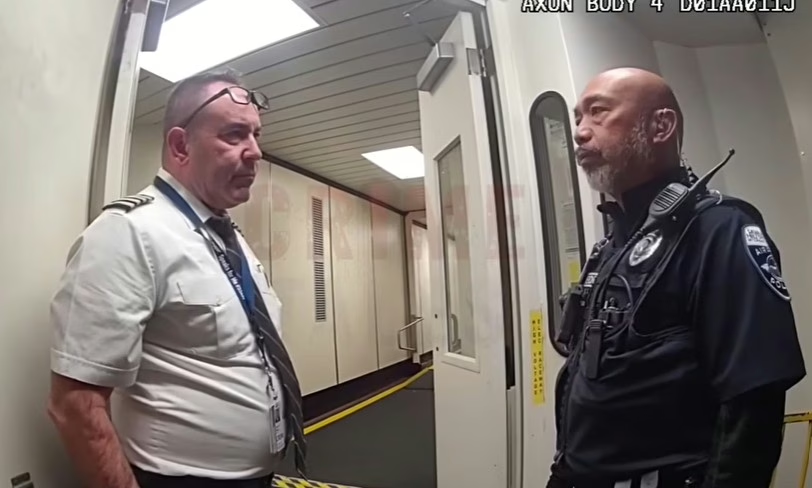
PILOT'S LIQUOR IS EVIDENT BUT HE STILL WANTS TO FLY THE AIRPLANE
By SyndicatedNews | SNN.BZ
In a stark reminder of the stringent safety protocols governing air travel, newly released bodycam footage has exposed the dramatic arrest of a Southwest Airlines pilot moments before he was set to command a flight carrying over 140 passengers. The incident, which unfolded on January 15, 2025, at Savannah/Hilton Head International Airport in Georgia, involved 52-year-old Captain David Paul Allsop, who was detained by airport police after a TSA officer detected a strong odor of alcohol on his breath. Click logo below to book your flight…
The episode, captured in unflinching detail on police body cameras and later disseminated publicly in August 2025, has reignited discussions about pilot accountability and the zero-tolerance policies enforced by the Federal Aviation Administration (FAA). Allsop, a resident of Bedford, New Hampshire, was scheduled to pilot Flight 3772, a Boeing 737 bound for Chicago’s Midway International Airport. What began as a routine pre-boarding check escalated into a full DUI investigation inside the jet bridge, halting the flight and stranding passengers.
A Routine Check Turns Tense
According to the bodycam video, the trouble started when a TSA officer approached Allsop, noting the unmistakable scent of alcohol emanating from the pilot. “I can smell alcohol on you,” the officer stated plainly, prompting Allsop to initially downplay the concern. The pilot admitted to consuming “a few beers”—specifically, three light beers—approximately 10 hours earlier the previous night. He also mentioned chewing nicotine gum, which he suggested might contribute to the odor.
Undeterred, the officer invoked federal aviation regulations, which prohibit pilots from consuming alcohol within eight hours of flight duty—a rule colloquially known as the “bottle to throttle” guideline—and impose a blood alcohol content limit of 0.04%, half that allowed for drivers under Georgia law. Allsop was asked to perform field sobriety tests right there in the confined space of the jet bridge, under the watchful eyes of his first officer and airport personnel.
The footage shows Allsop hesitating at first, declaring, “There’s no need,” before relenting. He underwent three standard tests: the horizontal gaze nystagmus (tracking an object with his eyes), the walk-and-turn (nine heel-to-toe steps along a straight line), and the one-legged stand (balancing on one foot while counting to 30). Officers observed several indicators of impairment, including involuntary eye jerking, balance instability, and missed heel-toe steps. His first officer corroborated the timeline, confirming they had shared drinks the night before during a layover.
Arrest and Immediate Fallout
Faced with these results, Allsop was informed of his rights under Georgia’s implied consent law, which mandates chemical testing for suspected impaired drivers—including pilots operating commercial aircraft. Refusal of a blood draw could result in a one-year suspension of his driver’s license and serve as evidence in court. Allsop opted against the blood test, leading to his immediate arrest on charges of driving under the influence (DUI) and willful intent to operate a commercial aircraft while intoxicated.
Handcuffed and escorted from the jet bridge, Allsop was transported to the Chatham County Detention Center, where he was booked and later released that same day on a $3,500 bond. Southwest Airlines swiftly removed him from flight duty, reassigning the aircraft and crew to ensure passenger safety. The airline issued a statement emphasizing its commitment to rigorous safety standards: “Safety is our highest priority, and we cooperate fully with all investigations.” Passengers were accommodated on a later flight, with minimal disruptions reported.
Legal and Professional Repercussions
The FAA wasted no time in suspending Allsop’s pilot certification pending a full review, a decision that later culminated in outright revocation earlier in 2025. This action effectively grounded him indefinitely from commercial aviation, marking a devastating blow to a career spanning decades with Southwest.
Allsop’s attorney has contested the arrest’s validity, arguing that the field sobriety tests were administered improperly in the awkward confines of the jet bridge and that the nicotine gum explanation was dismissed too hastily. “The officer’s observations were subjective, and the tests were not conducted under ideal conditions,” the lawyer stated in court filings. The case remains ongoing in Chatham County Superior Court, with a preliminary hearing scheduled for early 2026. No trial date has been set, and Allsop has pleaded not guilty to the charges.
This incident is not isolated; it echoes a string of high-profile aviation alcohol-related mishaps, including a 2023 case involving a Delta Air Lines pilot in Utah and another Southwest captain detained in 2022 for similar reasons. Aviation experts stress that such events, though rare, underscore the industry’s multilayered safeguards—from peer reporting to random testing—that prevent impaired pilots from taking the controls.
As the bodycam footage circulates widely on platforms like YouTube, it serves as a sobering public service announcement. For pilots like Allsop, the line between off-duty relaxation and on-duty responsibility is razor-thin, and crossing it can ground dreams as surely as it grounds planes.
This article is based on publicly released bodycam footage and court documents. Southwest Airlines and the FAA declined further comment on the ongoing legal proceedings.