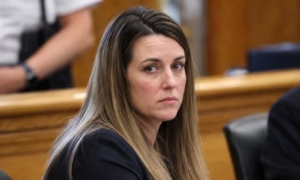
Robert Gouveia, Esq, explains How The Fulton Board Caught Filing ILLEGAL Lawsuit!

Attorney Highlights Concerns Over Fulton County Officials’ Compliance with Georgia Open Meetings Law in Election Records Lawsuit
By SyndicatedNews Legal Eagle | SNN.BZ
Attorney Robert Gouveia, Esq., a legal analyst known for reviewing public records and government actions, recently released a detailed video examination of procedural steps taken by Fulton County, Georgia, officials in response to the federal seizure of 2020 election materials.
In the February 2026 livestream titled “Fulton’s ILLEGAL Lawsuit BUSTED! New Brennan SUBPOENAS!,” Gouveia focused exclusively on whether the county followed its own state requirements when authorizing litigation to recover ballots, tabulator tapes, and related records taken by the FBI on January 28, 2026
Gouveia reviewed court filings, public announcements, email correspondence, and meeting agendas. He noted that Fulton County Commission Chairman Rob Pitts publicly announced the filing of the federal lawsuit on the morning of February 4, 2026, without any prior public board vote or agenda item listing the matter. No regular or special meeting of the Board of Commissioners or Board of Registration and Elections had included authorization for the legal action or allocation of funds to pursue it.
Later that same day, county staff reportedly circulated an email seeking retroactive board approval. Gouveia cited Georgia’s Open Meetings Act (OCGA § 50-14-1 et seq.), which requires that official actions by public bodies—including decisions to initiate litigation—occur at meetings open to the public, with proper notice, and that votes be taken and recorded in open session. Email or other non-public polling methods, he explained, do not satisfy the statute’s transparency mandates. He described the sequence as an attempt to act first and seek ratification afterward, a process he characterized as inconsistent with the law’s plain text.

Board member Julie Adams, according to emails and a subsequent letter Gouveia referenced, objected to the process and on February 16, 2026, formally requested that Georgia Attorney General Chris Carr investigate potential violations of the Open Meetings Act, unauthorized use of county resources, and related procedural issues. Adams reportedly argued that the litigation was never properly placed on any meeting agenda for February 4 or February 12, 2026, and that the board had not discussed or voted on the matter in public.
Gouveia also questioned whether the named plaintiffs—the Board of Commissioners and Board of Registration and Elections—had legal standing to sue for return of the materials. Court documents and body-camera footage from the FBI raid indicated the seized items were in the custody of the Fulton County Clerk of Superior Court, not the boards themselves. Under Georgia law, only the proper custodian typically has authority to demand their return, he noted.
The attorney emphasized that his analysis was limited to procedural compliance and did not address the merits of the underlying federal investigation, the FBI search warrant, or any past disputes regarding the 2020 election itself. He pointed out that the Open Meetings Act applies equally to all public officials and all topics, regardless of political context. “If government bodies can bypass open-meeting requirements when it suits them, public trust erodes across the board,” Gouveia stated in the video.
Fulton County officials have defended the lawsuit as necessary to protect local election records and ensure chain-of-custody for ongoing operations. Chairman Pitts has publicly described the seizure as disruptive to the county’s ability to administer future elections. No court has yet ruled on the procedural objections raised by Gouveia or Adams.
In a time when election administration remains a sensitive national issue, Gouveia’s review serves as a reminder that state and local governments are bound by the same transparency rules they enact and enforce on others. Whether the Fulton County lawsuit ultimately proceeds, is dismissed on procedural grounds, or results in further state-level inquiry remains to be seen. What is clear from the public record is that questions about adherence to Georgia’s open-government statutes have been formally raised and deserve impartial examination by the appropriate authorities.
Public confidence in democratic institutions depends not only on the outcomes of elections but on the visible integrity of every step officials take afterward. Requiring strict compliance with open-meetings and authorization laws—without exception or shortcut—applies universally, ensuring accountability no matter which side of any dispute is involved.