Hours Before Court: The Killing of Bryce Boots and the Investigation That Followed

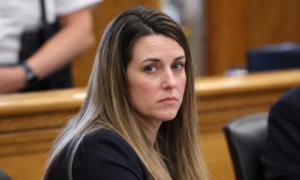
What began as the discovery of an abandoned sport utility vehicle in a rural farm field quickly evolved into one of Frederick County’s most closely watched homicide investigations. The primary character was Frances Virginia Hamilton.
By SyndicatedNews True Crime | SNN.BZ
FREDERICK COUNTY, Md. — Investigators immediately recognized that the circumstances surrounding the death pointed to a violent criminal act rather than an accident, launching a meticulous investigation that would ultimately span digital evidence, forensic analysis, witness interviews, and multiple arrests.
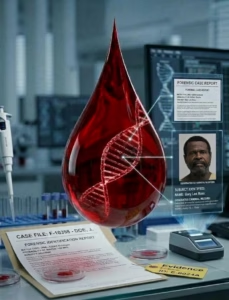
From the outset, detectives resisted drawing premature conclusions. Body-camera footage and investigative reports documented blood evidence throughout the vehicle, a blood-stained glove recovered nearby, and indications that the SUV may have been moved after the fatal assault. Investigators carefully examined whether the isolated farm field represented the actual murder scene or merely the location where the victim had been abandoned. Rather than allowing speculation to guide the investigation, law enforcement concentrated on preserving physical evidence and reconstructing the victim’s final movements.
As investigators interviewed neighbors, friends, and family members, they learned that Bryce Boots had been involved in an increasingly contentious domestic dispute with his estranged wife. Court records reflected ongoing protective-order proceedings, and Boots was scheduled to appear in court on the very morning his body was discovered. Witnesses described months of legal conflict, repeated law enforcement responses to the residence, and a deteriorating relationship. While these interviews provided detectives with valuable investigative leads, each statement required independent corroboration before becoming part of the evidentiary picture.
The timing of the homicide added a tragic layer to the case. According to the investigative record, only Bryce Boots’ estranged wife appeared at the scheduled protective-order hearing. Unaware that Boots had already been found deceased hours earlier, the court proceeded with the civil matter, issuing the requested protective order and directing him to vacate the residence and continue certain financial obligations. The extraordinary sequence of events illustrated how criminal investigations and civil court proceedings can unexpectedly intersect.
Rather than relying on rumor or neighborhood speculation, investigators assembled a case using objective evidence. Detectives analyzed cellular telephone records, surveillance footage, vehicle movements, forensic findings, and witness statements to establish a detailed timeline of the victim’s final hours. The investigation gradually focused on multiple individuals believed to have participated in the events surrounding Boots’ death, with detectives seeking corroboration for every significant piece of information before taking enforcement action.
The investigation ultimately resulted in the arrests of Keon and Alonzo, both accused of participating in the homicide. During interviews, detectives confronted the suspects with digital evidence, location information, and forensic findings developed throughout the investigation.
According to the investigative record, Keon eventually made statements regarding portions of the incident, while investigators continued to compare those statements against independently obtained evidence. The prosecution later secured convictions through the judicial process, demonstrating the importance of building a case that could withstand courtroom scrutiny rather than relying solely upon interviews or accusations.
One aspect of the investigation remains unresolved. Detectives sought to interview Bryce Boots’ estranged wife during the homicide investigation, but according to the investigative record, she died on February 24, 2024, before investigators were able to question or arrest her. Because she was never charged, no criminal court ever examined or resolved any allegations concerning her possible involvement. That distinction is important. Criminal investigations often generate suspicions, theories, and witness opinions, but under the American justice system those are not substitutes for formal charges, evidence tested in court, or judicial findings.
The homicide of Bryce Boots stands as a reminder that the most compelling true-crime stories are often those supported by evidence rather than speculation. Public curiosity naturally surrounds cases involving domestic conflict, unexpected violence, and unanswered questions. Yet responsible journalism demands that the public distinguish between what investigators can prove, what courts ultimately determine, and what remains unresolved.
In the Boots investigation, forensic evidence, digital records, court filings, and subsequent convictions tell a powerful story on their own—one that requires no embellishment to demonstrate the gravity of the crime or the painstaking work required to bring those responsible before the justice system.
Frances Virginia Hamilton died by suicide on February 24, 2024, in Anne Arundel County, Maryland. She was a former Baltimore Police officer. Investigators accused her of plotting to abduct and murder her estranged husband, Brice Wendell Boots. [1, 2, 3]
Before she could be arrested, Hamilton died by suspected suicide. Her nephew, Keon Wilson-Hawkins, was convicted of murder and kidnapping for his role in the plot. [1, 2]
SNN.BZ Editorial Note: This article is based upon publicly available investigative materials and court-related records. Statements attributed to witnesses or investigators are identified as such and should not be interpreted as judicial findings unless established through court proceedings. As additional verified public records become available, this article may be updated to reflect the public record.