Two Royal Couples, Two Crises
A side-by-side examination of Edward VIII and Wallis Simpson, Prince Harry and Meghan Markle, and the limits of royal independence.
By Arthur Reed | SyndicatedNews | SNN.BZ November 5, 2026
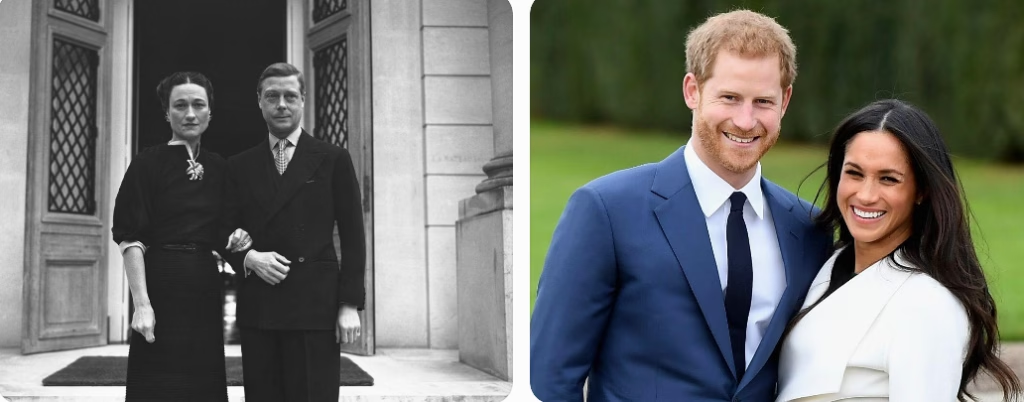
Nearly ninety years separate two royal couples whose departures from established roles tested the boundaries of British royal authority. Edward VIII abdicated the throne in 1936 to marry Wallis Simpson. Prince Harry and Meghan Markle stepped back from working royal duties in 2020, seeking a more independent life. Their decisions differed constitutionally, but each raised questions about titles, status, public responsibilities and the influence attached to membership in the royal family.
Edward became king in January 1936 after the death of George V. His intention to marry Wallis, an American whose second divorce was pending, encountered political and religious opposition. Edward signed the Instrument of Abdication on December 10, 1936; it took effect the following day. His brother succeeded as George VI, making Princess Elizabeth, the future Elizabeth II, heir presumptive. The abdication was a constitutional event, not merely a private family dispute.
Edward and Wallis married in France on June 3, 1937. She became Duchess of Windsor but was denied the style Her Royal Highness under arrangements made during George VI’s reign. The couple spent much of their subsequent lives outside Britain, maintaining a prominent international social circle. Their royal association persisted, even though Edward no longer held sovereign authority.
Harry and Meghan’s circumstances began differently. Their 2018 marriage received formal royal recognition, and Meghan became Duchess of Sussex. In January 2020, they announced plans to step back as senior working royals and become financially independent while continuing to support Elizabeth II. Buckingham Palace subsequently confirmed that they would stop carrying out royal duties, cease receiving public funding for such duties and no longer use their HRH styles.
Two royal couples compared
| Issue | Edward VIII and Wallis Simpson | Prince Harry and Meghan Markle |
|---|---|---|
| The royal break | Edward VIII abdicated in December 1936 to marry Wallis Simpson; his brother became George VI. | Harry and Meghan left working royal duties in 2020 but retained their dukedom and places in the succession. |
| The American spouse | Wallis was an American divorcée. Her proposed marriage to the reigning king precipitated a constitutional crisis. | Meghan, an American former actress and previously divorced, married Harry in 2018 with official royal recognition. |
| Titles and recognition | Wallis became Duchess of Windsor but was not granted the style Her Royal Highness. | Meghan received the HRH style at marriage; the Sussexes agreed not to use their HRH styles after 2020. |
| Independent households | Edward and Wallis lived chiefly abroad and maintained a high-profile social household. | Harry and Meghan settled in California and pursued independent charitable, media and commercial work. |
| Financial arrangements | Edward retained personal assets and negotiated financial arrangements with George VI. | The Sussexes ceased receiving public funds for royal duties and sought privately earned income. |
| Royal authority | Edward’s abdication changed the sovereign and succession, while recognition of Wallis remained contentious. | Elizabeth II declined a hybrid role combining selected official representation with private independence. |
| Public controversies | The Windsors’ 1937 visit to Nazi Germany and Edward’s wartime diplomatic record remain subjects of historical scrutiny. | The Sussexes’ interviews, memoir, business ventures and newspaper litigation have generated sustained public controversy. |
| Institutional effects | Edward’s abdication caused an immediate constitutional change and required the accession of George VI. | The Sussex departure reassigned duties and patronages without changing the head of state. |
The chart identifies the principal parallel: both couples sought a public life outside the ordinary structure of the working monarchy while retaining royal titles. The decisive difference is that Edward surrendered the crown and changed the succession; Harry and Meghan departed from official service without changing the sovereign or their positions in the succession.
Wartime history and modern controversy
Edward and Wallis visited Nazi Germany and met Adolf Hitler in October 1937. Captured German diplomatic records and contemporary reports of Edward’s remarks in 1940 have contributed to historical scrutiny of his political judgment. Accounts of Edward allegedly encouraging German bombing must be distinguished from claims that he personally sent specific written orders; the latter require direct documentary proof. There is no corresponding wartime national-security issue involving Harry and Meghan.
The Sussexes have instead faced controversy about their public criticism of royal family life, private commercial projects and litigation with newspaper publishers. Their media ventures demonstrate the continuing commercial recognition of their titles, but the possession or use of legally held titles does not itself establish misuse of royal authority.
Harry’s newspaper cases
On July 7, 2026, the High Court rejected the unlawful-information-gathering claims brought against Associated Newspapers by Prince Harry and six other claimants. The judge found the allegations had not been proved. Associated Newspapers described the ruling as a vindication, while the claimants disputed the result. An allegation’s failure in court is not automatically a judicial finding that the claimant knowingly lied. Harry’s earlier litigation had different outcomes: he secured a judgment against Mirror Group Newspapers in 2023 and a settlement with News Group Newspapers in 2025.
The extent of any lasting damage to public trust in the monarchy remains a separate evidentiary question. The 1936 abdication demonstrably changed Britain’s constitutional succession, whereas the Sussexes’ departure required institutional changes to duties, financing and representation. Assessing reputational consequences requires public-opinion evidence rather than assuming both events had the same effect.
The common question endures: How much independence can someone retain from the working monarchy while continuing to benefit from a royal identity? The Windsor and Sussex experiences provide two different tests of that boundary, separated by nearly a century.
Primary records and further reading
UK National Archives: Edward VIII abdication; Buckingham Palace: January 18, 2020 announcement; Sussexes: January 8, 2020 statement; High Court: Lawrence and others v Associated Newspapers (July 2026); High Court: consequential costs ruling (August 2026).
#BritishMonarchy, #KingEdwardVIII, #WallisSimpson, #PrinceHarry, #MeghanMarkle, #RoyalFamily, #DukeOfWindsor, #DukeOfSussex, #RoyalHistory, #RoyalControversy