GERMANY TIGHTENS ITS BORDERS
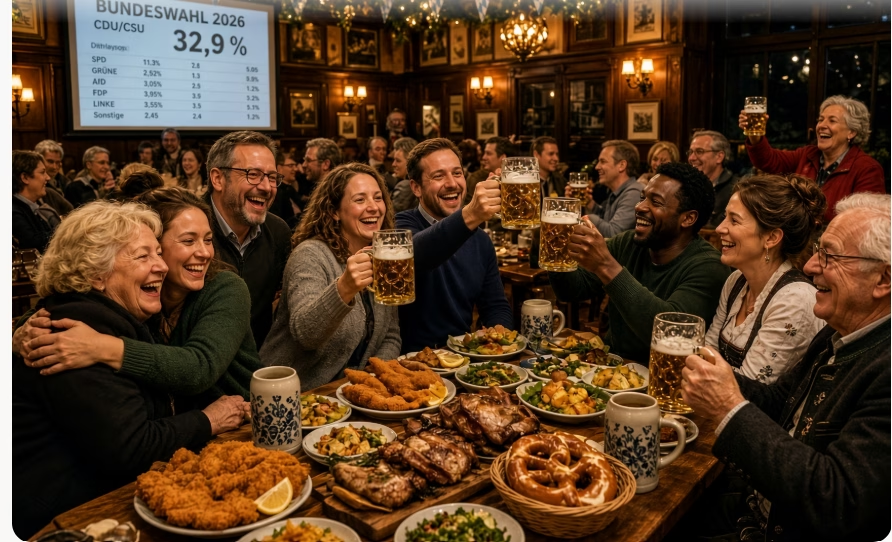
Germans celebrate their voting results
By SyndicatedNews Germany | SNN.BZ
Germany is extending controls along all nine of its land borders, continuing an extraordinary restriction of the border-free system that became one of modern Europe’s defining achievements. The German controls, currently due to expire September 15, will continue from September 16, 2026 through March 15, 2027, according to Germany’s notification to the European Commission.
The measure covers Germany’s land borders with France, Luxembourg, Belgium, the Netherlands, Denmark, Austria, Switzerland, the Czech Republic and Poland. Germany is therefore not sealing itself off from Europe, but travelers who once expected virtually unrestricted passage through the Schengen system can encounter German border checks.
Berlin cites continuing irregular migration, migrant smuggling, pressure on Germany’s asylum reception system and the broader international security environment. The German notification also specifically points to the consequences of Russia’s war against Ukraine and instability in the Middle East and Central Asia.
Germany began conducting controls at all its land borders in September 2024. What was presented as an exceptional response has subsequently been extended repeatedly. Interior Minister Alexander Dobrindt argues that continued controls remain necessary to reduce illegal migration.
The development strikes directly at one of Europe’s most recognizable accomplishments. The Schengen system was built around eliminating routine internal border checks, allowing hundreds of millions of Europeans and visitors to travel among participating countries with minimal interference. Germany sits geographically at the center of that system.
There is also disagreement inside the European Union over how long such measures should continue. EU Migration Commissioner Magnus Brunner has called for Germany’s internal border controls to end. Schengen rules permit temporary controls when exceptional threats exist, but they are supposed to be a last resort rather than a permanent replacement for free movement.
Germany is not alone. France, Denmark, Sweden, Poland and other European states currently maintain or have announced temporary internal border controls for reasons ranging from migration and organized crime to terrorism and security threats. That means the challenge facing Schengen is considerably larger than Germany alone.
The significance is therefore bigger than a checkpoint on a German highway. Europe spent decades dismantling internal borders as both a practical and symbolic expression of integration. Germany’s decision to keep checking every land frontier for another six months demonstrates how migration and security pressures are forcing governments to reconsider how much openness they are prepared to maintain.