MIDEAST DANGER ZONE
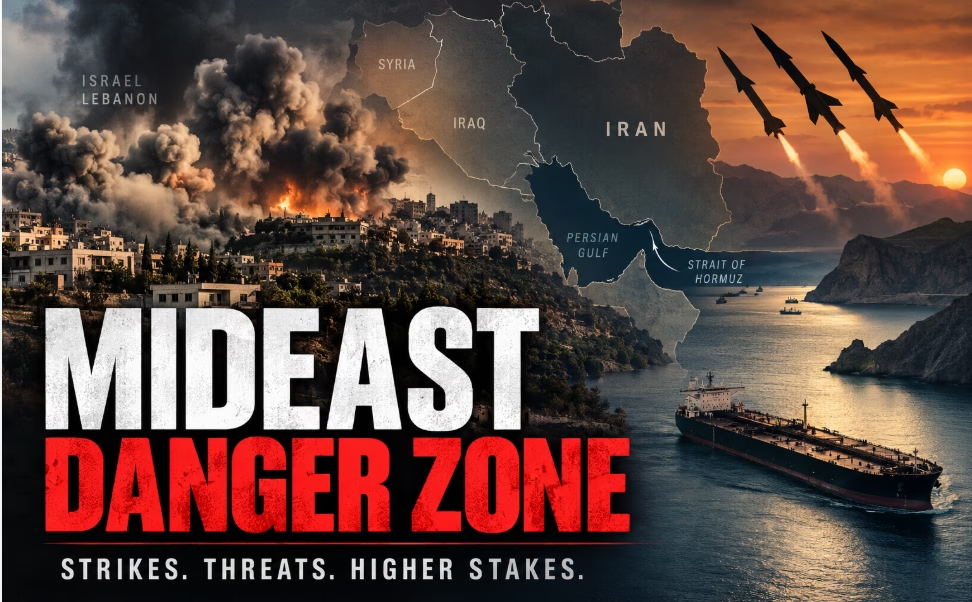
By SyndicatedNews | SNN.BZ
The Middle East entered another dangerous period Monday as Israeli strikes hit southern Lebanon while the confrontation involving Iran and the United States raised new concerns around the Persian Gulf and the Strait of Hormuz. In Lebanon, strikes on Kfar Rumman reportedly killed at least 12 people, adding another deadly episode to a regional conflict whose separate fronts are increasingly difficult to isolate from one another.
The Lebanon strikes underscore the continuing danger along Israel’s northern frontier. Military actions involving Israel and Hezbollah have repeatedly threatened to turn localized exchanges into a broader confrontation, while civilians in southern Lebanon remain exposed whenever fighting intensifies.
At the same time, Iran has issued a stark warning to Washington. Tehran said it would retaliate against additional U.S. attacks and specifically warned that American energy interests and infrastructure throughout the Gulf could become vulnerable.
That warning transforms the conflict from a regional military story into a potentially global economic story. The Persian Gulf contains some of the world’s most important oil and gas infrastructure, while the Strait of Hormuz remains one of the critical maritime passages connecting Gulf energy producers with international markets.
Any serious interruption to shipping through Hormuz could therefore reverberate far beyond Israel, Lebanon or Iran. Energy markets respond not merely to the physical loss of petroleum but to the possibility of interruption, meaning threats against tankers, ports, pipelines or other infrastructure can create price pressure even before a prolonged disruption occurs.
For Washington, that creates an unusually complicated strategic problem. The United States must protect its personnel, military installations and regional interests while also considering how an expanding confrontation could affect international shipping, allies, energy markets and the broader world economy.
Lebanon faces a different but equally severe calculation. Every expansion of hostilities threatens civilians and infrastructure in a country that has already endured years of political and economic instability. The danger is that actions on one front trigger retaliation on another, producing an escalation neither side initially intended.
The immediate question is therefore no longer simply what happens in one Lebanese village or during one confrontation in the Gulf. It is whether the different theaters are becoming components of a wider regional conflict. With Lebanon, Israel, Iran, Gulf energy infrastructure and the Strait of Hormuz increasingly appearing in the same strategic picture, the consequences of one miscalculation could travel around the world remarkably quickly.