Rex Heuermann Serial Killer: Sentencing June 17, 2026
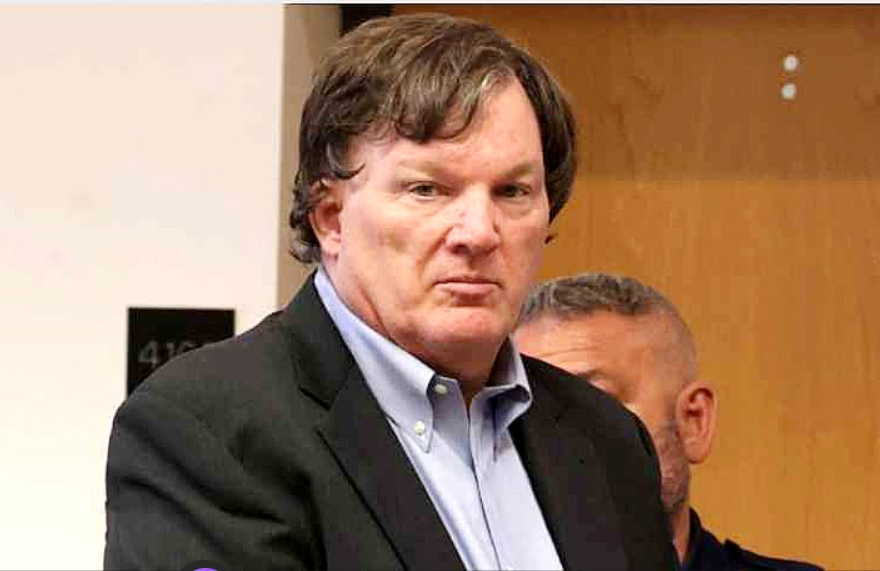
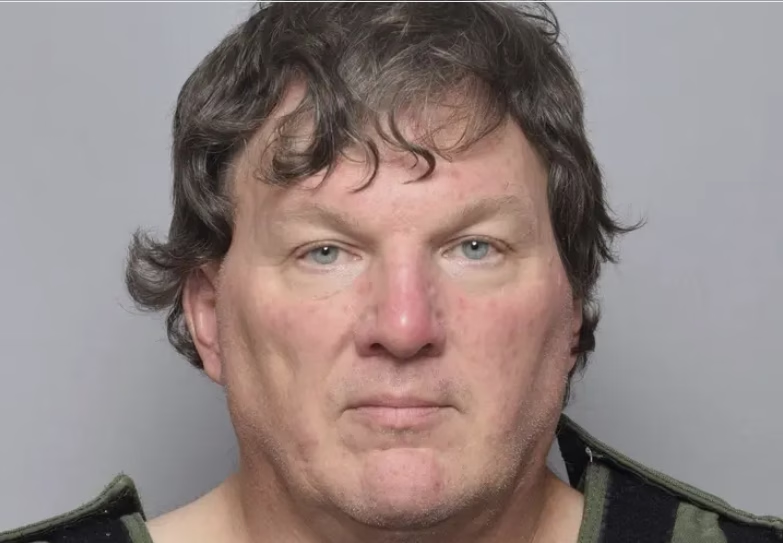
Rex Heuermann, a former Manhattan architect from Massapequa Park, Long Island, has emerged as the most prominent serial killer in the United States following his guilty plea in one of America’s longest-running and most notorious cold cases — the Gilgo Beach serial killings.
By SyndicatedNews | SNN.BZ
The “architect from Long Island” is widely understood to be Rex Heuermann, whose case became one of the most infamous serial murder investigations in modern American history. However, he is not generally considered the most notorious serial killer in U.S. history—figures such as Ted Bundy, Jeffrey Dahmer, and John Wayne Gacy are often more widely known. Still, the Gilgo Beach case is among the most sensational and haunting crime stories of the 21st century.
The Double Life of the Long Island Architect
By day, Rex Heuermann appeared to be a conventional suburban professional: a longtime architect, husband, father, and homeowner in Massapequa Park on Long Island. Prosecutors say that behind that façade lurked a predator who murdered women over a span of nearly two decades. In April 2026, Heuermann pleaded guilty to seven murders and admitted responsibility for an eighth killing, bringing a measure of closure to a mystery that had baffled investigators for years.
The victims were primarily women who advertised sex work services. According to court admissions and prosecutors, Heuermann used burner phones, arranged meetings, murdered the women—most often by strangulation—and disposed of their remains in isolated locations on Long Island. Some victims were found wrapped in burlap. Investigators also alleged that some victims were dismembered.
The Discovery That Horrified Long Island
The case exploded into public view in 2010 when police searching for missing woman Shannan Gilbert discovered human remains along Ocean Parkway near Gilgo Beach. What began as a missing-person search evolved into the discovery of multiple victims scattered across the area. The grim findings sparked years of speculation about whether a serial killer had been operating undetected on Long Island.
Among the women eventually linked to Heuermann were Melissa Barthelemy, Megan Waterman, Amber Lynn Costello, Maureen Brainard-Barnes, Jessica Taylor, Sandra Costilla, Valerie Mack, and Karen Vergata.
The Chilling Evidence
What captivated true-crime followers was the extraordinary amount of alleged planning uncovered by investigators.
Court filings described a deleted “planning document” that prosecutors said functioned as a checklist for serial murder. Investigators alleged it contained notes on preparation, avoiding detection, supplies, and cleanup. Among the phrases reported in court documents were “hit harder” and “small is good,” which prosecutors argued reflected a preference for petite victims.
Authorities also cited extensive digital evidence, including internet searches, phone records, and communications linked to burner phones. Prosecutors alleged Heuermann spent years studying criminal investigations and serial killers while refining methods to evade detection.
The Pizza Crust Breakthrough
One of the most striking details was how investigators finally identified their suspect.
After years of dead ends, investigators recovered DNA from a discarded pizza crust that Heuermann allegedly threw away in Manhattan. They compared that DNA to evidence associated with the killings, helping connect him to the case. Combined with cell-site data, vehicle descriptions, financial records, and other forensic evidence, the DNA became a crucial breakthrough in a mystery that had endured for more than a decade.
The Confession
In April 2026, Heuermann entered guilty pleas and admitted responsibility for eight murders spanning from 1993 to 2010. Prosecutors said he strangled many of the victims and concealed their remains in remote locations around Long Island. The plea spared victims’ families a lengthy trial and transformed one of America’s most enduring cold-case mysteries into a rare serial-killer confession.
Why the Case Fascinated the Public
The Gilgo Beach murders gripped the public because of the contrast at the center of the story: an apparently ordinary professional who, according to prosecutors and his own admissions, maintained a hidden life of extreme violence for years. The case combined many elements that draw intense public attention—long-unsolved murders, hidden victims, forensic breakthroughs, digital trails, and a suspect who appeared outwardly unremarkable.
The reality behind the headlines remains grim. At its core, the story is not about the killer’s notoriety but about the women whose disappearances went unresolved for years and whose families spent decades seeking answers.
Job Competition Between Law Enforcement Was Real Not a Rumor
Elected officials and top law enforcement leaders in Suffolk County prioritized protecting their own political positions and departmental turf over effective collaboration, notably failing to share critical information with professionals in the adjoining Nassau County and with federal agencies. Under the leadership of Police Chief James Burke — a protégé of powerful local prosecutor Thomas Spota — Suffolk authorities largely sidelined the FBI, which had been involved early on with phone record analysis and other expertise, while fostering a culture of isolation driven by ego and local power dynamics.
This political competition and reluctance to partner with neighboring jurisdictions or outside experts contributed to years of investigative stagnation after the 2010–2011 discoveries of the victims’ remains. What could have been a coordinated, multi-agency effort across county lines was instead hampered by infighting and a “we’ll handle it ourselves” mentality, allowing the suspected killer to evade capture for over a decade until a renewed task force with fresh leadership and advanced DNA techniques finally broke the case.