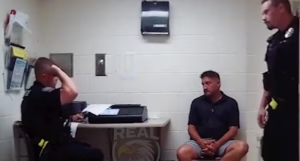
How Shoplifting Affects Working People Directly

The cost of retail theft does not simply disappear. Ultimately, much of those losses are passed on to honest customers through higher prices, meaning regular shoppers often end up paying more for everyday products.
By SyndicatedNews Retail Theft | SNN.BZ
Organized retail theft (ORT) is one of the more interesting crime beats because the reality is often more complex than the public image of people stealing items from store shelves.
Products most frequently targeted by shoplifters include a range of high-value, easily concealable, and quickly resellable items. According to various retail security reports and analyses from 2024-2025, top categories encompass apparel (such as athletic clothes, denim, and graphic T-shirts), electronics and accessories (including mobile devices, tablets, batteries, and audio equipment), health and beauty products (cosmetics, fragrances, body creams, and over-the-counter medications), and accessories like jewelry, handbags, and backpacks. Other commonly stolen goods are alcohol and beverages, meat and seafood, baby formula, laundry products, power tools, hardware, and home improvement supplies. These items often fit the “CRAVED” profile—concealable, removable, available, valuable, enjoyable, and disposable—which makes them attractive to both opportunistic thieves and organized retail crime (ORC) groups seeking fast resale profits.
Retailers across various sectors are significantly affected by shoplifting, with big-box stores, pharmacies, grocery chains, and apparel retailers often hit hardest. National Retail Federation (NRF) surveys indicate that chains like Walmart, Target, CVS, Walgreens, and Home Depot frequently report elevated incidents due to their high foot traffic and product mix. Urban stores face disproportionate impacts, with 65% of incidents occurring in city locations, though suburban malls have also seen rises. Organized retail crime exacerbates the issue for retailers stocking high-demand, portable goods, leading to combined increases in shoplifting and merchandise theft incidents of around 19% from recent prior years. Smaller businesses and those in high-crime areas also report substantial strain, contributing to broader concerns about employee safety and store closures in extreme cases.
The recovery rate for stolen merchandise remains relatively low overall, though targeted law enforcement efforts can yield notable successes in specific operations. Most retailers report less than half of theft incidents to law enforcement, limiting formal recovery tracking. Industry-wide, only a fraction of stolen goods is typically recovered through store apprehensions or police actions. In California, for example, coordinated task forces have recovered tens of millions in goods over multiple years through arrests and investigations, but these represent exceptional enforcement outcomes rather than the national norm. Shoplifting apprehensions have increased in some tracked data (around 28% in one recent period), yet the vast majority of thefts go unresolved due to underreporting and the challenges of pursuing low-to-mid-value cases.
A substantial portion of stolen merchandise, particularly from organized operations, ends up resold online through e-commerce platforms, auction sites, flea markets, and social media marketplaces. Organized retail crime groups often rely on digital channels to fence goods quickly, with estimates suggesting billions in stolen items circulate this way annually. While exact nationwide percentages are difficult to pinpoint due to the underground nature of these markets, reports highlight that ORC frequently funnels products into online resale streams, alongside pawn shops and secondary retailers. This online proliferation not only reduces recovery chances but also enables thieves to monetize goods rapidly, fueling the cycle of repeat offenses.
Recent prosecutions have uncovered theft rings worth millions of dollars operating across multiple states, with logistics networks, recruiters, warehouses, and sophisticated resale operations. Some investigations have even tied ORT proceeds to drug trafficking and other organized criminal activity. And sometimes, the thief just finds theft “convenient.”
The Amazon/eBay/Facebook Marketplace angle: Stolen goods move from a pharmacy shelf in Florida to an online listing that looks completely legitimate.
The “professional thief” economy: People who treat retail theft as a full-time occupation,
Store employees, warehouse workers, trucking personnel, or inventory managers who facilitate theft from inside the supply chain.
The interstate network angle: A theft ring operating in multiple cities can be more interesting than local shoplifting because it resembles organized crime rather than opportunistic theft.
“A multi-state criminal network moved millions of dollars in stolen retail goods through online marketplaces and local fencing operations, exploiting weaknesses in the supply chain.”
One caution: ORT is also a politically charged topic. Some public claims about retail theft losses have been challenged or revised over the years, so the strongest reporting relies on court records, indictments, police investigations, retailer disclosures, and verified data rather than broad claims about a nationwide “shoplifting epidemic.” The distinction between organized theft rings and ordinary shoplifting is important and often gets blurred in public discussion.