Tiffany’s Designs Step Into Light
The Met pairs Tiffany studio drawings with decorative objects, illuminating the designers and conservation work behind the finished creations.
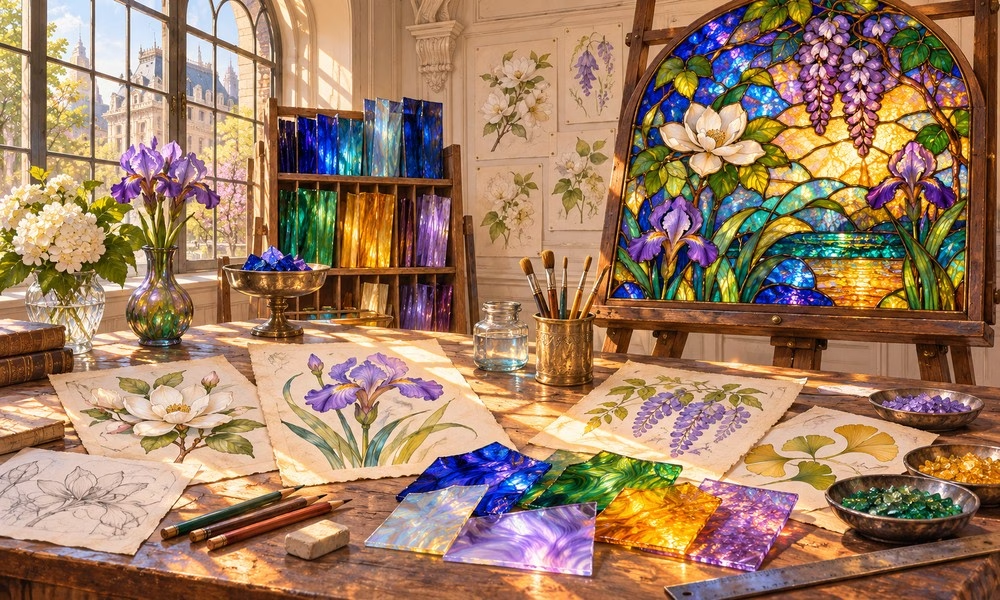
AI generated for illustrative purposes; an imagined studio, not a photograph of the exhibition or an actual Tiffany work.
By Edward Pembroke
November 29, 2026 · Editorial review: Arthur Reed
NEW YORK — The Metropolitan Museum of Art is tracing the work behind Louis Comfort Tiffany’s decorative creations in an exhibition that places design drawings alongside finished objects. Designing the Gilded Age: Drawings from the Studios of Louis C. Tiffany is on view through February 7, 2027.
The museum’s current exhibition overview describes nearly 120 watercolor drawings for American and international commissions. Together with stained-glass windows, mosaics, enamelwork and lamps, they show how a design moved from a sheet of paper into an object or architectural setting.
One reunion involves Woman in a Pergola with Wisteria, a 1911 stained-glass window lent by the Chrysler Museum of Art. According to The Met’s July 28 announcement, original wisteria transoms discovered in an Arizona home allow the ensemble to be presented together for the first time in at least half a century.
The exhibition also examines the people behind the Tiffany name. The museum identifies Frederick Wilson, Jacob Holzer, Agnes Northrop, Clara Driscoll and Julia Munson among the designers whose contributions helped shape the studios’ output. Its account emphasizes collaboration, including the work of women and immigrant artists who were not always credited.
Conservation is another part of the story. The Met says the presentation draws on decades of preservation and research into fragile works on paper. It is organized by curator Alice Cooney Frelinghuysen with research associate Barbara Veith, and is accompanied by an illustrated catalogue.
Some drawings preserve evidence of commissions that were damaged, destroyed or never built. That makes them more than preliminary sketches: they retain ideas and details that cannot always be recovered from surviving objects. Side-by-side displays give visitors a way to compare an initial design with its eventual realization.
The exhibition is in Galleries 691–693 at The Met Fifth Avenue and is included with museum admission. The museum’s exhibition page provides the current visitor information and related programming. For visitors familiar mainly with Tiffany lamps, the presentation offers a broader view of the studio’s work in interiors and architectural decoration.