Fired by Facebook, Hired by the Future
From Oculus Rift to autonomous aircraft, underwater systems and retro gaming, Palmer Luckey keeps building after his Facebook departure.
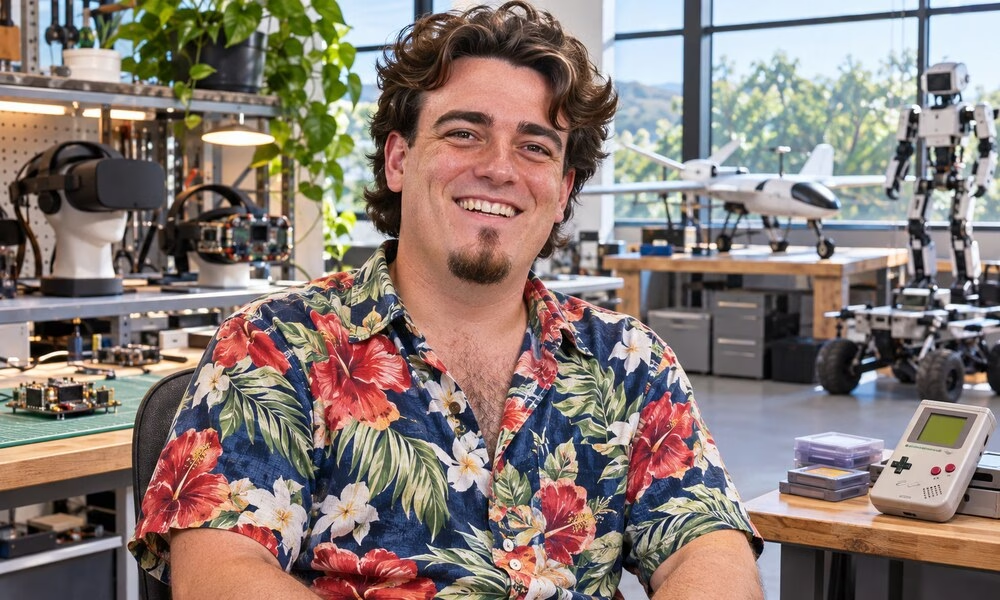
Palmer Luckey. AI generated for illustrative purposes.
Edward Pembroke – Down the Middle
Some inventors develop a brilliant product and spend the rest of their careers enjoying the rewards. Palmer Luckey appears to have other plans. After helping revive virtual reality, selling his company to Facebook for approximately $2 billion, and subsequently losing his position there, the California-born entrepreneur turned his attention to autonomous aircraft, underwater vehicles, defense software, and even classic video games. His career is an unusual example of what happens when an inventor’s ambitions extend well beyond his first breakthrough.
Luckey founded Oculus VR in 2012 at age 19, having developed early virtual-reality headset prototypes while experimenting with electronics. His Oculus Rift helped bring immersive gaming from a specialist pursuit into the consumer technology market. Facebook announced its acquisition of Oculus in March 2014, when Luckey was 21. The agreement was valued at approximately $2 billion, with additional payments possible for specified milestones. The consumer Oculus Rift launched in 2016, helping establish the modern virtual-reality market.
Watch: Palmer Luckey interviews on YouTube.
His relationship with Facebook ended in March 2017, amid controversy surrounding his political activities and litigation involving Oculus. Although Facebook initially announced his departure without publicly explaining the circumstances, Luckey subsequently stated that he had been fired. He has associated the dismissal with his political support for Donald Trump, but the precise internal reasoning remains disputed. In 2024, Meta technology chief Andrew Bosworth apologized publicly for earlier remarks about the matter, while Mark Zuckerberg expressed respect for Luckey’s achievements and interest in possible future collaboration.
Losing his place at Facebook did not end Luckey’s entrepreneurial career. In 2017, he co-founded Anduril Industries, a defense-technology company developing autonomous systems and software for military and security applications. Its central software platform, Lattice, integrates information from sensors and other equipment to help operators identify and respond to potential threats. The company’s approach combines software, artificial intelligence, sensors and purpose-built hardware, with human supervision playing an important role.
Anduril’s expanding product range illustrates the ambition of that undertaking. Its Ghost family consists of modular reconnaissance aircraft, while Roadrunner is a twin-turbojet autonomous aircraft designed for vertical takeoff, landing and reuse. The company’s Fury program concerns an unmanned aircraft designed for military aviation missions. Other systems include Sentry surveillance equipment, Anvil drone interceptors and Pulsar electronic-warfare technology. These are company-developed platforms, however, and should not be mistaken for inventions personally engineered by Luckey alone.
Anduril has also ventured beneath the ocean’s surface. Dive-LD and Dive-XL are autonomous underwater vehicles designed for missions that may include surveying, reconnaissance and specialized payload delivery. Such systems reflect a broader shift toward unmanned maritime operations. They also demonstrate that Luckey’s second major company has moved far beyond the virtual-reality technology that originally made him famous.
There is another, rather charming, side to this technological empire. Through ModRetro, Luckey has returned to his longstanding enthusiasm for vintage gaming hardware. In 2024, the company introduced Chromatic, a handheld gaming system compatible with Game Boy and Game Boy Color cartridges. While much of the technology industry races toward increasingly elaborate digital experiences, Luckey has also invested in recreating the enjoyment of simpler gaming hardware with modern engineering. Apparently, even the future sometimes benefits from a little nostalgia.
Comparisons between Luckey and Elon Musk are understandable, although their companies, backgrounds and areas of expertise differ. Both entrepreneurs are associated with ambitious engineering projects, manufacturing challenges and industries traditionally dominated by established organizations. Luckey’s record is notable because his career spans consumer electronics, software, autonomous systems, defense technology and retro gaming. Whether individual projects ultimately meet their commercial or operational goals is a separate question from the scale of the engineering ambitions behind them.
Luckey’s story raises a question worth considering: What happens when an unusually capable inventor encounters a corporate environment that no longer welcomes him? In this case, the answer was not retirement or obscurity. It was another company, followed by a growing collection of technological projects. His accomplishments are substantial, although the long-term performance and consequences of these technologies will continue to require independent scrutiny. The remarkable part is that the entrepreneur who once helped people enter virtual worlds is now developing systems intended to operate in the real one.