Thomas Markle; the Monarchy’s Unwanted Inheritance
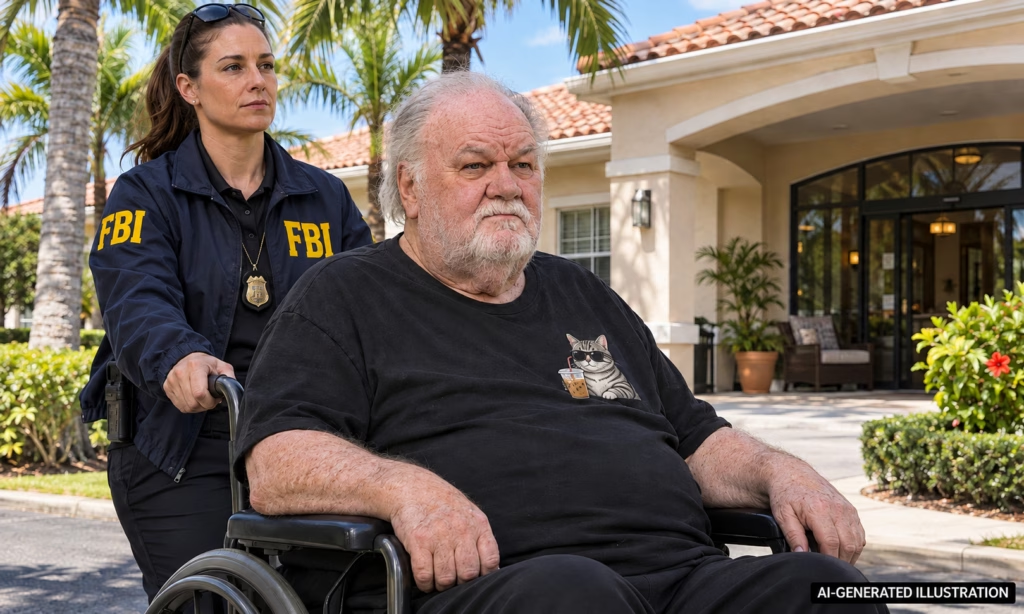
AI Illustration of FBI verified escort of Thomas Markle being wheeled out of Florida nursing home by female FBI agent.
By Senior Staff Member | Opinion
A federal criminal complaint and supporting affidavit filed in the Central District of California on November 5, 2026, charge Thomas Wayne Markle with possession of child pornography under 18 U.S.C. § 2252A(a)(5)(B). The document establishes probable cause based on materials seized from two Los Angeles-area storage units he has rented continuously since mid-2008. Agents recovered film negatives, slides, and other items. After digitizing a portion of the 35mm negatives, the FBI described three specific images involving nude pre-pubescent girls in explicit poses. In two of them, an adult male matching Markle’s appearance (identified by a witness who has known him since the 1970s) is shown touching or positioned with a child in a manner the agent assessed as designed to elicit a sexual response. One image series was linked to Anahaw Lodge, a Philippine motel from the 1970s–80s era. Kodak film edge markings indicated interstate commerce. The investigation remains ongoing; Markle is presumed innocent until proven guilty.
Update, November 9, 2026. People and USA Today reported that Doria Ragland helped federal investigators identify her former husband, Thomas Markle Sr., in photographs. Paragraph 13 of the FBI affidavit says a person described as “Witness 3,” who had known Markle since the 1970s, identified him in two redacted photographs. The public affidavit does not name the witness.

These are not distant or abstract allegations. They concern visual depictions of the sexual exploitation of very young children, stored for nearly two decades in units paid for and controlled by the man who is the biological father of the Duchess of Sussex. Meghan has previously stated that she became aware of troubling allegations against her father years earlier and chose to bar him from any contact with Archie and Lilibet in order to protect them. The current federal case gives that earlier decision a concrete and public legal form.
The emotional consequences for the royal family are real even if they remain largely private. The monarchy is a family institution as well as a constitutional one. Harry is the King’s son. Archie and Lilibet are the King’s grandchildren. The knowledge that their maternal grandfather stands accused of possessing images of pre-pubescent girls in sexualized poses—and that some of those images appear to depict him—places an unavoidable human burden on those relationships. Whatever private conversations occur inside the family, the public record already shows that Meghan treated the risk as serious enough to sever contact. That choice, now reinforced by a sworn FBI affidavit describing the nature of the material, cannot be emotionally neutral for Harry or for his father and brother.
Reputationally, the damage is more visible and harder to contain. The British monarchy’s public standing depends on a carefully maintained separation between the institution and personal scandal. The 2020 decision by Harry and Meghan to step back from senior royal duties was already framed, in part, around differing expectations of privacy and conduct. The emergence of federal charges of this gravity against Meghan’s father supplies a fresh and particularly toxic illustration of the complications that accompanied the 2018 marriage. Critics do not need to invent new narratives; the affidavit itself supplies graphic detail about the alleged material and its long-term storage. For an institution that has spent years emphasizing duty, continuity, and the protection of children through its charitable work, association—even by marriage and even after formal withdrawal—with a man facing these allegations is corrosive.
The Palace has so far remained characteristically silent or minimal in its comments. That restraint is consistent with its post-2020 posture of institutional distance. Yet silence does not erase the association in the public mind. Every new development in the Markle investigation becomes, by extension, a story about the father of the Duchess of Sussex and the grandfather of two children who hold royal titles. The monarchy can limit official roles and withhold public endorsement; it cannot fully detach the family name from the blood relationship that already exists.
In practical terms, the case strengthens the logic of the existing separation rather than creating it. Harry and Meghan left the working royal fold years ago. The allegations against Thomas Markle make any future reintegration even less plausible and give the institution additional reason to maintain clear boundaries. Emotionally, they add a layer of private distress that no amount of protocol can fully shield. Reputationally, they furnish a durable, documented example of how one marriage introduced an entirely separate American family’s legal and personal liabilities into the orbit of the Crown. The affidavit’s descriptions of the images leave little room for euphemism about the seriousness of what is alleged. That gravity now sits, unwanted, beside the royal family’s own name.