Marijuana Reform Meets Family Tourism
Opinion: Federal marijuana reform and Florida’s family tourism economy require clear rules on lawful access and public smoking.
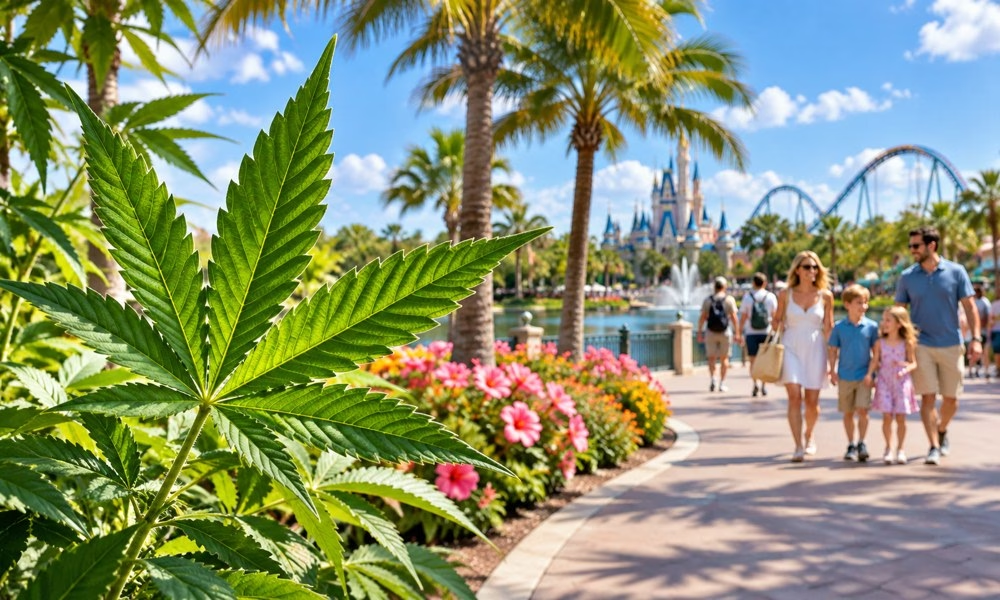
AI-generated conceptual illustration of cannabis policy and Florida family tourism. It does not depict an actual location or incident.
By Arthur Reed — SNN.BZ
Opinion
America’s marijuana debate requires more than a choice between prohibition and legalization. It requires clear answers about where cannabis may be sold, who may purchase it, and where it may be consumed. For Florida, those questions carry particular weight: adult choices share public space with families visiting one of the country’s best-known vacation destinations.
The national discussion is gaining fresh attention. Representative Dina Titus and Republican political operative Roger Stone have expressed support for bipartisan marijuana reform, according to Marijuana Moment. Stone said he would urge President Donald Trump to sign legislation Congress sends him. That represents Stone’s position, rather than a presidential commitment or an enacted law.
Across the United States, legalization remains a patchwork of state rules operating alongside federal controls. Permission under a state’s recreational marijuana law does not establish nationwide legality. The Justice Department’s recent federal registration initiative concerns qualifying medical marijuana businesses; the department expressly says that the underlying order does not authorize recreational marijuana. Broader rescheduling is a separate proceeding.
Florida’s medical marijuana program allows access for qualified patients through licensed medical marijuana treatment centers. Hemp products operate under a separate legal framework and are not restricted solely to medical patients. Consequently, a cannabis-related product displayed in a smoke shop should not automatically be described as either illegal recreational marijuana or an approved medical product. Its contents and compliance matter.
For Central Florida, the policy question extends beyond the dispensary counter. Orlando’s appeal rests heavily on families enjoying attractions, hotels, restaurants and shared outdoor spaces. Parents walking with children should be able to expect an enjoyable environment without navigating other people’s marijuana smoke. That expectation deserves consideration alongside the interests of patients, adult consumers and businesses.
Florida already excludes public smoking from its authorized medical marijuana use. That makes enforcement of existing restrictions part of the discussion today. Any future recreational legalization should explain plainly where consumption would be permitted, how restrictions would be enforced, and how visitors would learn the rules. Legal possession should never leave the public guessing about permission to smoke on a busy sidewalk.
My view is that responsible reform should combine lawful adult access with practical boundaries: reliable age checks, accurate product labeling, packaging that protects children, and enforceable restrictions on smoking in shared public spaces. Retailers should face understandable requirements and consistent oversight. Tourism workers should have clear procedures for addressing complaints.
Florida can respect medical patients and debate broader adult access while protecting the family experience that helps sustain its tourism economy. Washington must clarify federal policy; Florida must decide how cannabis fits into everyday life within its borders. Both responsibilities demand more precision than a promise to “legalize marijuana.”
Featured image: AI-generated conceptual illustration of cannabis policy and Florida family tourism. It does not depict an actual location or incident.