OIL DEAL OPENS VENEZUELA’S REAL ESTATE
As U.S.-Venezuela Investment Expands, Available Real Estate Could Offer a Head Start to Companies Entering the Country
By SyndicatedNews | SNN.BZ
WASHINGTON/CARACAS — A remarkable transformation is taking place in the relationship between the United States and Venezuela. President Donald Trump has announced an agreement giving the United States what his administration describes as majority control over more than 65 billion barrels of Venezuela’s proven oil reserves, an arrangement the White House is calling the largest oil agreement in history.
The announcement, featured in an NBC News report by Yamiche Alcindor, represents something that would have been almost unimaginable only a short time ago: Washington moving from years of sanctions and confrontation with Caracas to becoming deeply involved in the development of one of the world’s greatest petroleum resources.
The historic new energy arrangement between the United States and Venezuela is fundamentally about petroleum, but its economic consequences are unlikely to stop at the edge of an oil field. If the enormous investment contemplated under the agreement materializes, Venezuela will need something else almost immediately: places for the people and companies arriving to do business.
Engineers, energy executives, attorneys, accountants, construction companies, equipment suppliers, logistics specialists, consultants and financial professionals cannot conduct a multibillion-dollar rebuilding effort from an oil rig. They require offices, residences, hotels, meeting facilities, warehouses and places to establish permanent operations. That makes Venezuela’s existing real estate — including properties whose owners are already prepared to sell — an overlooked part of the country’s emerging investment story.
The U.S.-Venezuela arrangement involving North American Blue Energy Partners, or NABEP, encompasses 17 Venezuelan oil fields containing approximately 65 billion barrels of proven reserves. Plans contemplate investment reaching as much as $100 billion. At the same time, Chevron and other international energy companies are expanding Venezuelan operations, while Washington has been modifying sanctions restrictions to permit a broader range of authorized commercial activity.
Those developments potentially create an entirely new customer base for Venezuelan real estate.
Every major international energy development creates an ecosystem around it. Petroleum companies require contractors. Contractors require subcontractors. All of them require professional services, transportation, communications, housing and administrative facilities. Foreign executives and technical personnel need places to stay. Companies entering a country frequently need temporary offices before deciding whether to build permanent headquarters.
Venezuela already has many of those assets available.
One particularly unusual opportunity is presently on the market on Margarita Island, Venezuela’s famous Caribbean tourism destination.
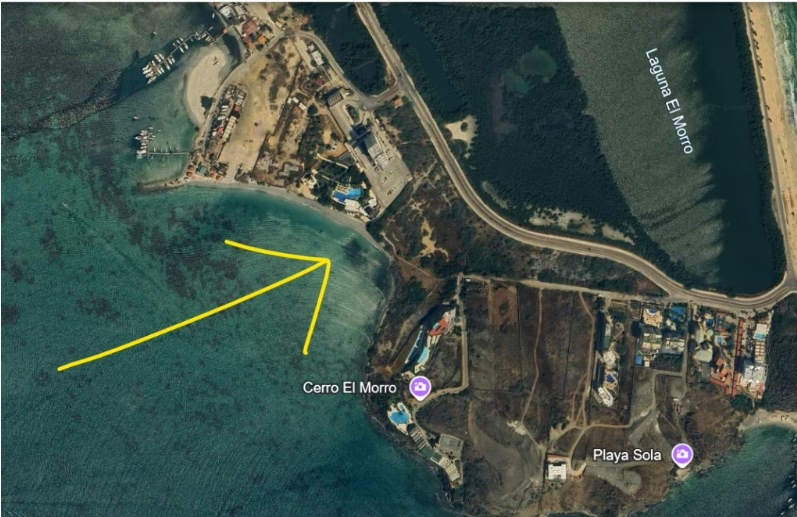
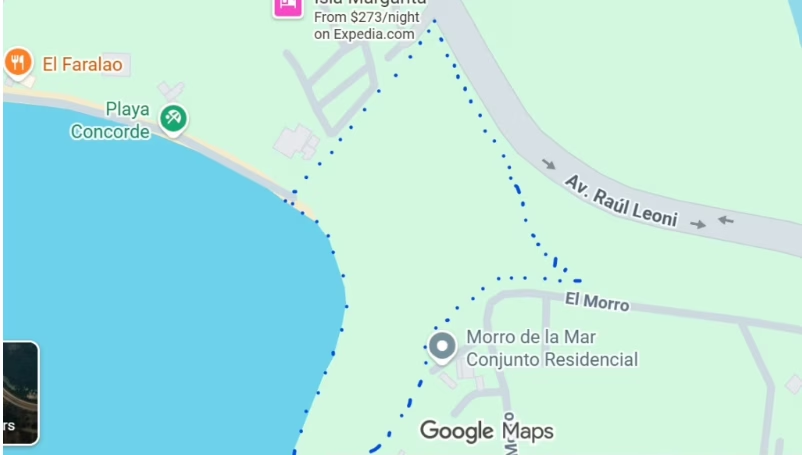
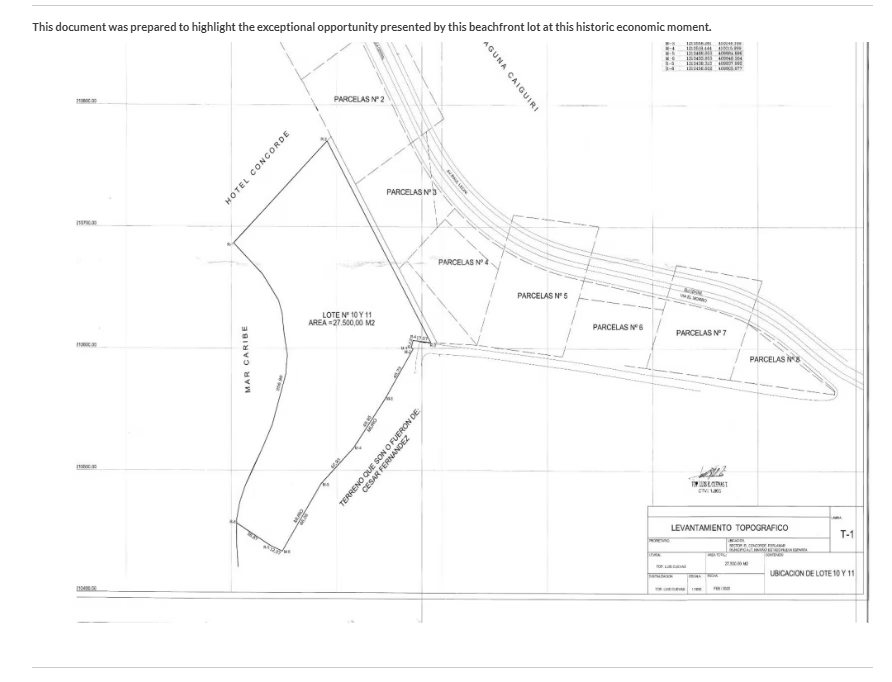
A privately owned beachfront property immediately adjoining the Wyndham Concorde Resort is currently available for sale. Rather than waiting years for land to become available after investment activity accelerates, a company or developer entering Venezuela could examine an existing beachfront opportunity now.
The Property
- Size: 27,500 m² (approx. 2.75 hectares or 6.8 acres)
- Location: Porlamar, Margarita Island, Venezuela
- Frontage: Direct Caribbean Sea beachfront
- Adjacency: Immediate border with the Wyndham Concorde Luxury Hotel
- Ownership: Single owner
- Documentation: All ownership and property documents are in hand and ready for transfer
- Owner’s direct cell phones: +1 (954) 882-9921 and +1 (954) 770-9882
The site offers unobstructed sea views, direct beach access, and seamless integration into an already proven luxury hospitality ecosystem. Infrastructure, access roads, and surrounding amenities are firmly established, eliminating the uncertainty that often accompanies undeveloped beachfront assets.
Strategic Significance
This property sits in one of the most valuable tourism zones on Margarita Island, benefiting from:
- Existing high-end hotel traffic
- Proximity to international travelers and resort clientele
- Strong appeal for luxury resort development, branded residences, or flagship hospitality projects
- Margarita Island’s Free Port status, enhancing investment and operational efficiency
For international hotel chains, this is a natural expansion site. For private investors, it represents a trophy asset with long-term upside in an emerging Caribbean market.
Who This Is For
This offering is not for casual buyers.
It is intended exclusively for:
- Ultra-high-net-worth individuals
- Institutional investors
- Private equity groups
- International hotel and resort operators
Only buyers of proven financial capacity
The location deserves consideration for more than conventional tourism.
Subject to Venezuelan land-use regulations, permitting and development approvals, beachfront property of this nature could potentially be evaluated for a hotel or resort, luxury residential development, corporate offices, executive accommodations, meeting and conference facilities, a corporate retreat, mixed-use development or a combination of hospitality and business uses.
Imagine, for example, an international company establishing its Venezuelan administrative or regional office overlooking the Caribbean rather than occupying another conventional office tower.
For executives traveling repeatedly between the United States and Venezuela, a corporate campus combining offices, accommodations and meeting facilities could offer an entirely different environment for conducting business. For a hotel developer, the adjoining Wyndham property demonstrates that an established hospitality market already exists at the location.
The property is not being proposed as part of the U.S.-Venezuela energy agreement, nor is there any indication that NABEP, Chevron or another participant has expressed an interest in purchasing it.
The opportunity is much simpler:
The property is available at precisely the moment a new group of international investors and companies has a reason to look at Venezuela again.
That distinction matters.
The objective is not to suggest that an oil company needs a Caribbean beach. It is to recognize that the extraordinary amount of economic activity surrounding petroleum development can bring hundreds of companies and thousands of professionals into a country. Some will establish offices. Some will purchase residences. Some will build. Others may identify opportunities completely unrelated to petroleum after arriving in Venezuela.
Margarita Island represents the tourism and development side of that opportunity.
Caracas represents another. The same owner offering the Margarita Island beachfront property also owns a luxury residence located within approximately one or two blocks’ walking distance of the U.S. Embassy in Caracas, according to information supplied by the owner.
That creates a very different proposition.
As American diplomatic and commercial activity in Venezuela increases, conveniently situated high-quality residential property could become relevant to corporate executives, international consultants, investors and others who need to spend substantial periods in Caracas.
The property’s proximity to the American diplomatic mission could make it particularly interesting to an American company establishing Venezuelan operations, although any prospective purchaser should independently verify the precise distance, title, security considerations, permitted use and all other property particulars.
The Caracas residence and Margarita beachfront property consequently represent two distinct opportunities emerging against the same economic backdrop.
One is positioned near the center of American diplomatic activity in the Venezuelan capital.
The other sits on the Caribbean beside an established international resort.
Both are available while Venezuela is undergoing what could become its most important period of foreign investment in decades.
The larger opportunity may extend far beyond these two properties.
Years of economic difficulty encouraged some Venezuelan property owners to sell, while development projects were postponed and international investors largely remained on the sidelines. If confidence returns, that inventory could become increasingly interesting to developers with the capital and patience necessary to enter a recovering market early.
There is no guarantee that Venezuela will experience a real-estate boom. Political risk remains. Sanctions compliance remains important. Title and ownership must be carefully verified. Foreign investors require qualified Venezuelan legal counsel, and any American purchaser must ensure that a transaction complies with applicable U.S. sanctions and Treasury regulations.
But investment opportunities rarely begin after every uncertainty has disappeared.
They begin when circumstances change.
The U.S.-Venezuela energy arrangement represents precisely that kind of change. Billions of dollars may be committed to petroleum production, electrical infrastructure, transportation and related industries. International corporations are once again evaluating Venezuela. American businesses that would not have considered entering the country several years ago suddenly have a reason to examine it.
And companies participating directly in the petroleum projects are only the beginning.
Behind them can come engineering companies, construction firms, technology providers, environmental specialists, financial institutions, insurers, attorneys, accountants, equipment manufacturers, logistics companies and entrepreneurs.
Those businesses will need somewhere to operate.
For some, that could mean Caracas.
For others, an available beachfront location on Margarita Island might present an opportunity to create something considerably more ambitious.
The oil may be beneath Venezuela’s soil.
But the opportunities created above ground could be just as interesting.
Interested In Licensing?
The Department of the Treasury’s Office of Foreign Assets Control (OFAC) is issuing Venezuela-related General License 46D, “Authorizing Certain Activities Involving Venezuelan-Origin Oil or Petrochemical Products;” Venezuela-related General License 47B, “Authorizing the Sale of U.S.-Origin Diluents to Venezuela;” Venezuela-related General License 48C, “Authorizing the Supply of Certain Items and Services to Venezuela;” Venezuela-related General License 50C, “Authorizing Transactions Related to Oil or Gas Sector Operations in Venezuela of Certain Entities;” Venezuela-related General License 51C, “Authorizing Certain Activities Involving Venezuelan-Origin Minerals, Including Gold;” Venezuela-related General License 52B, “Authorizing Certain Transactions Involving Petróleos de Venezuela, S.A.;” Venezuela-related General License 54B, “Authorizing the Supply of Certain Items and Services for Minerals Operations in Venezuela;” and Venezuela-related General License 61A, “Authorizing the Supply of Certain Items and Services to Venezuela Related to Telecommunications.”
Additionally, OFAC is issuing two new Venezuela-related Frequently Asked Questions (FAQs 1267 and 1268), amending two Venezuela-related Frequently Asked Questions (FAQs 1233 and 1244), and archiving FAQ 1260.