Executive Power’s Not “Terrifying” It’s Normal
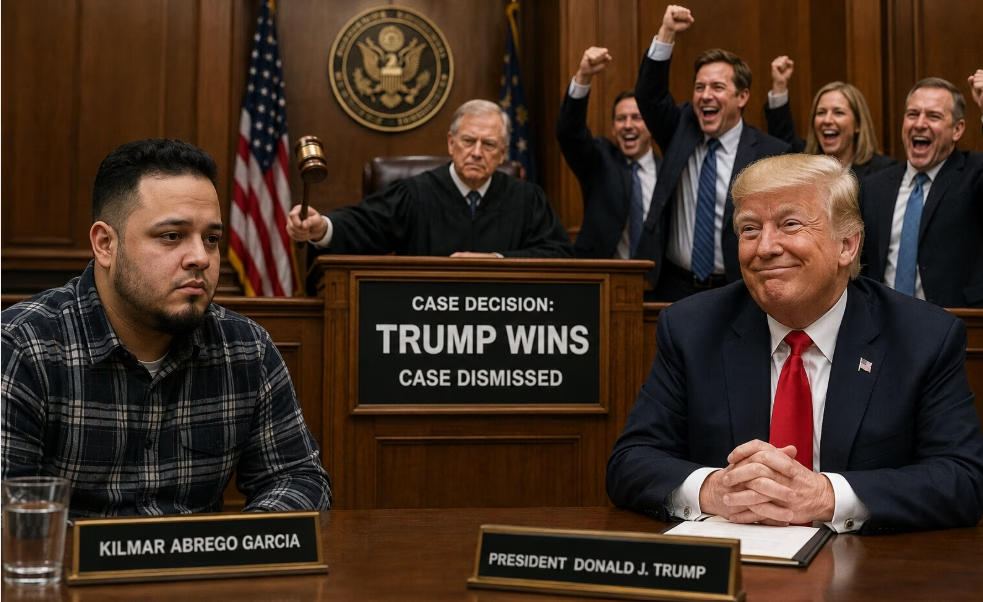
Critics of President Donald Trump’s immigration policies have described the expanding legal battle over Kilmar Abrego Garcia in dramatic terms, including warnings about supposedly “terrifying” presidential power.
By SyndicatedNews Opinion | SNN.BZ
Critics of President Donald Trump’s immigration policies have described the expanding legal battle over Kilmar Abrego Garcia in dramatic terms, including warnings about supposedly “terrifying” presidential power. But dramatic language should not substitute for constitutional analysis.
The central question is not whether someone likes Trump, dislikes his immigration policies or sympathizes with Abrego Garcia. The question is much narrower: What authority does the executive branch actually possess under federal immigration law, and where do the legitimate powers of the federal courts begin and end?
Abrego Garcia is a Salvadoran national who entered the United States unlawfully. His complicated immigration history included a 2019 order granting him withholding of removal to El Salvador. That protection was significant because it prohibited his removal to that particular country while the order remained effective.
When the government nevertheless sent him to El Salvador in March 2025, the administration acknowledged that his removal there resulted from an administrative error. That fact should not be rewritten merely because it is inconvenient to either side of the political argument.
The Supreme Court consequently required the government to “facilitate” Abrego Garcia’s release from custody in El Salvador and to ensure that his case would be handled as it would have been had he not been improperly sent there. But the Court did something else that deserves considerably more attention. It cautioned that the district court’s order had to respect the executive branch’s constitutional role in foreign affairs and specifically instructed the lower court to proceed with “due regard for the deference owed to the Executive Branch in the conduct of foreign affairs.” That is hardly a declaration that federal judges may dictate every aspect of immigration and foreign policy.
The distinction is critical. A judicial order preventing the government from removing someone to one particular country is not necessarily an order granting that individual an unrestricted right to remain permanently in the United States. Withholding of removal is not American citizenship. It is not a green card. And it does not automatically erase every other authority Congress has provided for removing a person who otherwise lacks a lawful basis for remaining here.
That does not mean a president possesses unlimited deportation power. He plainly does not. The executive must obey statutes, constitutional protections and valid judicial orders. Individuals facing removal may possess procedural and substantive rights that the government must respect. But acknowledging those limitations does not require pretending that the executive branch has been stripped of its traditional responsibility for enforcing federal immigration law.
This is where descriptions such as “terrifying” become more political than illuminating. Every branch of the federal government exercises enormous power. Federal judges can invalidate government actions. Congress can enact laws affecting hundreds of millions of people. Presidents command executive agencies, conduct foreign relations and enforce federal law. The American constitutional system does not eliminate powerful government institutions; it divides their powers and establishes checks among them.
Immigration particularly demonstrates why those boundaries matter. Congress writes immigration laws. Executive agencies administer and enforce them. Courts determine whether government officials have remained within statutory and constitutional boundaries. A judge properly stopping an unlawful removal is exercising judicial power. But a court attempting to assume responsibilities constitutionally or statutorily entrusted to the executive presents a different separation-of-powers problem.
That principle should survive changes in political leadership. Conservatives who defend executive authority under President Trump should recognize comparable constitutional authority when a Democrat occupies the White House. Liberals who defended broad executive discretion under Democratic administrations should likewise hesitate before declaring comparable presidential authority inherently dangerous when exercised by a Republican. Constitutional powers belong to offices, not political parties.
The Abrego Garcia litigation therefore should not be reduced to “Trump versus the courts.” The original removal to El Salvador raised a genuine legal problem because of the existing withholding order, and the judiciary properly examined it. At the same time, judicial correction of an executive error does not transform the judiciary into the executive branch. The Supreme Court itself recognized that distinction when it simultaneously required government action and cautioned the lower court about executive authority in foreign affairs.
Americans can vigorously debate whether Trump’s immigration policies are wise, humane or effective. What should concern everyone, however, is replacing legal analysis with frightening adjectives whenever constitutional authority produces an outcome someone dislikes. Presidential power is not automatically “terrifying” because a president uses it, and judicial power is not automatically illegitimate because it restrains him. The durable American position is considerably simpler: enforce the immigration laws, protect genuine due-process rights, require every branch to obey lawful court orders—and insist that presidents and judges alike remain within the constitutional powers actually assigned to them.