Fauci’s Diary Chronicles He Forced Fed Employees To Get Him Cash-Awards Then pleads the 5th – 111 times
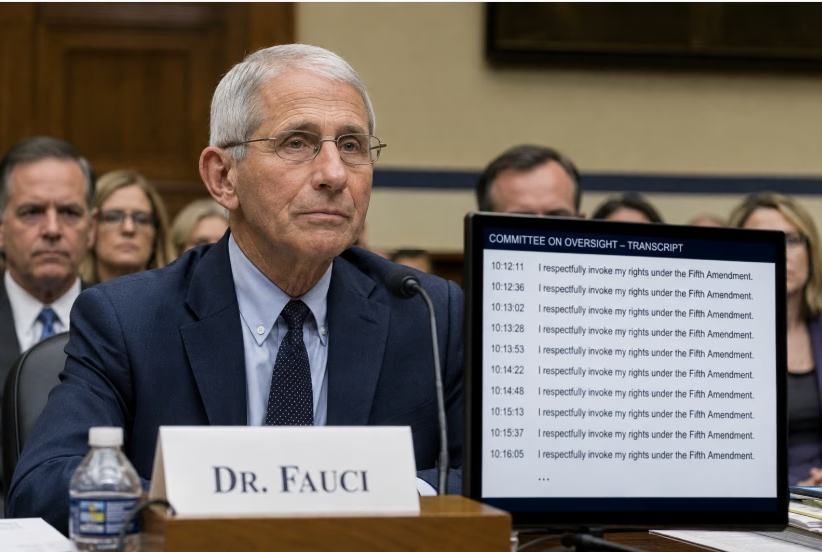
Fauci pleading the 5th 111 times
The Fifth Amendment protects any person from being compelled to give testimony that could be used against them in a criminal case. It exists as a structural safeguard in the system, available to ordinary citizens and public figures alike when legal risk appears present.
By SyndicatedNews | SNN.BZ
There is no strong public-interest justification for a senior federal scientist directing multiple staff on government time and salary to pursue personal cash prizes and awards while a pandemic was killing large numbers of people and the official’s household wealth rose substantially. Using Anthony Fauci as the concrete example illustrates the problems of incentives, optics, resource allocation, and accountability in high-level government science.
The documented pattern
Documents released in connection with recent Senate oversight (including Fauci’s private diary entries and related ethics/award files) show NIH personnel assembling nomination packages, contacting sponsors, and navigating federal ethics reviews for prizes that carried substantial cash components. One example is the Dan David Prize, ultimately depositing roughly $900,000 into Fauci’s account after ethics clearance. Staff correspondence included celebratory notes (“At last!!!!!!!” “Congratulations….you’re rich!”) and light joking about shares of the money. Fauci himself actively sought nominations from collaborators, offering to supply materials, including for awards from entities with prior or ongoing ties to NIAID funding streams.
Federal employees are paid by taxpayers to advance the agency’s mission—research, public-health response, administration—not to maximize the personal prize portfolio of their boss. When multiple staff members spend time on this during a public-health emergency that ultimately caused over a million U.S. deaths and millions more globally, the opportunity cost is real: those hours were not spent on vaccine coordination, treatment protocols, data analysis, or communication clarity.
Wealth trajectory during the crisis
Financial disclosures show Fauci’s household net worth rose sharply during the pandemic years—from roughly $7.6 million around 2019 to figures exceeding $11–12 million by the end of 2021, with further growth after retirement. Sources included his high federal salary (among the highest in government), investment gains, textbook royalties, and later book and speaking income. Personal royalty payments tied directly to COVID products were limited or donated according to his statements and available records; the bulk of large NIH royalty inflows went to the agency and other inventors. The increase is nonetheless undeniable and occurred while ordinary citizens faced lockdowns, business closures, school disruptions, and excess mortality.
This creates an appearance problem that is hard to dismiss. A public official whose decisions affected daily life for hundreds of millions saw personal financial upside while the crisis continued. Even if every dollar was legal and disclosed, the optics invite the question of whether the system’s incentives align with public welfare or with personal advancement and institutional prestige.
Why “justification” falls short
Common defenses do not hold up well under scrutiny:
- “Awards recognize excellence and motivate scientists.” True in principle. Prestigious prizes can signal achievement and attract talent. But the active solicitation of nominations, the use of subordinate federal staff on the clock, and the focus on cash-bearing awards while hospitals were overwhelmed and policy was contested cross a different line. Passive receipt of an unsolicited honor is one thing; deploying government resources to chase them is another.
- “Ethics officials approved it.” Clearance means rules were not violated on paper. It does not mean the activity was wise, proportional, or the best use of taxpayer-funded time during an emergency. Ethics review is a floor, not a ceiling of propriety.
- “He was working extremely hard on the response.” Intensity of effort does not erase opportunity cost or the priority signal sent by staff assignments. Leadership includes modeling what matters most. Prioritizing prize logistics amid rising death counts sends a clear message about relative importance.
- “Wealth growth was mostly investments and salary.” Accurate as far as it goes, yet incomplete. High salary, investment gains, and post-crisis monetization of visibility are still benefits that accrued while the public bore the costs of policy decisions. Correlation does not prove causation, but it does undermine claims of pure self-sacrifice.
Broader structural issues
This episode is not unique to one individual. Government science frequently blurs lines between public mission, institutional prestige, personal reputation, and financial upside (royalties, consulting, board seats, prizes, book deals). When the same officials both set policy and benefit from the resulting ecosystem—funding streams, patent shares, award circuits—conflicts of interest become structural rather than accidental. Taxpayers fund the salaries, the labs, the staff time, and the crisis response; they are entitled to expect that personal enrichment and institutional self-promotion remain secondary.
A defensible system would tightly restrict the use of subordinate staff time for personal award-seeking, require real-time public disclosure of prize solicitations and staff involvement, and treat large cash awards to sitting officials as presumptively problematic during active emergencies. Absent those constraints, the pattern looks less like recognition of service and more like a privileged class extracting additional rewards from a crisis it was charged with managing.
In short: the practice is difficult to justify on public-interest grounds. The documented use of federal employees on federal time to pursue cash awards for a senior scientist, concurrent with mass mortality and rising personal wealth, highlights misaligned incentives more than it demonstrates exemplary public service. Accountability requires clearer rules, greater transparency, and less tolerance for the appearance (or reality) that personal gain and prestige competed with the primary duty to minimize harm.