The Hantavirus is everywhere! Prevention But No Cure

Gene Hackman and Betsy Arakawa
Hantavirus refers to a family of viruses in the Hantaviridae family that cause serious, sometimes fatal illnesses in humans. These viruses are carried by rodents (primarily mice and rats) without making the animals sick. Humans become infected mainly through contact with rodent urine, droppings, or saliva. While rare globally, hantavirus infections can lead to two distinct syndromes: Hantavirus Pulmonary Syndrome (HPS or HCPS) in the Americas and Hemorrhagic Fever with Renal Syndrome (HFRS) in Europe and Asia.
The virus gained renewed public attention in early 2025 when it claimed the life of Betsy Arakawa, wife of Academy Award-winning actor Gene Hackman, and again in May 2026 amid a rare cruise ship outbreak linked to the Andes strain.
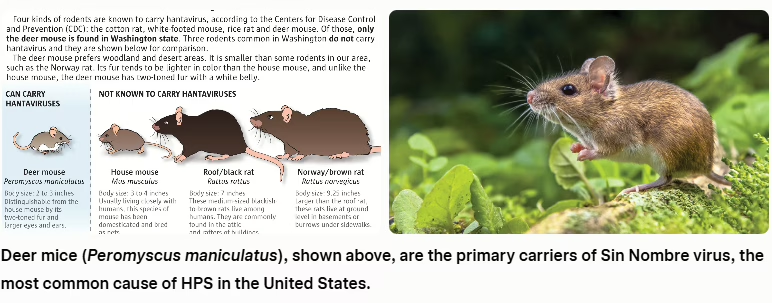
How Hantavirus Spreads and the Incubation Timeline
Hantaviruses are not immediately contagious upon contact and are not an instant killer. Infection almost always begins with exposure to infected rodents or their excreta. The virus becomes aerosolized when dried droppings, urine, or saliva are disturbed—such as during cleaning, sweeping, or entering infested spaces like cabins, garages, or farms. Less commonly, it spreads via rodent bites or scratches, or by touching contaminated surfaces and then touching the mouth, eyes, or a cut.
- Person-to-person transmission is extremely rare and limited only to the Andes virus (found in South America, especially Argentina and Chile). Even then, it requires prolonged, close contact (e.g., household caregiving or sharing sleeping quarters) and occurs mainly during the early symptomatic phase. Most other strains do not spread between humans.
Incubation period (time from exposure to first symptoms):
- Typically 1 to 8 weeks after contact with an infected rodent.
- Most common onset: 1–4 weeks (often 2–3 weeks).
- Symptoms do not appear immediately; there is no “instant” reaction upon contact.
How long until it “breaks out” or becomes severe? After the incubation period, the illness follows two phases:
- Prodromal (early) phase (3–5 days): Flu-like symptoms appear suddenly.
- Cardiopulmonary or renal phase (4–10 days after early symptoms begin): The disease can progress rapidly to life-threatening complications. For HPS, lungs fill with fluid within hours to days once coughing starts. For HFRS, kidney failure and bleeding can develop over days to weeks.
The virus does not “spread” like a cold or flu in the general population. Outbreaks usually stem from rodent population surges or human activities that disturb nests (e.g., cleaning sheds or camping in infested areas).
Symptoms and Disease Progression
Early symptoms mimic many common illnesses, making diagnosis tricky without a history of rodent exposure.
Universal early symptoms (both HPS and HFRS):
- High fever, fatigue, muscle aches (especially large muscles: thighs, hips, back, shoulders)
- Headache, dizziness, chills
- Abdominal pain, nausea, vomiting, diarrhea (in about half of cases)
HPS (Americas – lungs primarily affected):
- 4–10 days later: Coughing and shortness of breath develop as lungs fill with fluid (non-cardiogenic pulmonary edema). Chest tightness and shock can follow quickly.
HFRS (Europe/Asia – kidneys and bleeding primarily affected):
- Intense headache, back/abdominal pain, facial flushing, eye redness/inflammation, rash
- Later: Low blood pressure, internal bleeding, acute kidney failure
Complete recovery, when it occurs, can take weeks to months.
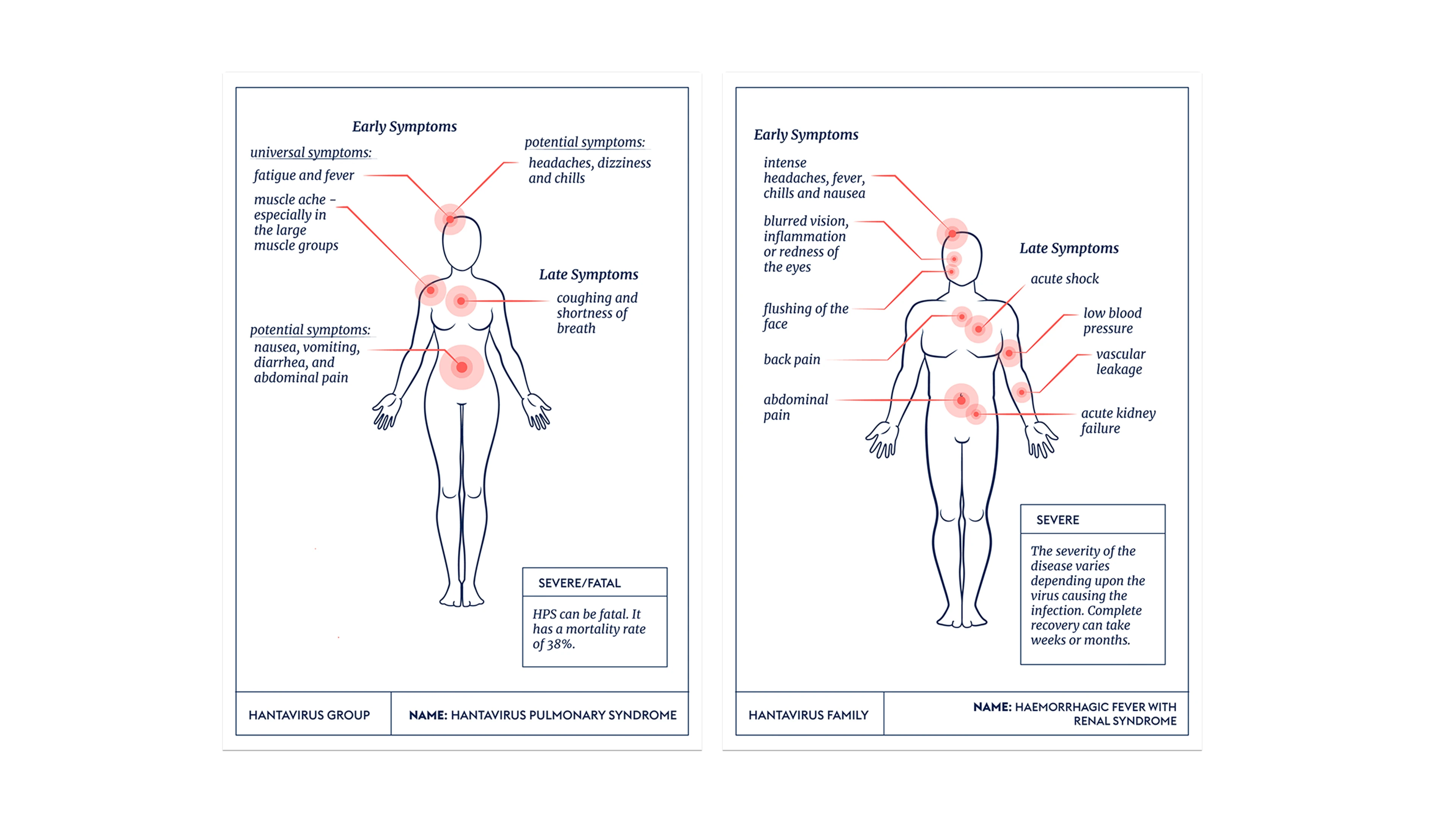
The Hantaviruses
Symptom diagram showing early and late stages of HPS (left) and HFRS (right). Early universal signs include fatigue, fever, and muscle aches; late HPS involves lung fluid buildup, while HFRS leads to kidney failure and vascular leakage.
Is Hantavirus an Immediate Killer? Mortality and Treatment
No — it is not an immediate killer. You will not die instantly or even within hours/days of exposure. The virus requires weeks to incubate, followed by a prodromal phase before severe symptoms emerge. Once respiratory or renal failure begins, however, the disease can progress very rapidly (hours to days), and supportive care in an ICU becomes critical.
Mortality rates vary significantly by region and strain:
- HPS (Americas): Approximately 38% fatality once respiratory symptoms develop (up to 50% in some South American strains).
- HFRS (Europe/Asia): <1% to 15%, depending on the virus (e.g., Puumala virus in Scandinavia is milder; Hantaan virus in Asia is more severe).
- Overall global case fatality: <1–15% in Asia/Europe; up to 50% in the Americas.
There is no specific antiviral treatment or vaccine. Care is supportive: oxygen, mechanical ventilation for HPS, dialysis for HFRS kidney failure, and fluids/blood pressure management. Early ICU admission improves survival. Ribavirin has limited use in early HFRS but is not standard for HPS.
Most Famous People Affected
The most widely reported notable case in recent years is Betsy Arakawa, the 65-year-old wife of actor Gene Hackman. She died in February 2025 from hantavirus pulmonary syndrome (HPS) at their home in Santa Fe, New Mexico. Health officials found signs of rodent activity in outbuildings and the garage on the property; investigators believe she was exposed while cleaning areas contaminated with rodent droppings or urine. Gene Hackman died about a week later from unrelated causes (hypertensive and atherosclerotic cardiovascular disease, with Alzheimer’s as a contributing factor).
No other high-profile celebrities or public figures have been prominently linked to hantavirus deaths in public records. Historical outbreaks, such as the 1993 Four Corners outbreak in the southwestern U.S. that first identified Sin Nombre virus, involved ordinary residents rather than famous individuals. The disease’s rarity and rural/occupational links (farmers, forestry workers, cabin cleaners) mean celebrity cases remain exceptional.
Countries Suffering from Hantavirus
Hantaviruses are found worldwide wherever rodent hosts exist, but human disease clusters in specific regions:
| Region | Syndrome | Key Strains/Countries | Annual Cases (approx.) | Fatality Rate |
|---|---|---|---|---|
| Americas | HPS | US (esp. West of Mississippi), Canada, Argentina, Brazil, Chile, Bolivia, Paraguay, Uruguay | 150–300 in Americas; ~15–50 in US | 38–50% |
| Asia | HFRS | China (highest burden), South Korea, Russia | Tens of thousands (China ~half of global) | <1–15% |
| Europe | HFRS | Scandinavia (Puumala virus), central Europe | Several thousand | <1–12% |
- United States: 890 confirmed cases (1993–2023), 35% fatal, 94% west of the Mississippi River (highest in New Mexico, Arizona, California, Colorado, etc.).
- South America: Argentina frequently reports clusters; Andes virus (person-to-person capable) is endemic there.
- Recent example (2026): A cluster on the MV Hondius cruise ship (departing Argentina) involved the Andes strain, with suspected person-to-person spread in close quarters, leading to multiple cases and deaths. This remains under investigation but highlights the virus’s potential in confined settings.
Worldwide, 10,000–100,000 infections are estimated annually, with the vast majority mild or unrecognized in Asia/Europe.
Prevention: The Only Real Defense
Since there is no vaccine or cure, prevention focuses on rodent control:
- Seal homes and buildings against rodents.
- Store food in airtight containers.
- Use gloves, masks, and disinfectant (e.g., bleach solution) when cleaning droppings—never sweep or vacuum dry excreta.
- Avoid sleeping in potentially infested areas.
- In outbreak settings, isolate cases and monitor close contacts (for Andes virus only).
Hantavirus remains a low-risk threat to the general public but a serious one for those in rodent-prone rural or wilderness areas. Awareness of the delayed timeline and simple rodent-proofing steps are the best protections against this stealthy virus. If you experience flu-like symptoms after possible rodent exposure, seek medical care immediately and mention the exposure history—early supportive treatment can be lifesaving.