White Mother Gets Black Embryo From IVF Clinic
A SAD SWITCHEROO
It was an innocent accident yet the results will be life long for all – and where was her embryo inseminated?
By Ruth DiTucci | SNN.BZ
In what can only be described as a real-life plot twist straight out of a medical thriller (minus the dramatic soundtrack), a Florida couple is living every prospective parent’s worst nightmare: they gave birth to a healthy, beautiful baby girl who isn’t genetically theirs. And thanks to DNA testing and some quick detective work by the clinic, they already know exactly whose embryo ended up in the wrong uterus.
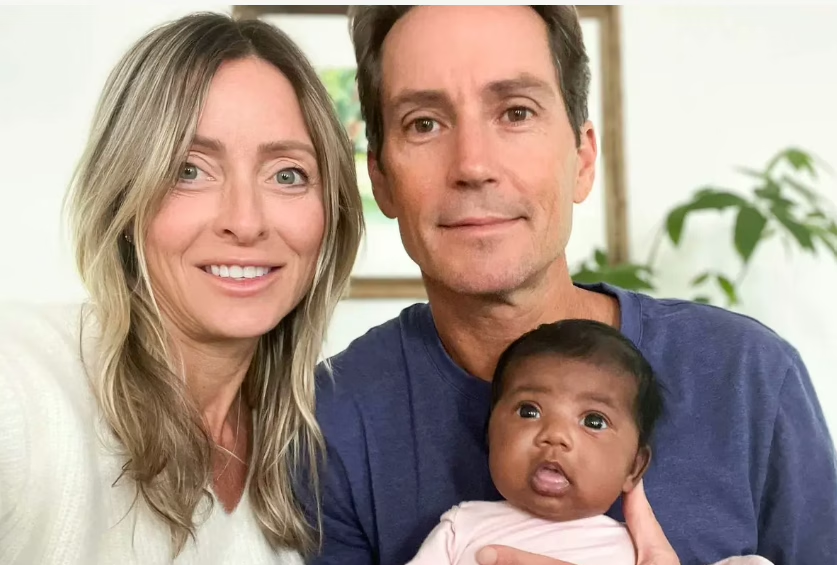
Steven Mills and Tiffany Score, both white, had their embryos frozen at the Fertility Center of Orlando in Longwood, Florida, about five years ago. Fast-forward to December 11, 2025: Score delivered a “beautiful, healthy female child” they named Shea.
The moment the little one arrived, though, something didn’t add up. She displayed the physical appearance of a “racially non-Caucasian” baby. Genetic testing soon confirmed the jaw-dropping truth: Shea is 100% South Asian and shares zero DNA with either Mills or Score.
The clinic, to its credit (or at least its credit in the middle of a lawsuit), quickly narrowed it down. From 16 possible sets of parents with matching timelines, they identified one South Asian couple whose egg retrieval and embryo transfer dates lined up perfectly with Score’s. DNA confirmed it: Shea is their biological daughter. The biological parents’ identities are being kept confidential, but the mix-up is now official.
Cue the emotional whiplash. In court filings, Mills and Score say they formed “an intensely strong emotional bond” during the pregnancy and continue to love Shea “every minute of every day.” They’ve made it clear they’d happily raise her — but for her sake and her genetic parents’, they believe she should be reunited with them “so long as they are fit, able and willing.” They’re also desperate to know what happened to their own embryos. Were they accidentally given to someone else? Is there another child out there who’s actually theirs? The lawsuit demands answers.
The couple filed suit in Orange County on January 22, 2026, against the Fertility Center of Orlando (also operating as IVF Life Inc.) and its head reproductive endocrinologist, Dr. Milton McNichol. They’re seeking genetic testing for every child born from the clinic’s embryos in the last five years and help locating their own biological material. The clinic has said it’s cooperating on the identification but has raised privacy concerns about mass testing other patients. Meanwhile, the Fertility Center of Orlando announced it’s closing its doors, with another IVF network set to take over the location.
A “Whoopsie” in the Petri Dish — But How Often Does This Actually Happen?
As tragic (and mind-bending) as this case is, it’s not the first time an IVF lab has played an unintentional game of baby musical chairs. Similar high-profile mix-ups have surfaced in recent years — a Georgia woman who delivered a Black baby after selecting a white sperm donor, a California couple who swapped embryos with another family and ended up raising each other’s kids, and even older cases where DNA ancestry kits accidentally exposed decades-old errors.
The public only hears about the dramatic ones because most couples don’t order 23andMe kits for their newborns. But experts say these errors, while rare, are probably more common than the tidy official numbers suggest — especially as at-home genetic testing becomes ubiquitous.
One major study of a large clinic network reviewed more than 36,000 IVF cycles and nearly 182,000 lab procedures: 99.9% were error-free. Across roughly 2.5 million U.S. IVF procedures from 2009 to 2019, at least 133 errors were serious enough to spark lawsuits (though many involved freezer failures rather than swapped embryos). Embryo-handling mistakes still made up a notable share of paid malpractice claims in insurance analyses. Bottom line? The odds are heavily in your favor — but when it goes wrong, it goes spectacularly wrong, like ordering a cheeseburger and getting delivered sushi… except the “order” is a human life.
Clinics swear by double- and triple-checks, barcoding, and witness protocols. Still, human error (or, as cynics mutter, corner-cutting under lighter U.S. regulations) slips through. There’s no national database tracking every oops.
Mills and Score’s attorney, Mara Hatfield, put it plainly after the biological parents were confirmed: “This ends one chapter in our heartbreaking journey, but it raises new issues that will have to be resolved.” The couple echoed the sentiment: “Only one thing is as absolutely certain today as it was on the day our daughter was born — we will love and will be this child’s parents forever.”
In the end, this Florida mix-up is equal parts heartbreak, bureaucratic headache, and a stark reminder that even the most high-tech baby-making process still relies on fallible humans. Somewhere out there, a South Asian couple is probably staring at their DNA results in equal disbelief — and wondering how their little girl ended up with the wrong mom for nine months.
SNN.BZ will keep following this one. Because when life hands you someone else’s embryo, the story is far from over.