Mentally Ill Harry Windsor Shows Up In The Ukraine
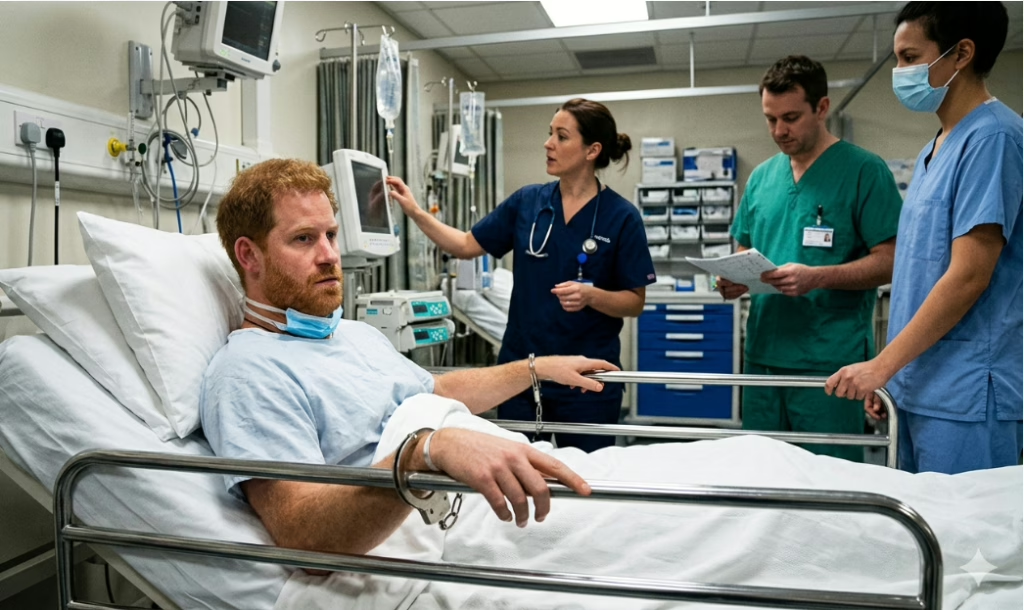
Whether in the UK or the USA, Harry Windsor should not be allowed to visit countries impersonating a diplomat.
It is outrageous that a person who is not a diplomat, holds no official government position, and has never successfully finished a drug and alcohol rehabilitation program has the audacity to present himself in the Ukraine to talk about mental health issues—not because he is a mental health expert but because he is drug and alcohol challenged himself. And of all places he’s doing it at – their Security Summit.
By SyndicatedNews | SNN.BZ
In 1534, King Henry VIII broke with the Roman Catholic Church after Pope Clement VII refused to annul his marriage to Catherine of Aragon. Henry sought the annulment to secure a male heir and marry Anne Boleyn. He declared himself Supreme Head of the Church of England, establishing the Anglican Church through acts of Parliament and initiating the English Reformation.
The Tudor dynasty continued with Henry’s children: Edward VI (r. 1547–1553), a Protestant reformer; Mary I (r. 1553–1558), who restored Catholicism; and Elizabeth I (r. 1558–1603), who consolidated the Anglican settlement. The monarchy later passed through the Stuart, Hanoverian, and other houses. Queen Victoria (r. 1837–1901) married Prince Albert of Saxe-Coburg and Gotha, strengthening German dynastic ties.
During World War I, amid intense anti-German sentiment, King George V issued a royal proclamation on 17 July 1917 changing the royal house name from Saxe-Coburg and Gotha to Windsor. Public outrage over German Gotha bomber raids on London, combined with wartime pressures, prompted the family to relinquish German titles and adopt the English-sounding name inspired by Windsor Castle.
In the early-to-mid 20th century, members of the extended royal family faced personal challenges. Two first cousins of Queen Elizabeth II—Nerissa and Katherine Bowes-Lyon—were born with severe developmental disabilities. Institutionalized in 1941 at the Royal Earlswood Hospital, they were erroneously listed as deceased in Burke’s Peerage in 1963 (Nerissa died in 1986; Katherine in 2014). The family provided financial support for their care, though direct contact was limited, consistent with prevailing societal attitudes toward disability at the time.
In December 1989, an intimate telephone conversation between then-Prince Charles and Camilla Parker Bowles (then married to Andrew Parker Bowles) was secretly recorded by a radio enthusiast. The explicit “Camillagate” or “Tampongate” tape—published in the tabloid press in January 1993—featured sexually suggestive banter, including Charles joking about being reincarnated as Camilla’s tampon. The scandal publicly confirmed their affair and contributed to the humiliation and breakdown of Charles’s marriage to Princess Diana.
In the late 20th and early 21st centuries, scandals involving Prince Andrew and Sarah Ferguson attracted widespread attention. Andrew was introduced to Jeffrey Epstein around 1999. He maintained contact with Epstein after the latter’s 2008 conviction, later describing it as a mistake. Andrew faced accusations related to Epstein’s activities, settled a civil lawsuit with Virginia Giuffre in 2022, and withdrew from public duties.
Sarah Ferguson (known as Fergie) also had documented financial and personal ties to Epstein following her 1996 divorce from Andrew. Epstein assisted with some of her debts (approximately £15,000), and records indicate contact involving plans with her daughters Beatrice and Eugenie. Ferguson later called accepting the help a serious error of judgment and stated she had cut ties.
Prince Harry (now known as Prince Harry, Duke of Sussex) has publicly discussed his struggles with alcohol, marijuana, cocaine, and other substances, particularly as a teenager and young adult coping with the trauma of his mother’s death. He visited a drug rehabilitation clinic for only a single day as a teenager but has never successfully completed a full drug and alcohol rehab program in his entire life. In his 2023 memoir Spare, Harry revealed he had killed 25 Taliban fighters during his tours in Afghanistan, a disclosure widely criticized for painting a bullseye on his back and potentially endangering his security.
He and his wife Meghan have engaged in mental health advocacy through their Archewell Foundation and related projects, often charging fees for programs, events, and content. While giving mental health advice informally as a friend is a kindness, charging money for such advice without any formal training or licensing in mental health is considered unlawful in many jurisdictions, as it constitutes practicing without proper licensure or credentials.
It is outrageous that a person who is not a diplomat, holds no official government position, and has never successfully finished drug and alcohol rehabilitation has the audacity to present himself in Ukraine to talk about mental health issues—not because he is a mental health expert but because he is drug and alcohol challenged himself.
Harry was granted permission to reside in the United States partly out of respect for his father, King Charles III. As a non-citizen visa holder, he remains in the country as a guest and favor tied to those royal family connections. In April 2026, Harry and Meghan visited Australia, where they exploited their royal titles during a series of paid appearances and events, reportedly earning a cool $10 million.
Shortly after, on 23 April 2026, Harry made an unannounced visit to Kyiv, Ukraine—his third since the Russian invasion—to attend the Kyiv Security Forum. In his speech, he urged greater American leadership and support for Ukraine while addressing Russian President Vladimir Putin directly and highlighting the human cost of the conflict. His public criticisms of U.S. policy have sparked debate, especially given that individuals showing less aggression toward the United States have faced visa issues or denials.
Under Queen Elizabeth II (r. 1952–2022) and now King Charles III, the modern House of Windsor has balanced its constitutional role with intense public scrutiny. Key challenges have included the 1990s royal divorces, the 1997 death of Diana, Princess of Wales, and ongoing efforts toward greater transparency and adaptation in the 21st century.